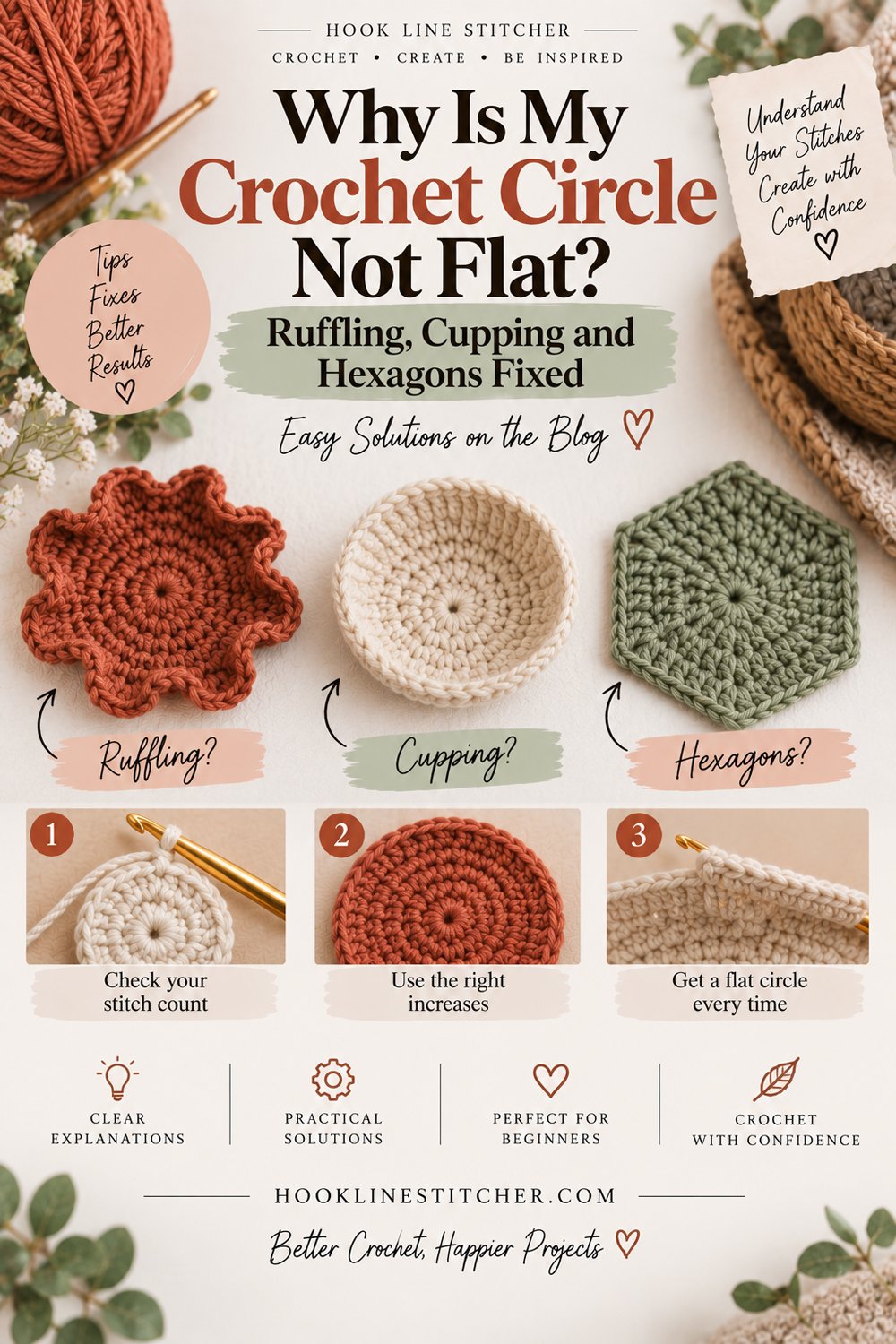
Circles go wrong in three distinct ways, and each one tells you something different about what you did.
Ruffling means too many stitches. Cupping means too few. A hexagon means the right number in the wrong places. So the answer to why is my crochet circle not flat depends entirely on which of the three you’re looking at.
Once you can tell them apart, all three are easy to fix — and understanding the rule behind them is one of the genuinely transferable pieces of knowledge in crochet. Flat circles are the basis of hats, bags, baskets, coasters, mandalas, rugs and half of amigurumi.

From the shop · New pattern
A sweet cat-ear coaster in just 5 rounds. Beginner friendly, printable 7-page PDF for $4.99.
See the pattern →The rule
Every round must add the same number of stitches as the first round contains.
If round 1 has 6 stitches, every round adds 6: 6, 12, 18, 24, 30, 36.
If round 1 has 12 stitches, every round adds 12: 12, 24, 36, 48.
That’s it. The reason is geometry — a circle’s circumference grows at a constant rate as its radius grows, so the stitch count must grow at a constant rate too.
The number depends on stitch height. Six for single crochet, twelve for double crochet. Taller stitches add more radius per round, so they need more stitches to keep up. This is why a pattern that works perfectly in single crochet turns into a disaster if you substitute double crochet without adjusting.
Why is my crochet circle not flat? Quick diagnosis
| What you see | What it means | What to do |
|---|---|---|
| Wavy, ruffled edges | Too many stitches | Count; rip back; recount each round |
| Bowl shape, edges rising | Too few stitches, or tight tension | Count; if correct, loosen or go up a hook size |
| Six corners, counts correct | Increases stacking | Stagger the increase positions |
| Slightly uneven but roughly flat | Tension variation | Block it |
Problem 1: it’s ruffling
The edges wave and won’t lie flat. The fabric looks like a lettuce leaf.
Cause: too many stitches. You’ve added more than the rule allows, so there’s more circumference than the radius can support and the excess has to go somewhere — it goes up and down.
How to confirm: count a round and compare to the rule. If round 4 of a single crochet circle has 26 stitches instead of 24, that’s your answer.
The fix:
- Count every round against the pattern, or against the rule if you’re improvising.
- Rip back to the last round you know was correct and rework from there.
- If the ruffle is very mild and the counts are right, it’s tension — your stitches are slightly too tall for their width. Blocking usually handles it.
When ruffling is deliberate: it’s exactly how you make a ruffle on a scrunchie or a ghost hem. Same mechanism, used on purpose.
Problem 2: it’s cupping
The edges pull upward and the circle turns into a shallow bowl.
Cause: too few stitches, or tension too tight. Not enough circumference for the radius, so the edges are dragged inward.
How to confirm: count. If round 4 has 22 instead of 24, that’s it. If the counts are right and it’s still cupping, tension is the culprit.
The fix:
- Check the counts first and rip back if they’re wrong.
- If the counts are right, loosen your grip or go up a hook size. The Craft Yarn Council hook size chart tells you what the next size up is called.
- Mild cupping blocks out. Dampen, pin flat, let dry.
When cupping is deliberate: this is precisely how you make a hat, a basket or an amigurumi head. You stop increasing, and the fabric has no choice but to rise. A cupping circle isn’t broken — it’s an early basket.
Problem 3: it’s a hexagon
The stitch counts are perfect and the thing still isn’t round. Instead there are six straight edges and six corners.
Cause: your increases are stacking. If you put every increase in the same position round after round, they line up into six radiating lines, and the fabric folds along them.
This one confuses people because nothing is technically wrong — the counts are right. It’s purely a placement problem.
How to confirm: look at the circle and find the corners. Trace a line from each corner back to the centre. If your increases sit along those lines, that’s your answer.
The fix: stagger the increases. Shift where the increase falls each round.
Instead of always starting a round with an increase:
- R3: (sc, inc) x6
- R4: (inc, 2 sc) x6 — note the increase moved to the front
- R5: (2 sc, inc, sc) x6
Any scheme that moves the increase position works. The simplest approach is to start each round with a different number of plain stitches before the first increase.
Many published patterns quietly handle this for you, which is why the same pattern written two ways can produce a circle and a hexagon.
Blocking
Blocking fixes mild versions of all three. It cannot fix a stitch count error.
Dampen the piece, pin it flat into a proper circle — pins around the whole circumference, not just four points — and let it dry completely.
Cotton and wool hold the shape permanently. Acrylic holds it reasonably well; steam blocking works better for acrylic than wet blocking.
Preventing it
- Count every round. Circles compound errors faster than rows do, because a mistake in round 3 distorts every round after it.
- Know the rule for your stitch. Six per round for single crochet, twelve for double.
- Stagger your increases from round 3 onward.
- Lay the piece flat every few rounds and look at it. Catching a ruffle at round 4 costs you one round; catching it at round 12 costs you nine.
Frequently asked questions
Why is my crochet circle ruffling?
Too many stitches for the number of rounds. Count each round against the rule — 6 added per round for single crochet, 12 for double crochet.
Why is my crochet circle cupping?
Too few stitches, or tension that’s too tight. Check your counts first; if they’re right, loosen your grip or go up a hook size.
Why is my crochet circle turning into a hexagon?
Your increases are stacking in the same positions each round, which creates six fold lines. Shift where the increase falls each round.
How many stitches should each round of a crochet circle have?
Each round adds the same number as round 1 contains. For single crochet that’s 6 per round; for double crochet, 12.
Can blocking fix a crochet circle that isn’t flat?
It fixes mild ruffling, cupping and tension unevenness. It cannot fix a stitch count that’s wrong.
Is a cupping crochet circle always a mistake?
No. Deliberately stopping the increases is how hats, baskets and amigurumi are made. A cupping circle is a basket that hasn’t been finished yet.
From the shop · New pattern
A sweet cat-ear coaster in just 5 rounds. Beginner friendly, printable 7-page PDF for $4.99.
See the pattern →Cathrinee’s Supply Kit
The beginner basics I recommend
Why is my crochet circle not flat?
Your increase rate is wrong for the stitch you are using. A flat circle needs a fixed number of increases every round — 6 for single crochet, 8 for half double, 12 for double crochet. Too few and it cups, too many and it ruffles.
Why is my crochet circle cupping upward?
Not enough increases. The centre is growing faster than the outer edge can keep up with, so the edge pulls in and the circle turns into a bowl. Add an extra increase on the next round and it will start to flatten.
Why is my crochet circle ruffling and wavy?
Too many increases. The outer edge has more fabric than it needs, so it has nowhere to go but ripple. Work a round with fewer increases, or one round with none at all, and it will settle.
How many increases does a flat circle need?
Six per round for single crochet, eight for half double crochet, and twelve for double crochet. The rule is that each round adds the same number of stitches as the first round contained.
Is a cupping circle always a mistake?
No — it is exactly what you want for amigurumi, hats, baskets and bowls. Deliberately stopping the increases is how you turn a flat circle into a three-dimensional shape. It is only a problem when you wanted it flat.


8 Comments on “Why Is My Crochet Circle Not Flat? Ruffling, Cupping and Hexagons Fixed”