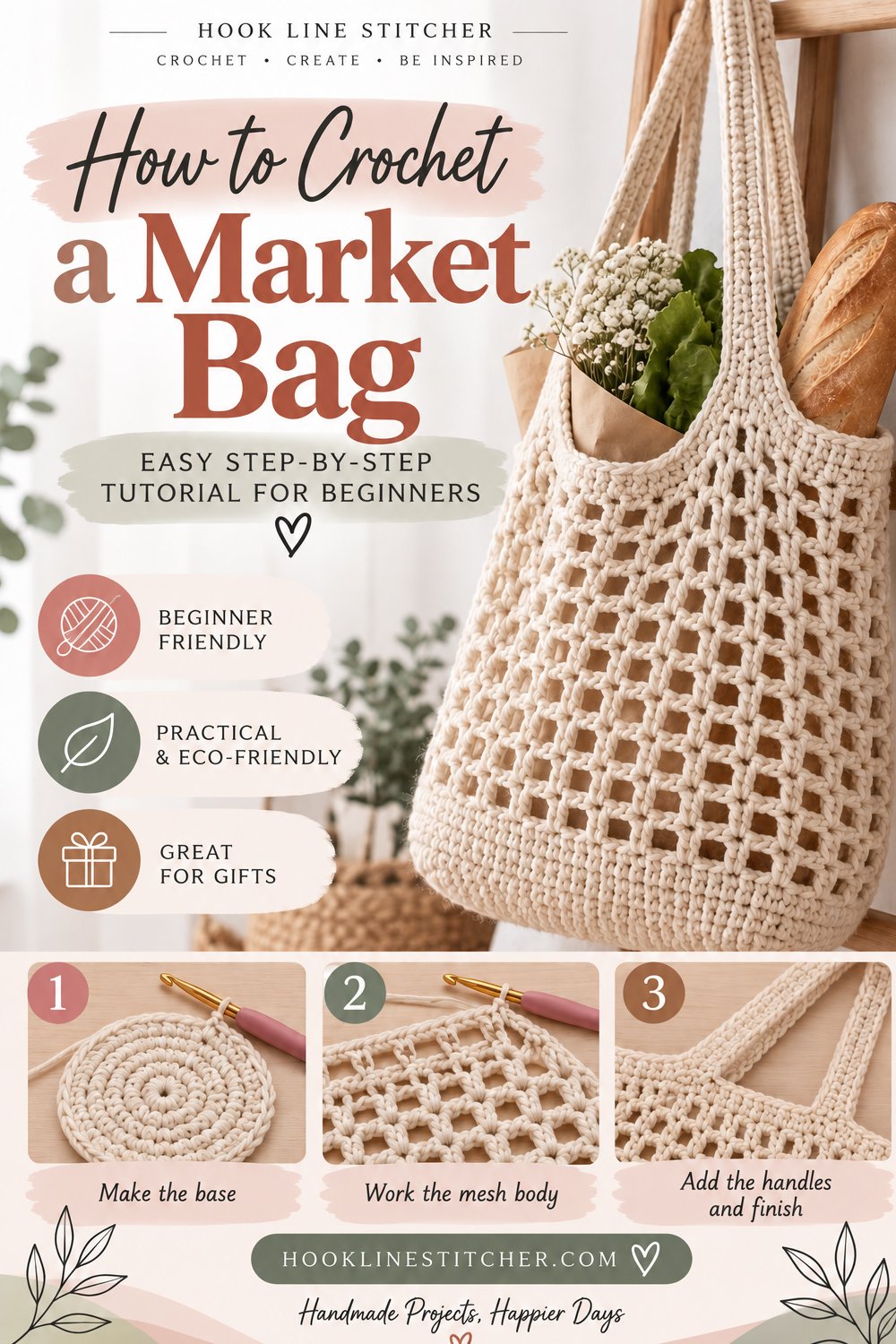
A market bag is the most practical thing you can make as a beginner. It folds into a pocket, it stretches to hold an unreasonable amount of shopping, and the mesh body works up far faster than solid fabric because most of it is holes.
The construction is two pieces of knowledge you may already have: a flat circle, and a simple repeating mesh. There is no shaping between them and no sewing except the handles.

From the shop · New pattern
A sweet cat-ear coaster in just 5 rounds. Beginner friendly, printable 7-page PDF for $4.99.
See the pattern →What you will need
| Item | What I recommend | Why |
|---|---|---|
| Yarn | Worsted weight (#4) cotton, about 250 yards | Cotton is strong and does not stretch permanently |
| Hook | 4.0 mm for the base, 5.0 mm for the mesh | Tight base, open body |
| Stitch marker | Or scrap yarn | Marks the round |
| Yarn needle | Blunt tapestry needle | Weaving in ends |
Use cotton. This is the one project where I would say it firmly. Acrylic stretches under weight and never fully recovers, so an acrylic market bag that carries groceries twice will sag down to your knees and stay there. Cotton stretches while loaded and springs back when empty. It also washes, which a bag that carries food needs to do.
From the shop · New pattern
A sweet cat-ear coaster in just 5 rounds. Beginner friendly, printable 7-page PDF for $4.99.
See the pattern →Cathrinee’s Supply Kit
Everything you need for this project
Stitches you need to know
- Magic ring — or chain 4 and join into a ring
- Single crochet (sc) — the base, see how to crochet a single crochet stitch
- Increase (inc) — 2 sc into one stitch
- Double crochet (dc) — the mesh, see how to crochet a double crochet stitch
- Chain (ch) and slip stitch (sl st)
How to crochet a market bag step by step
The base
- With the 4.0 mm hook: magic ring, 6 sc. Pull closed, place your marker, move it every round.
- Round 2: Increase in every stitch. 12 stitches.
- Round 3: (sc 1, inc) around. 18 stitches.
- Round 4: (sc 2, inc) around. 24 stitches.
- Round 5: (sc 3, inc) around. 30 stitches.
- Round 6: (sc 4, inc) around. 36 stitches.
- Keep going, adding one more plain stitch between increases each round, until the base measures 6 to 7 inches across. That is usually round 9 or 10, at 54 to 60 stitches.
- Check it is flat. Lay it on the table. It should sit perfectly flat with no cupping and no waves. If it cups, add an increase round; if it ruffles, work a round with none. The reasoning is in why is my crochet circle not flat.
The base is the only part of the bag that carries the weight, so it is worth getting right. A tight, flat, well-made base is what stops a loaded bag stretching into a sad cone.
The mesh body
- Switch to the 5.0 mm hook. The change in hook size is what creates the visual and structural break between the dense base and the open body.
- Round 1 of the mesh: Chain 4 (this counts as a dc plus ch 1). Skip 1 stitch, work (dc, ch 1) into each stitch around, skipping one stitch each time. Join with a slip stitch into the third chain of your starting chain 4.
- Round 2 onward: Chain 4. Work (dc into the next chain-1 space, ch 1) all the way around. Join with a slip stitch.
- Repeat for 16 to 20 rounds. Sixteen gives a compact bag about 12 inches deep; twenty gives a large one. Measure as you go and remember the bag will stretch downward when loaded, so make it shorter than you think you want.
- Two firming rounds at the top: Work one round of plain single crochet into every stitch and chain space around, then a second identical round. These rounds stop the top edge flaring and give the handles something solid to attach to. Do not skip them — this is where a market bag fails first.
The handles
- Mark your handle positions. Lay the bag flat. Put a marker 6 stitches either side of one fold, and the same either side of the opposite fold. You should have four markers, giving two handle gaps of about 12 stitches each.
- Round 1 of the handles: Single crochet around, but when you reach the first handle gap, chain 40 and skip the 12 marked stitches. Continue single crochet to the second gap, chain 40 and skip those 12 stitches. Single crochet back to the start and join.
- Rounds 2 and 3: Single crochet around, working into each chain of the handle as you pass it. Two passes over the chain turns a thin loop into a proper strap that will not cut into your hand.
- Fasten off and weave in every end thoroughly. Handles take all the strain, so run those ends back and forth several times.
- Block it. Dampen the bag, shape the base flat and hang it to dry. Cotton takes shaping very well.
Troubleshooting
The bag sags down to my knees when loaded. Acrylic yarn. There is no fix. Remake in cotton.
The base is cone-shaped. Not enough increases while you were making it. It will not carry weight properly — pull back and redo the base flat.
The mesh is uneven and some holes are bigger. You worked a dc into a stitch instead of a chain space, or skipped a space. Each round has exactly the same number of dc as the one before.
The top edge flares outward. You skipped the two solid single crochet rounds. Add them.
The handles stretch out long after a few uses. One pass of single crochet over the chain is not enough. Work three rounds over the handle chains, or for heavy use, cut a length of cotton cord and crochet over it.
The bag is too deep and drags on the ground. Mesh stretches a lot under load — take out four rounds.
I lost track of my round in the mesh. The join is your marker in the mesh section, since these rounds are joined rather than spiralled. Count your dc each round; it should never change.
How much does it hold?
More than it looks like it should. A bag with a 6-inch base and 18 mesh rounds comfortably holds a full grocery shop — the mesh stretches to roughly twice its resting size. That stretch is the point, and it is why the base and handles need to be solid while the body can be open.
Do not overload it, though. Cotton is strong but the handles are still yarn. If you are carrying anything genuinely heavy, crochet over a cord for the handles as described above.
Variations to try
- Lined bag. Cut a fabric circle and rectangle, sew them into a sack, and hand stitch it inside the bag. It turns the market bag into a handbag and stops small items falling through.
- Longer strap. Instead of two handles, make one 60-chain strap so it hangs crossbody.
- Striped mesh. Change colour every four rounds.
- Granny stitch body. Replace the mesh with clusters of 3 dc separated by chain 1 for a denser, prettier bag.
- Drawstring top. Thread a long chain through the final mesh round and pull to close.
- Matching set. Make it in the same cotton as a bucket hat or a bandana.
Why the base and the handles are the whole project
The mesh body takes the most time but carries none of the responsibility. All the engineering is in the flat tight base and the doubled solid handles. If you rush those two parts and make the mesh beautifully, you get a bag that fails; if you make those two parts properly and the mesh is a bit uneven, you get a bag you will use for years.
That trade-off shows up in a lot of crochet. Structure first, then decoration.
For more bags, see how to crochet a tote bag and how to crochet a mini bag. More home and practical projects are in easy crochet projects for the home.
To match your yarn to the right hook, use the Craft Yarn Council hook size chart.
What yarn should I use for a crochet market bag?
Cotton, without exception. Acrylic stretches under weight and never recovers, so an acrylic market bag sags permanently after a couple of shopping trips. Cotton stretches while loaded and springs back when empty, and it washes, which a food-carrying bag needs.
How big should the base of a market bag be?
Six to seven inches across, which is usually 54 to 60 stitches. Lay it on a table and check it sits perfectly flat — the base carries all the weight, so any cupping or ruffling there will get much worse once the bag is loaded.
How do I stop crochet bag handles from stretching?
Work at least three rounds of single crochet over the handle chains rather than one. For heavy use, lay a length of cotton cord along the chain and crochet over it, which stops the handle elongating entirely.
How many mesh rounds does a market bag need?
Sixteen to twenty. Sixteen gives a compact bag about 12 inches deep, twenty gives a large one. Mesh stretches considerably under load, so make the bag shorter than you think you want or it will drag on the ground when full.
Why does my market bag top edge flare outward?
You skipped the two solid single crochet rounds between the mesh and the handles. Those rounds stop the open mesh spreading and give the handles something firm to anchor into — they are the part of a market bag that fails first when left out.


One comment on “How to Crochet a Market Bag: Easy Step-by-Step Tutorial for Beginners”