Curling is the first real problem most beginners hit, and it arrives at exactly the wrong moment — three or four rows into something, when you’re just starting to feel like this might be working.
The good news is that why does my crochet curl has a small number of possible answers, they’re easy to tell apart, and some curling isn’t a problem at all.
First: is it actually a problem?
Mild curling in the first few rows of single crochet is normal. Single crochet makes dense fabric with very little give, and a narrow strip of it will lift at the edges simply because there isn’t enough weight to hold it flat. As the piece grows, it usually settles.
So before you rip anything out: work five more rows. If the curl relaxes as the piece gets bigger, it was never a fault.
If it’s still curling at row fifteen, or it’s curling hard enough to make a tube, keep reading.
Why does my crochet curl? The four causes
| What you see | Cause | Fix |
|---|---|---|
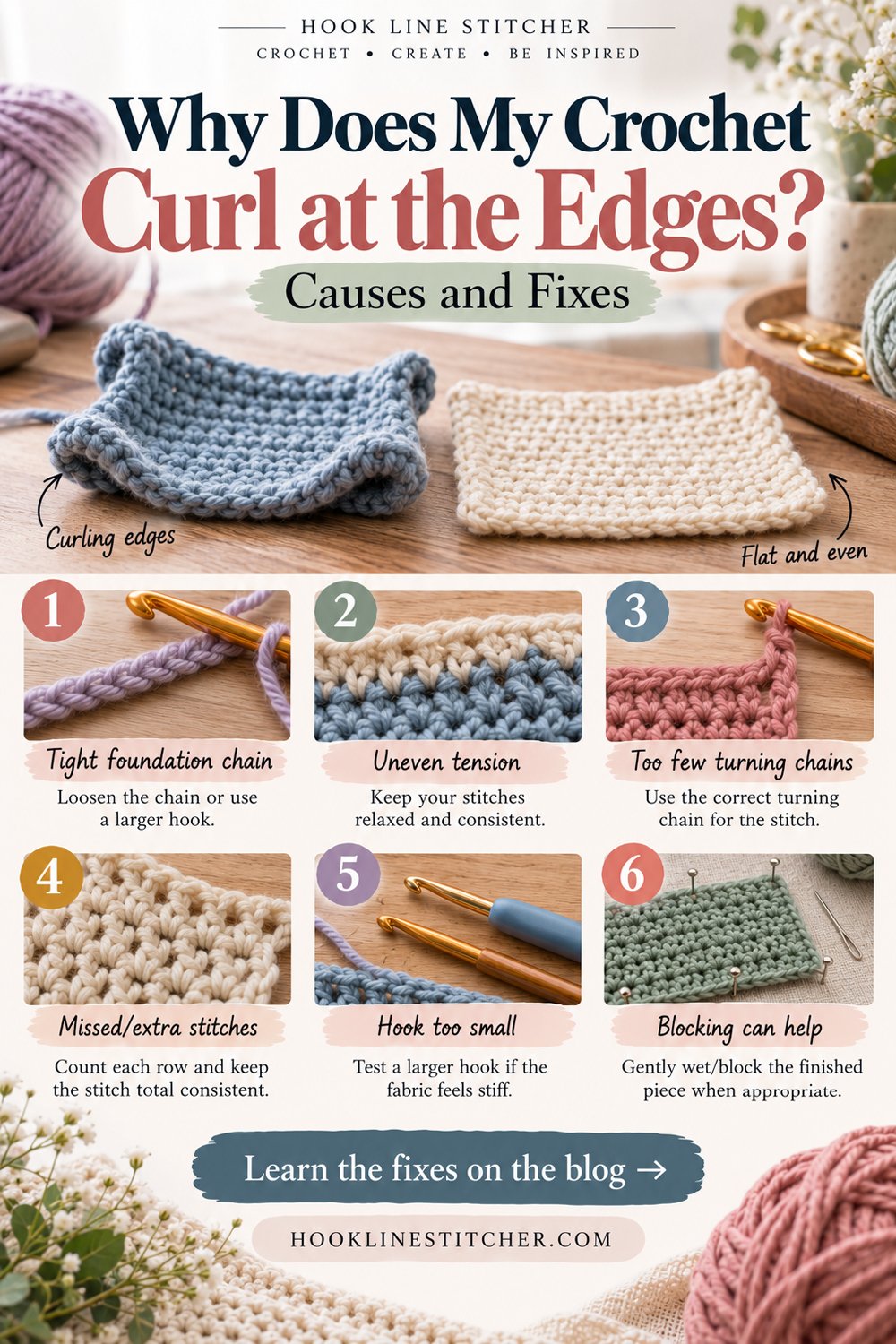
| Stiff fabric, springs back into a curl | Tension too tight | Loosen grip, go up a hook size |
| Curl worst along the bottom edge | Foundation chain too tight | Chain with a larger hook next time |
| You’re working single crochet or back loop ribbing | The stitch itself | Nothing — it is expected |
| Curl on one side only, banana-shaped | Uneven edge stitches | Watch the first and last stitch of each row |
Cause 1: tension too tight
This is the answer about seventy percent of the time.
Tight stitches have no slack in them. Each one pulls slightly against its neighbours, and across a row those small pulls add up into a curl. The fabric is essentially trying to shrink.
How to tell: press the piece flat with your hand. If it feels stiff, like card rather than cloth, and springs back into a curl the moment you let go, tension is your problem. Tight crochet also tends to be hard to insert the hook into on the next row.
The fix:
- Loosen your grip on the hook. Most beginners hold it far harder than necessary, and that grip pressure translates straight into stitch tightness. Consciously relax your hand and work five rows. Many people fix curling with this alone.
- Go up one hook size. A 5.5mm instead of a 5.0mm. There’s no prize for using the hook a pattern names — patterns ask you to match gauge, not hook size, and the Craft Yarn Council hook size chart shows how the labels line up.
- Check your yarn hand. If you’ve wrapped the yarn twice around your pinky for extra friction, unwrap it. That resistance may be more than you need.
Cause 2: the foundation chain is too tight
A tight foundation chain curls the bottom edge specifically, and it’s a different problem from general tension because you may have chained hours ago with a completely different grip.
How to tell: the curl is worst along the bottom edge, and the rest of the piece looks reasonably flat. The foundation chain also looks visibly narrower than the rows above it.
The fix: there isn’t one after the fact. For next time, work your foundation chain with a hook one size larger, then switch to the correct hook for row one. This is standard practice among experienced crocheters, not a beginner workaround.
Cause 3: the stitch itself
Some stitches curl by nature.
Single crochet curls most, because it’s short and dense.
Back loop only ribbing curls significantly while you’re working it, and flattens once the piece is seamed or blocked. If you’re making a headband or a pumpkin, the curl is expected and it disappears in assembly.
Amigurumi curls inward on purpose — that’s how flat circles become spheres.
How to tell: you’re working one of the above, and the curl matches what the stitch normally does.
The fix: nothing. Carry on.
Cause 4: the fabric is unbalanced
Less common, but real. If one edge of your work is consistently tighter than the other — usually because the first or last stitch of each row is worked differently from the rest — the fabric will curve toward the tight side.
How to tell: the curl is on one side only, and the piece looks slightly banana-shaped rather than tube-shaped.
The fix: pay attention to the first and last stitches of each row. The first stitch after turning sits directly under your hook and is easy to work too tightly; the last one is easy to rush.
Blocking: the fix for everything else
If your tension is fine and the piece still won’t lie flat, block it.
Dampen the finished piece — spray bottle, or a quick dunk and gentle squeeze.
Pin it flat into the shape it should be, on a towel or a foam mat. Pull it gently into square and pin the corners and the mid-points of each edge.
Let it dry completely before unpinning.
Cotton and wool hold the shape they dry in more or less permanently. Acrylic holds it well enough for most purposes, though it relaxes over time — for acrylic, steam blocking works better, hovering a steam iron just above the surface without touching it.
Don’t press an iron directly onto acrylic. It flattens the stitches permanently and gives the fabric a shiny, dead look that can’t be undone.
What won’t fix it
Adding a border won’t fix a tension problem. A border on a curling piece gives you a curling piece with a border. It does help with mild edge curl on an otherwise flat fabric, but it can’t rescue a fabric that’s fundamentally too tight.
Working looser only on the edges makes the piece uneven rather than flat.
Washing without pinning does nothing. The pinning is the blocking.
How to prevent it next time
- Hold the hook loosely. Check your grip every twenty minutes, because it creeps tighter without you noticing.
- Chain your foundation with a larger hook.
- Make a small swatch before committing to a big project. Ten rows tells you what the fabric will do.
- Don’t judge anything before row five.
Frequently asked questions
Is it normal for crochet to curl?
Mild curling in the first few rows of single crochet is normal and usually settles as the piece grows. Persistent curling, or curling severe enough to form a tube, means tension is too tight.
How do I stop my crochet from curling?
Loosen your grip on the hook first — that fixes it most of the time. If it doesn’t, go up one hook size. Blocking the finished piece handles what’s left.
Why does the bottom of my crochet curl?
The foundation chain is too tight. Work it with a hook one size larger next time, then switch back for the first row.
Does blocking permanently stop crochet curling?
On cotton and wool, more or less permanently. Acrylic relaxes over time, so steam blocking works better for it than wet blocking.
Can I iron crochet to flatten it?
Never press an iron directly onto acrylic — it flattens and shines the stitches permanently. Hover a steam iron just above the surface instead, or wet-block natural fibres.
Why does my single crochet curl more than double crochet?
Single crochet is shorter and denser, so it has less give and less weight to hold it flat. Taller stitches drape more naturally.
Cathrinee’s Supply Kit
The beginner basics I recommend
Why does my crochet curl at the edges?
Curling is almost always tension, not a mistake in the pattern. Stitches worked too tightly pull the fabric inward, and single crochet curls more than any other stitch because it is short and dense. Going up one hook size usually fixes it on its own.
Will blocking fix curled crochet?
Yes for wool and cotton, only temporarily for acrylic. Natural fibres hold a blocked shape permanently once pinned damp and left to dry. Acrylic springs back, so with acrylic you need to fix the tension or add a border rather than rely on blocking.
Does a border stop crochet from curling?
It usually does. Two or three rounds of single crochet around the whole piece add weight and outward pull that counteract the curl. Work 3 stitches into each corner so the border lies flat instead of pulling the corners in.
Why does the bottom edge curl more than the sides?
Because your foundation chain is tighter than the rest of the work. Most people chain more tightly than they crochet. Make your starting chain with a hook one or two sizes larger, then switch back for row one.
Is some curling normal in crochet?
A slight curl in the first few rows is completely normal and usually relaxes as the piece grows heavier. If it is still curling after ten rows, or if it rolls into a tube, that is tension and it needs fixing.