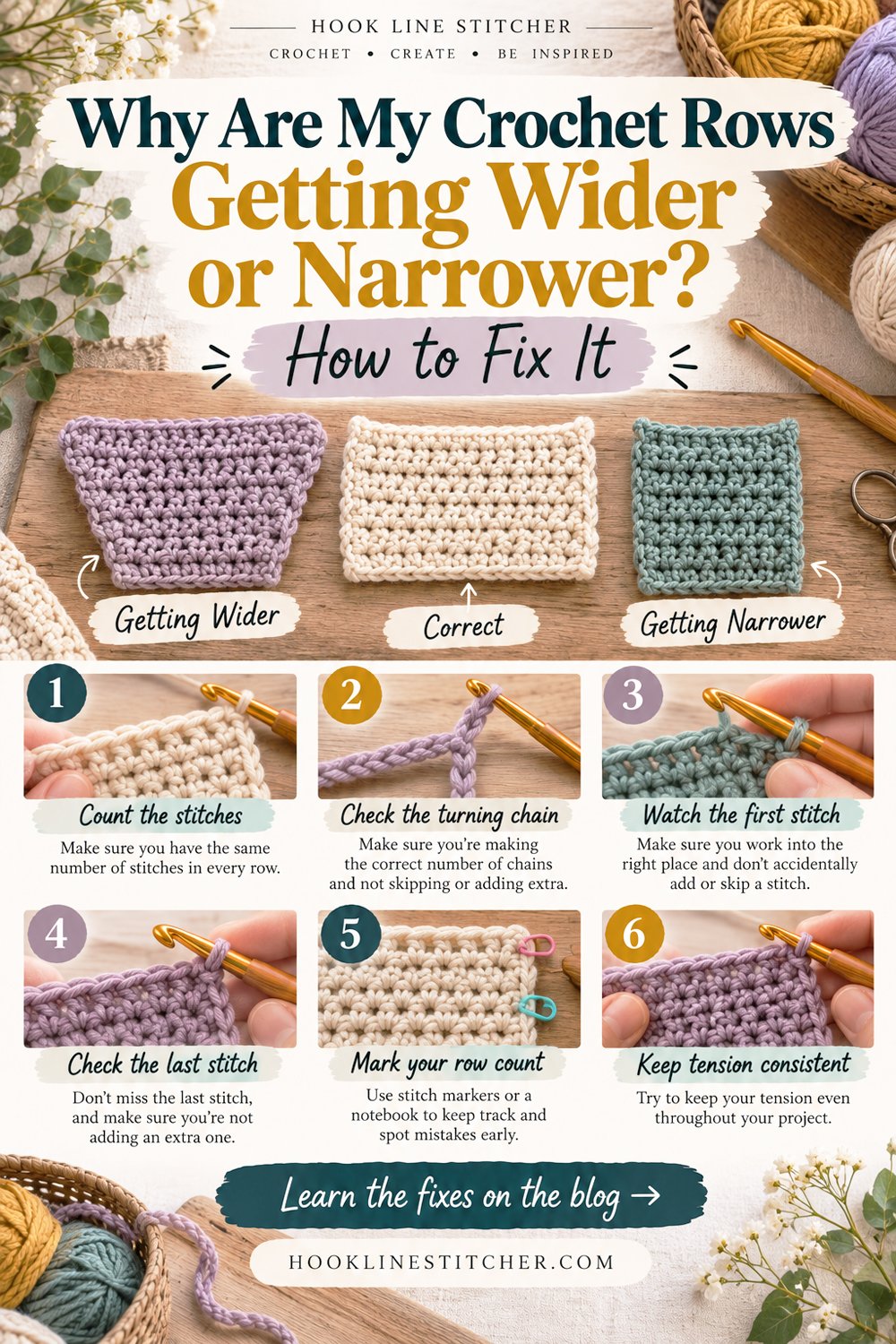
This is the most common failure in beginner crochet, and it’s responsible for more abandoned projects than any other single problem.
You chain thirty. You work a row. Twenty rows later your rectangle is a trapezoid, and you have no idea where it went wrong — because it went wrong one stitch at a time, invisibly, across twenty rows.
If you are asking why are my crochet rows getting wider, or narrower, the cause is almost always one of two things, and both happen at the ends of rows.
Why the ends of rows are the problem
In the middle of a row, every stitch looks the same. You can see the V on top of the previous stitch, you put your hook under it, and there’s no ambiguity.
At the ends, that breaks down. After you turn, the first stitch sits directly underneath the loop on your hook, partly hidden. At the other end, the turning chain from the previous row stands there looking very much like a stitch, whether or not it is one.
So the two failures are: missing the first stitch, and adding an extra one into the turning chain.
If your rows are getting NARROWER
You’re losing a stitch per row, and it’s almost certainly the first stitch after turning.
Why it happens: you turn your work, you chain one, and the first stitch of the row is sitting right under that chain. It’s easy to look past it and put your hook into the second stitch instead. The row comes out one short, and because the edge still looks tidy, nothing seems wrong.
How to confirm: count a row. If it’s one fewer than the row before, and the shortfall appears at the start rather than the end, this is it.
The fix: after turning, look for the stitch directly below your hook before you do anything else. That’s stitch one. Put a marker in it.
Why are my crochet rows getting wider?
You’re gaining a stitch per row, and it’s the turning chain.
Why it happens: in single crochet, the chain-1 at the start of each row is height only — it is never a stitch. But it sits at the end of the next row looking exactly like one, so it’s easy to work into it, which adds a stitch.
In taller stitches it’s murkier, because sometimes the turning chain is a stitch. Double crochet patterns frequently say “ch 3 (counts as first dc),” in which case you must work into it at the end of the next row. Other patterns chain 2 and don’t count it, in which case you must not.
How to confirm: count a row. One more than the row before, with the extra appearing at the end.
The fix, by stitch:
- Single crochet: ch 1 is NEVER a stitch. Never work into it.
- Half double crochet: ch 2, usually not counted. Check the pattern.
- Double crochet: ch 3 traditionally counts, ch 2 usually doesn’t. Read what the pattern says, and hold to the same choice for the entire project. Switching partway is what actually ruins edges.
The fix that works for both
Put a stitch marker in the first stitch of every row, right after you make it. Move it up each row.
That single habit solves both problems at once. The marker tells you where the row starts, which means you can’t miss the first stitch — and it also tells you where the row ends on the return, which means you know exactly which stitch is your last one and whether anything beyond it is a turning chain.
Most crocheters stop needing markers after a few weeks, once the shape of a row becomes readable. Until then, use them. It is not a beginner crutch; plenty of experienced crocheters still mark the first stitch on long projects.
And count at the end of every row. Thirty stitches, always thirty. It takes about eight seconds and it’s the cheapest insurance in crochet. Catching an error one row later costs you one row. Catching it twenty rows later costs you twenty.
Can you fix it without starting over?
Depends how far in you are.
If you’re one or two rows past the error: pull those rows out. Fastest option by far.
If you’re many rows in and the drift is small: you can compensate by working a decrease or an increase at the appropriate edge to bring the count back — but be honest, this shows. It leaves a visible step in the edge.
If you’re many rows in and the drift is large: the piece is the shape it is. Either accept it, or pull it back. For a first project, accepting it and starting the next one with a marker is often the better use of your time — you’ll learn more from making a second flat rectangle than from unpicking the first.
A border helps. An edging round of single crochet all the way around, worked evenly, does disguise mild unevenness. It can’t rescue a genuine trapezoid.
Preventing it permanently
- Marker in the first stitch of every row
- Count at the end of every row
- Know whether your turning chain counts, and never change your mind mid-project
- Work in good light. A lot of missed stitches are simply not-seen stitches
- Use smooth, light-coloured yarn while learning. Dark and fuzzy yarn hides the stitch tops, and you can’t count what you can’t see. The Craft Yarn Council yarn weight system is a useful reference when you’re choosing something to practise on
Frequently asked questions
Why are my crochet rows getting wider?
You’re adding a stitch each row, almost always by working into the turning chain at the end of the row. In single crochet the chain-1 is never a stitch.
Why are my crochet rows getting narrower?
You’re missing the first stitch after turning. It sits directly under the loop on your hook and is easy to look past.
Does the turning chain count as a stitch?
In single crochet, never. In double crochet it depends on the pattern — chain 3 traditionally counts, chain 2 usually doesn’t. Follow the pattern and stay consistent.
How do I keep my crochet edges straight?
Put a stitch marker in the first stitch of every row and count your stitches at the end of every row. Those two habits prevent nearly all edge problems.
Can I fix crochet rows that are already uneven?
If you’re one or two rows past the mistake, pull them back. If you’re much further, a border disguises mild unevenness but can’t fix a major drift.
Do experienced crocheters count every row?
On projects where it matters, yes. Counting isn’t a beginner habit you grow out of — it’s the habit that prevents the problem in the first place.
Cathrinee’s Supply Kit
The beginner basics I recommend
Why are my crochet rows getting wider?
You are adding stitches at the row ends, almost always by working an extra stitch into the turning chain. Count your stitches at the end of every row until it becomes automatic — catching it on row three is a two-minute fix, catching it on row thirty is not.
Why are my crochet rows getting narrower?
You are missing the last stitch of each row. The final stitch sits right at the edge and is easy to skip because it looks like part of the turning chain. Look for the last visible V at the end of the row and work into it.
Should I crochet into the turning chain?
It depends on the stitch. For single crochet, do not — chain 1 and work into the first real stitch. For double crochet, the chain 3 counts as a stitch, so you skip the first stitch and work into the top of the turning chain at the end of the next row.
How do I keep my crochet edges straight?
Count every row, use a stitch marker in the first and last stitch of each row, and keep your turning chain consistent. Those three habits together eliminate nearly all edge problems.
Can I fix uneven rows without starting over?
Yes if you catch it within a few rows — just pull back to the last correct row. If it is far back, finish the piece and even it out with a single crochet border, working more or fewer stitches along the wobbly edge to square it up.


4 Comments on “Why Are My Crochet Rows Getting Wider or Narrower? How to Fix It”