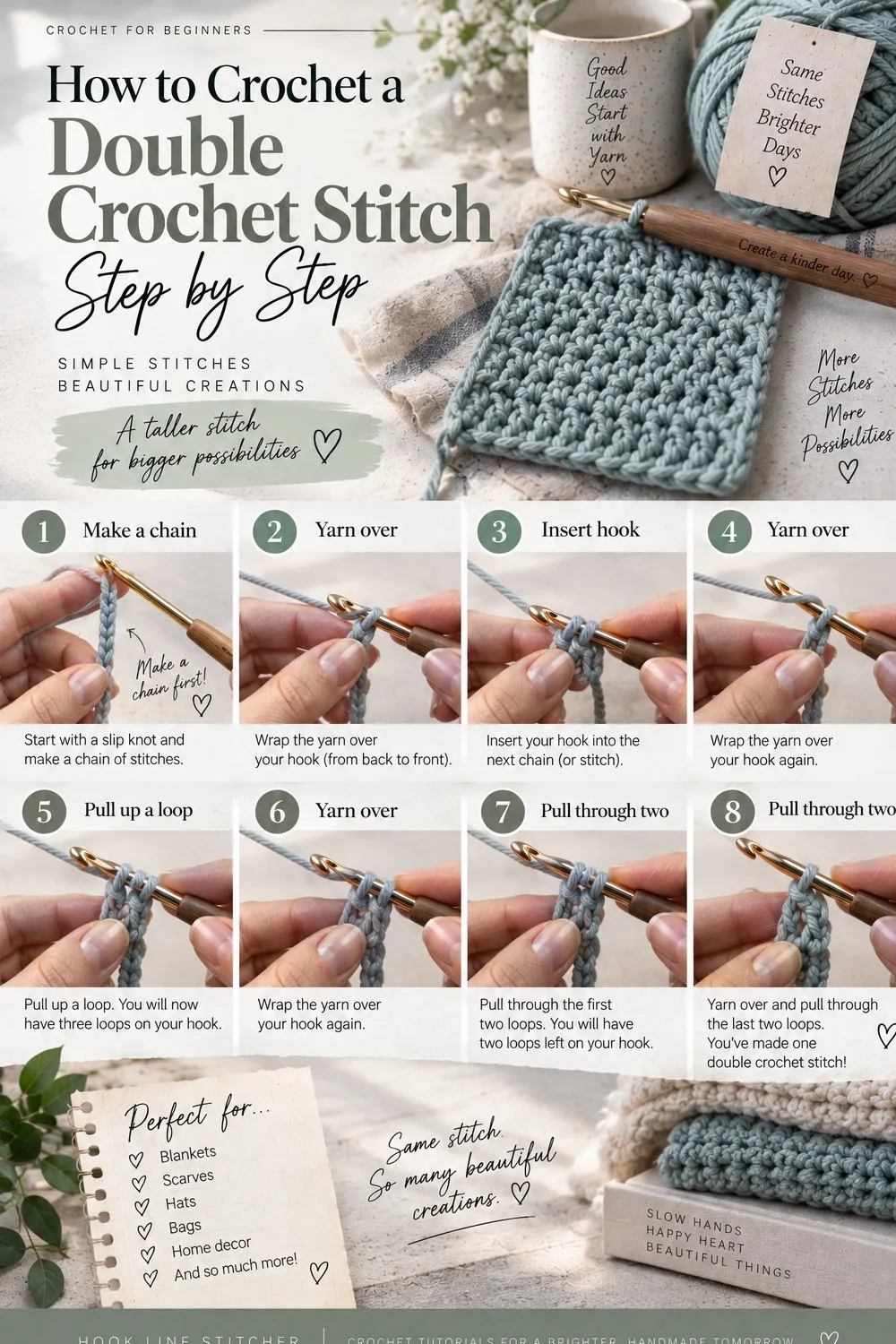
Learning how to double crochet is where crochet starts to feel fast.
Double crochet is the fourth of the 7 crochet stitches every beginner should know, and the one that the granny, shell and bobble stitches are all built from.
After single crochet, where a scarf takes what feels like a thousand rows, double crochet is a relief. It’s roughly twice the height, so you cover ground about twice as quickly, and the fabric it makes is softer and more fluid. Most blankets, most scarves, and every granny square you’ve ever seen are built on this stitch.
It has one complication, and it’s a real one: the turning chain. More disagreement exists about the double crochet turning chain than about almost anything else in beginner crochet, and it’s the reason a lot of first blankets have odd holes down the sides.
Both approaches are explained here, along with which one I’d actually recommend.
US and UK terms
US double crochet is the same stitch as UK treble crochet.
This is the most dangerous naming clash in crochet, because “double crochet” exists in both systems and means different things. UK “double crochet” is what Americans call single crochet — a much shorter stitch.
So a UK pattern saying “dc” and a US pattern saying “dc” are asking for two completely different stitches.
This guide uses US terms throughout. If you’re following a pattern and unsure which system it uses, look for the phrase “single crochet” — if it appears, the pattern is US.
Before you start
You should already be able to:
- Make a chain
- Recognise the V at the top of a stitch and insert your hook under both loops
Single crochet isn’t strictly required first, though most people learn it first and it helps. If you’ve done single crochet, double crochet will click quickly — it’s the same idea with an extra step at the front and an extra step at the back.
You’ll want a 5.0mm or 5.5mm hook, smooth light-coloured worsted yarn, and a stitch marker.
How double crochet differs from single crochet
Worth understanding before you make one, because it explains every step.
Single crochet: insert hook, pull up a loop, pull through both. Two loops on the hook at the busiest moment.
Double crochet: yarn over first, then insert, then pull up a loop, then work off the loops two at a time. Three loops on the hook at the busiest moment.
That opening yarn over is the whole difference. It’s what makes the stitch taller — and forgetting it is the single most common double crochet mistake, because you end up making a single crochet without realising.
Practical consequences of the extra height:
- Faster. Fewer rows for the same fabric.
- More drape. Looser, softer, better for wearables and blankets.
- Less yarn for the same area. Double crochet is noticeably more economical than single crochet, which surprises people — the taller stitch covers more ground per length of yarn.
- Less structure. Not the stitch for baskets, bags, or amigurumi. Stuffing shows through and the fabric won’t hold a shape.
How to double crochet: step by step
Make a slip knot and chain 23.
That’s 20 stitches plus 3. Double crochet needs three chains of height to start, which is why the number looks odd.
Row 1
Step 1 — Yarn over. Before you go anywhere near the chain. Wrap the working yarn over the hook from back to front. You now have two loops sitting on the hook: your working loop and the yarn over.
Step 2 — Insert your hook into the fourth chain from the hook. Count carefully — the loop on the hook doesn’t count. The first V below it is one, then two, then three. Insert into the fourth.
Those three skipped chains are the height of your first stitch. In this row, they are your first double crochet.
Step 3 — Yarn over and pull up a loop. Draw the hook back through the chain. Three loops on the hook. Stop and check. Three is the count that tells you you’re doing it right.
Step 4 — Yarn over, pull through the first two loops. Two loops remain.
Step 5 — Yarn over, pull through the last two loops. One loop remains. That’s one double crochet.
Step 6 — Repeat into each chain across.
The rhythm, once it’s in your hands, is: yarn over, in, up, through two, through two. Say it out loud the first dozen times. It sounds silly and it works.
At the end of the row, count. You should have 20 stitches — the 19 you made, plus the three skipped chains at the start counting as your first double crochet.
Turning and Row 2
Here’s the part with two schools of thought.
Step 1 — Chain 3, then turn.
Step 2 — Now decide what that chain-3 is.
Option A: the chain-3 counts as your first stitch. Skip the first actual stitch of the row, work a double crochet into the second, continue across, and at the end work your final double crochet into the top of the previous row’s turning chain.
This is the traditional method and what most older patterns assume.
Option B: chain 2, and it doesn’t count as a stitch. Work a double crochet into the very first stitch, continue across, and work the last one into the last actual stitch — ignoring the turning chain entirely.
This is what most modern designers use, and it’s what I’d recommend to a beginner.
Why option B is better: a chain-3 is slightly narrower than a real double crochet, so treating it as a stitch leaves a visible gap at the start of every row. Down the side of a blanket, those gaps become a row of holes. A chain-2 that doesn’t count sits tucked against the first stitch and the edge stays closed.
Option B is also easier to count, because every stitch in the row is a real stitch and you never have to hunt for the top of a turning chain.
The one rule that matters more than which option you pick: read what the pattern says and stay consistent. If a pattern says “ch 3 (counts as first dc),” follow it. If it just says “ch 3, turn” with no note, it usually doesn’t count. Switching methods partway through a project is what actually ruins edges.
Step 3 — Work across and count. Twenty stitches, every row.
Counting, and why edges go wrong
Double crochet rows go wrong in exactly the same two ways single crochet rows do, but the turning chain makes it easier to lose track.
Rows getting wider: you’re working both into the first stitch and treating the chain-3 as a stitch, so you gain one each row.
Rows getting narrower: you’re skipping the first stitch (as if the chain counts) but not working into the turning chain at the end, so you lose one each row.
The fix is the same as always. Put a stitch marker in the first stitch of every row and move it up as you go. Count at the end of every row. Twenty stitches, always twenty.
Nine out of ten crooked beginner blankets come down to this and nothing else.
Getting the tension right when you double crochet
Double crochet has a longer pull-up than single crochet, which gives you more room to be inconsistent.
Watch the pull-up height in step 3. That first loop you draw through should come up to roughly the height of a chain — not stretched tall, not pulled down tight. Inconsistent pull-ups are the main reason double crochet rows look wavy even when the count is right.
Stiff, cardboard-like fabric means tension is too tight. Loosen, or go up a hook size.
Big sloppy holes between stitches means too loose. Go down a size, or add friction in your yarn hand.
A good double crochet fabric drapes over your hand and has small even spaces between stitches. Some openness is correct here — it’s not meant to be solid like single crochet.
Common mistakes
Forgetting the first yarn over. You’ll make a single crochet instead and it’ll be obviously shorter. If one stitch in a row looks stunted, this is why.
Pulling through all three loops at once. That makes a different stitch entirely. Two at a time, twice.
Starting in the wrong chain. Fourth chain from the hook on row one. Starting in the third leaves your edge tight; starting in the fifth costs you a stitch.
Inconsistent turning chain treatment. Pick option A or option B and hold it for the whole project.
Not counting. Eight seconds a row. It’s the cheapest insurance in crochet.
Working into the wrong loops at the end of a row. The top of a turning chain is a fiddly thing to find. If you’re using option B, you never have to, which is one more argument for it.
What you can make once you know how to double crochet
Blankets. The classic use. Fast enough to finish, soft enough to use.
Scarves and shawls. Drape is the point, and double crochet has it.
Granny squares. Every traditional granny square is clusters of three double crochets separated by chain spaces. Learn this stitch and granny squares are immediately available to you.
Anything you want done this month rather than next.
Not for: amigurumi, baskets, bags, anything structural. The gaps and the softness work against you.
What’s next
With chain, single crochet and double crochet, you can make the large majority of beginner patterns.
The natural next step is the granny stitch — clusters of three double crochets with chain spaces between them. It’s not a new stitch so much as a new arrangement of the one you just learned, and it opens up granny squares, granny stripe blankets, and a whole category of projects that look far more complicated than they are.
Half double crochet is also worth picking up soon. It sits between single and double in height, and some people prefer its texture over both.
Where double crochet is used on the site
Frequently asked questions
Cathrinee’s Supply Kit
The beginner basics I recommend
How do you crochet a double crochet stitch?
Yarn over, insert the hook into the next stitch, yarn over and pull up a loop so you have three loops on the hook. Yarn over and pull through two, then yarn over and pull through the remaining two.
What is the turning chain for double crochet?
Chain 3, and it counts as the first double crochet of the row. That means you skip the first stitch of the row and work into the second, then work your last stitch into the top of the previous turning chain.
Why does my double crochet have a gap at the edge?
That is the turning chain gap and it is normal. You can reduce it by chaining 2 instead of 3, or eliminate it entirely by using a standing double crochet at the start of each row instead of a chain.
How is double crochet different from single crochet?
Double crochet is twice as tall and much more open, because of the extra yarn over before inserting the hook. It works up faster and gives a softer drape, which is why blankets and shawls usually use it.
Is double crochet good for beginners?
Yes, and many people find it easier than single crochet because the taller stitch is easier to see and count. It also grows fast, which keeps a first project from feeling endless.


9 Comments on “How to Crochet a Double Crochet Stitch Step by Step”