Almost everyone learning how to crochet a scarf picks it as their first big project, and it’s the right instinct — a scarf is a rectangle, and a rectangle needs no shaping, no sizing and no assembly.
But it’s also the project where most beginners discover their edges drift. A scarf is long enough that a single missed stitch per row turns into a visible wedge by the end. That’s not a reason to avoid it. It’s a reason to count.
This guide gives you the dimensions that actually work, three stitch options with different looks, and the habit that keeps your edges straight.
About six hours for a full-length scarf, spread over a few evenings.
What you need to know first
- Chain stitch
- One stitch from: single crochet, half double crochet or double crochet
- Turning at the end of a row
That’s genuinely all. A scarf is the same row repeated.
What you need
Worsted weight (4) yarn, about 300 metres for an adult scarf. A soft acrylic, a wool blend or merino all work. Skip cotton — it has no bounce and a cotton scarf hangs heavy and cold.
A 5.5mm hook — slightly larger than worsted usually calls for, because a scarf should drape rather than stand up.
A tapestry needle and scissors.
A stitch marker. You’ll want it.
Cathrinee’s Supply Kit
Everything you need for this project
Terms
US crochet terms.
- ch = chain · sc = single crochet (UK double crochet) · hdc = half double crochet · dc = double crochet (UK treble) · st(s) = stitch(es)
What size should a crochet scarf be?
Getting this right first saves you from a scarf that’s too short to tie or too wide to sit flat.
| Scarf type | Width | Length |
|---|---|---|
| Child | 12–15 cm | 100–120 cm |
| Adult, standard | 18–20 cm | 150–170 cm |
| Adult, long wrap | 25–30 cm | 180–200 cm |
| Skinny scarf | 10–12 cm | 150 cm |
A useful rule for length: the scarf should be roughly the height of the person wearing it. That gives enough to wrap once and still hang.
On width: wider is not cosier, it’s just heavier. Past about 25 cm a scarf starts bunching at the neck instead of lying flat.
Choosing your stitch
The stitch changes the fabric more than the yarn does.
Double crochet — the usual choice. Tall, so it grows quickly, and it drapes well. A scarf in dc takes about half the rows of one in sc.
Half double crochet — slightly denser and warmer, still reasonably quick. The best all-rounder if you’re undecided.
Single crochet — densest and warmest, and by far the slowest. A full scarf in single crochet is a real commitment. Lovely result, though.
Moss stitch — alternating sc and ch-1, which makes a soft woven-looking fabric with lovely drape. Slightly more interesting to work than plain rows.
The pattern
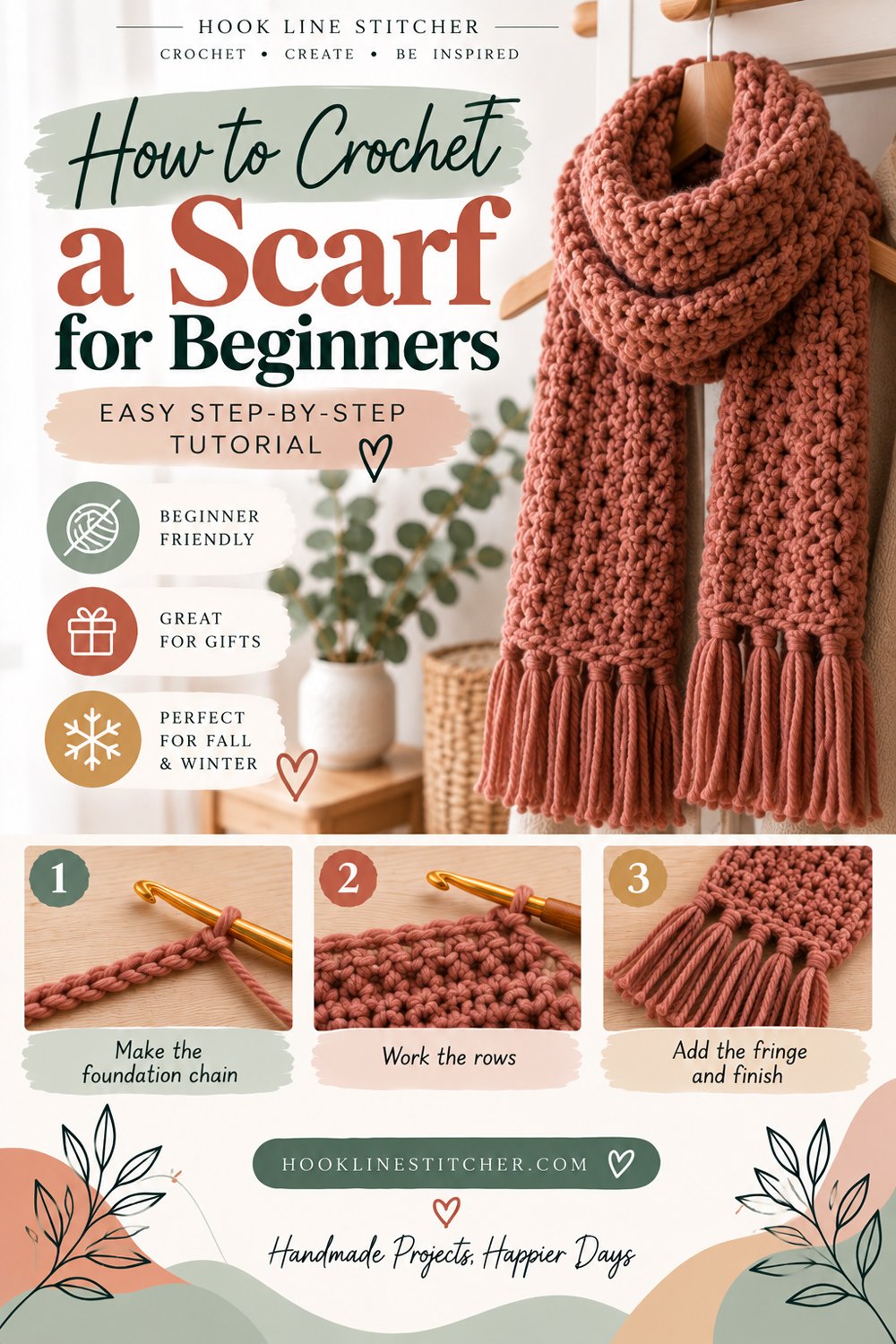
Step 1: The foundation chain
Chain to your width, not to a fixed number — the number of chains depends on your tension.
Chain about 40 to start, lay it flat without stretching, and measure. Adjust until it matches the width you want from the table above, then add one extra chain for a turning chain.
For most people in worsted weight, an 18 cm scarf is around 35 chains.
Chain loosely. A tight foundation chain pulls the bottom edge in and the scarf ends up narrower at one end. If your chains are tight, work them with a hook one size larger, then switch back for row one.
Step 2: The rows
Row 1: dc in the 3rd ch from the hook, then dc in each ch across. Count. You should have two fewer stitches than your chain count — that’s correct, the skipped chains form the first stitch’s height.
Row 2: Ch 2, turn. Dc in each st across, working into the last stitch of the row below rather than into the turning chain.
Repeat row 2 until the scarf reaches your target length.
That’s the whole pattern. The craft is in the consistency.
The habit that keeps your edges straight
Put a stitch marker in the first stitch of every row and move it up as you go. Count at the end of every row.
Eight seconds a row. Over a 150 cm scarf that’s maybe six minutes total, and it’s the difference between a rectangle and a wedge. If your count drifts, crochet rows getting wider or narrower explains which mistake causes which.
A note on the turning chain: chain 2 at the start of each dc row and don’t count it as a stitch. Work a real double crochet into the first stitch. The traditional chain-3 counted as a stitch leaves a gap at the end of every row, and down a scarf’s full length those gaps form a ladder of holes along both edges.
Step 3: Fasten off and block
Fasten off, leaving a 20 cm tail. Weave it into the back of the stitches in one direction, then turn and come back the other way.
Block it. Dampen the scarf, lay it flat, gently straighten the edges, and pin it to shape until dry. This evens out the small tension differences between the evening you started and the evening you finished — and those are always there.
Adding fringe
Fringe is the fastest way to make a plain scarf look finished.
Cut lengths of yarn twice your intended fringe length plus 3 cm. For a 15 cm fringe, cut 33 cm lengths.
Take two or three strands together, fold them in half, push the folded loop through a stitch at the end of the scarf with your hook, then pull the loose ends through that loop and tighten.
Space them every second or third stitch across both ends, then trim level with scissors — lay the scarf flat and cut along a straight edge.
Troubleshooting your crochet scarf
The scarf is getting wider. You’re adding a stitch each row, almost always by working into the turning chain at the end. Count every row.
The scarf is getting narrower. You’re missing the first stitch after turning — it sits right under your hook and is easy to look past. Marker in the first stitch.
The edges are wavy rather than straight. Uneven tension between sessions. Blocking fixes most of it.
The bottom edge is tighter than the rest. A tight foundation chain. Nothing to do now; next time, chain with a bigger hook.
There’s a row of holes down both sides. The turning chain again. Chain 2 and don’t count it.
It’s stiff and doesn’t drape. Tension too tight, or too small a hook. Go up a size — scarves want loose, soft fabric.
I ran out of yarn halfway. Join the new ball mid-row by working the last stitch of the old yarn up to its final step, then completing it with the new. Never knot.
Variations
- Striped scarf: change colour every four or six rows. It uses up odd balls and looks deliberate.
- Two-colour marl: hold two strands of different colours together throughout on a 7.0mm hook. Quick, warm, and the colour effect is lovely.
- Pocket scarf: crochet two small squares and sew one to each end as pockets.
- Infinity scarf: make it 150 cm long, then seam the two ends together into a loop.
- Child’s scarf: 12 cm wide and 100 cm long. A good second project after a dishcloth.
Frequently asked questions
How do you crochet a scarf for beginners?
Chain to your chosen width, work one row of double crochet, then repeat that row until the scarf reaches your chosen length. There’s no shaping and no assembly.
How wide should a crochet scarf be?
About 18–20 cm for an adult and 12–15 cm for a child. Wider than 25 cm starts bunching at the neck rather than lying flat.
How long should a crochet scarf be?
Roughly the height of the person wearing it — around 150–170 cm for an adult. That’s enough to wrap once and still hang.
How much yarn do I need for a crochet scarf?
About 300 metres of worsted weight yarn for a standard adult scarf.
Which stitch is best for a crochet scarf?
Double crochet is the usual choice because it drapes well and works up quickly. Half double crochet is slightly denser and warmer.
Why is my crochet scarf getting wider?
You’re working into the turning chain at the end of each row, which adds a stitch. Chain 2 at the start of a double crochet row and don’t count it as a stitch.
How long does it take to crochet a scarf?
About six hours for a full-length adult scarf in double crochet, usually spread over several evenings.