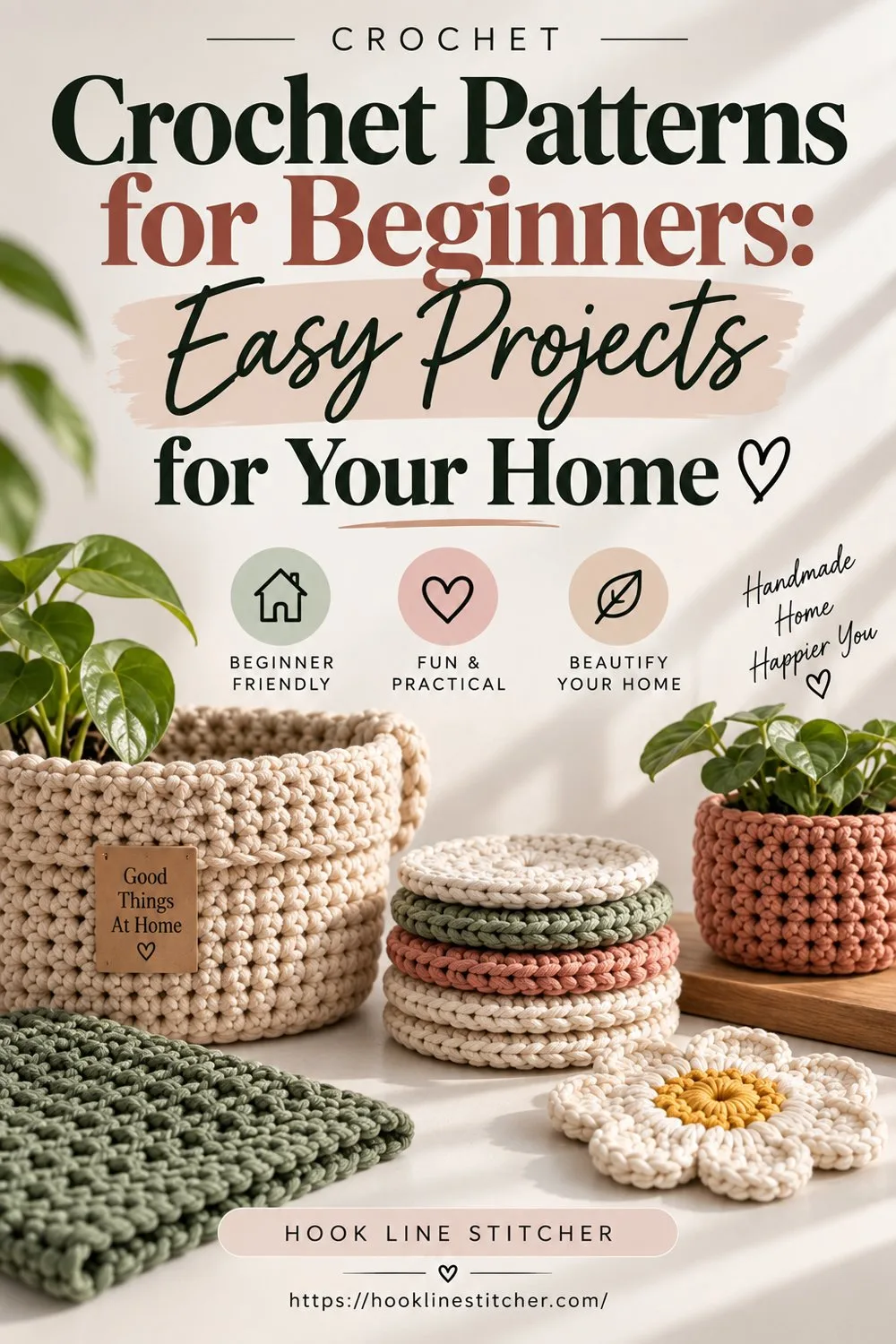
Crochet projects for the home follow a different rule than crochet for people, and getting it wrong is why so many beginner baskets end up as floppy bowls.
A scarf should drape. A jumper should have give. A basket should stand up on its own with a set of keys in it, and a coaster should stay flat under a hot mug rather than curling at the edges.
That difference comes down to two decisions made before you start: fibre and gauge. Home items want cotton or something stiffer, worked on a hook a size or two smaller than the label recommends. The stitches will feel tight and your hand will notice. That tightness is the point.
Get those two right and every one of the crochet projects for the home below is beginner-level. Get them wrong and no amount of skill rescues it.
The one rule that governs most of this
Nearly every round object in this list is the same construction:
Make a flat circle, stop increasing, keep crocheting.
The fabric has nowhere to go but upward, and a circle becomes a cylinder with a base. No seams, no panels, no assembly.
Two details make it work properly. First, a flat circle requires each round to add the same number of stitches as the first round contains — six for single crochet, twelve for double. Add more and it ruffles; add fewer and it cups.
Second, one round worked in back loops only at the point where the base ends and the sides begin creates a crease, so the base turns a clean right angle instead of curving gently upward. That single round is the difference between a basket and a bowl.
Learn both on a coaster, which takes fifteen minutes, and then most of this list is available to you.
Kitchen
Dishcloths
Time: 45 minutes each · Yarn: cotton, always
The most used handmade object in most houses. Cotton absorbs, scrubs, washes hot, and outperforms shop-bought cloths noticeably. Single crochet in a square, nothing more.
Acrylic is useless here — it does not absorb and it melts against a hot pan.
Coasters
Time: 15 minutes each · Make: six
Three rounds of double crochet plus an edging. Cotton only: acrylic is a plastic and softens under a hot mug.
Also the best place to learn the flat circle rule, which is why it is the first thing I would make from this list regardless of whether you need coasters. Full coaster pattern.
Pot holders
Time: 1 hour each
Must be thick — worked with the yarn held double, or in a dense textured stitch. A thin pot holder transmits heat and becomes decorative rather than useful, which defeats the point.
Jar cosies
Time: 30 minutes
A tube of tight single crochet around a jar turns it into a utensil pot or a vase. Straightforward, and a good use of the circle-to-sides trick at small scale.
Storage
Mini basket
Time: 90 minutes · Yarn: t-shirt yarn, macramé cord, or chunky cotton
The project that teaches the whole construction. Keys by the door, hair clips on a dresser, chargers in a drawer.
This is where fibre choice is most visible. T-shirt yarn or macramé cord gives a basket that stands unaided. Chunky cotton is very good. Worsted cotton held double works well. Acrylic sags within a week and there is no technique that fixes it. Full mini basket pattern.
Nesting basket set
Time: an afternoon · Make: three
Same pattern at three sizes — stop the base at 24, 30 and 36 stitches — with the same number of side rounds each. Three baskets that stack look considered in a way one basket does not.
Mini bag or pouch
Time: 2 hours
The basket with taller sides and a strap. Useful for things that need to hang rather than sit — by a door, on a hook, in a wardrobe. Full mini bag pattern.
Plant pot cover
Time: 90 minutes
A basket sized to slip over a nursery pot. Measure the pot’s diameter, work the base to match, then straight sides to just below the rim. One of the few crochet items that genuinely improves a room rather than just adding to it.
Living room
Granny square blanket
Time: weeks, twenty minutes at a time
The realistic way for a beginner to make a blanket. Sixty squares at twenty minutes each is a project you can carry in a bag and pick up for a single square at a time — which is how blankets actually get finished, rather than as one enormous piece that lives in a corner.
Cushion cover
Time: 4–6 hours
Nine granny squares sewn into a three-by-three grid, backed with fabric or a second set of squares. A much shorter commitment than a blanket and it uses the same skill.
Garland
Time: an evening
Ten to fifteen crochet hearts or stars chained together. Looks like a lot of work and it is a single evening. Cotton holds its shape and survives being put away and brought out again. Full heart pattern.
Table runner
Time: 5–8 hours
A long rectangle in an open stitch. Simple, though the length means your tension has to hold steady for a while — which makes it a good project for after you have made a few smaller things.
Bathroom
Washcloths
Time: 45 minutes each
Cotton, worked in a soft textured stitch rather than a dense one. Made in a set of three, they are a better bathroom gift than most bought ones.
Small storage basket
Time: 90 minutes
Cotton rather than t-shirt yarn here, since it will get damp. Cotton tolerates humidity and washes; some cords do not.
Choosing yarn for crochet projects for the home
The short version, in order of how well each works. If you are unsure what weight a ball of yarn actually is, the Craft Yarn Council yarn weight system is the standard reference, and most labels follow it.
For baskets and anything that must stand: t-shirt yarn, macramé cord, chunky cotton, or worsted cotton held double. Never acrylic.
For anything touching food, heat or water — dishcloths, coasters, pot holders, washcloths: cotton only. Acrylic is a plastic. It does not absorb, and it softens against heat.
For blankets, cushions and anything soft: acrylic is fine and often better — softer, cheaper, washes easily, and comes in more colours.
Hook size: one to two sizes below the label for anything structural. Standard size for anything meant to be soft.
That one paragraph prevents most of the disappointment in beginner home crochet.
Where to start with crochet projects for the home
If you have never made anything from this list, make a coaster first. Fifteen minutes, and it teaches the circle rule that governs the baskets, the pots and the bags.
Then a mini basket, which teaches the circle-to-sides transition.
After those two, everything else on this page is a variation on something you already know. That is the useful thing about crochet projects for the home — the same flat circle sits underneath most of them.
Frequently asked questions
What crochet projects for the home are best for beginners? Coasters, baskets, dishcloths, pot holders, plant pot covers and garland are all beginner-level. Blankets and cushion covers are approachable if built from granny squares.
Why will my crochet basket not stand up? The yarn is too soft or the hook too large. Use t-shirt yarn, macramé cord or chunky cotton, with a hook one or two sizes smaller than recommended.
What yarn should I use for crochet home decor? Cotton or stiffer fibres for anything structural or anything near heat and water. Acrylic is fine for soft items like blankets and cushions.
Can you crochet a basket without sewing? Yes. Work a flat circle base, then stop increasing and continue in rounds — the sides rise on their own with no seams.
Are crochet coasters actually useful? Cotton ones are, if the fabric is dense. They absorb condensation well, which is what damages wooden furniture.
What is the easiest crochet home project for a beginner? A coaster. Fifteen minutes, and it teaches the flat circle rule that most other round home projects depend on.
How do I make a crochet blanket as a beginner? Granny squares. Sixty small squares at twenty minutes each is far more achievable than one large piece, and it is portable.
For the full beginner path from first stitch onward, see the complete guide to beginner crochet projects.
Cathrinee’s Supply Kit
The beginner basics I recommend
What crochet projects are useful around the home?
Dishcloths, pot holders, coasters, baskets, cushion covers, plant hangers and table runners. All of them get used daily, which is what separates a useful make from a decorative one.
What yarn should I use for crochet home projects?
Cotton for anything in the kitchen or bathroom — it absorbs, washes and handles heat. Acrylic or a wool blend for cushions, blankets and decorative pieces where durability matters more than absorbency.
What is the easiest crochet home project for a beginner?
A dishcloth. It is a flat square with no shaping, it teaches consistent edges, and it is immediately useful. Coasters are a close second and take half the time.
How do I make crochet home decor look coordinated?
Pick three colours and use them across every piece. A basket, cushion and coaster set in the same palette reads as deliberate design; the same items in unrelated colours read as leftovers.
Are crochet home items durable?
Yes if you match the fibre to the job. Cotton kitchen items survive years of washing. The usual cause of a short life is the wrong yarn — acrylic in the kitchen, or a loose fabric where a dense one was needed.


2 Comments on “Crochet Patterns for Beginners: Easy Projects for Your Home”