The crochet jellyfish is having a moment, and it deserves it. The dome is a simple half sphere — the same shape as the top of any amigurumi head — and the tentacles curl into perfect spirals entirely by themselves, with no shaping and no blocking. You chain a length, work two stitches into every chain on the way back, and physics does the rest. It is the most satisfying trick in beginner crochet.
It is also a forgiving project. Tentacles do not have to match. A jellyfish with eight slightly different tentacles looks better than one with eight identical ones.
From the shop · New pattern
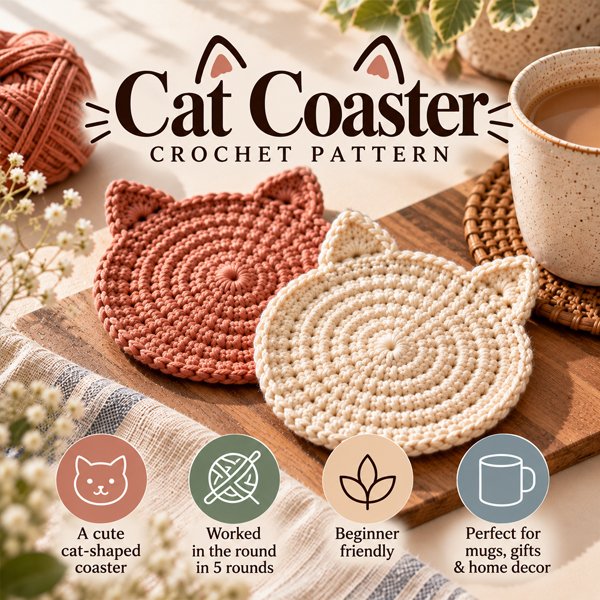
A sweet cat-ear coaster in just 5 rounds. Beginner friendly, printable 7-page PDF for $4.99.
See the pattern →What you will need
| Item | What I recommend | Why |
|---|---|---|
| Yarn | Worsted weight (#4), about 70 yards | Standard amigurumi weight |
| Hook | 3.5 mm | Dense fabric so stuffing cannot show |
| Stuffing | Polyester fibrefill | Fills the dome |
| Stitch marker | Or scrap yarn | Marks the round |
| Yarn needle | Blunt tapestry needle | Attaching tentacles |
A slight sheen helps here — cotton or a cotton blend gives the tentacles crisper spirals than a very soft acrylic, because the stitches hold their twist better. But acrylic works perfectly well and is cheaper, so use what you have.
Two colours look lovely: one for the dome, one for the tentacles. One colour is also fine.
From the shop · New pattern
A sweet cat-ear coaster in just 5 rounds. Beginner friendly, printable 7-page PDF for $4.99.
See the pattern →Cathrinee’s Supply Kit
Everything you need for this project
Stitches you need to know
- Magic ring — the closed starting loop
- Single crochet (sc) — see how to crochet a single crochet stitch
- Increase (inc) — 2 sc into one stitch
- Invisible decrease (dec) — front loops only of the next two stitches, yarn over, pull through both
- Chain (ch) — see how to crochet a chain stitch
Why the tentacles spiral
This is worth understanding rather than just following. When you chain a straight line and then work two stitches into every single chain on the way back, you are trying to fit twice as much fabric along the same length. The strip cannot lie flat, so it has to twist — and it twists into an even spiral all by itself. Change the number to three stitches per chain and it curls tighter. Work one stitch per chain and it stays straight.
That same principle is what makes a crochet flower ruffle, and it is the opposite of the problem people hit in why is my crochet circle not flat — same cause, different intention.
How to crochet a jellyfish step by step
The dome
- Magic ring, 6 sc. Pull closed, place your marker, and move it every round.
- Round 2: Increase in every stitch. 12 stitches.
- Round 3: (sc 1, inc) around. 18 stitches.
- Round 4: (sc 2, inc) around. 24 stitches.
- Round 5: (sc 3, inc) around. 30 stitches.
- Rounds 6 to 10: Single crochet around, no increases. 30 stitches per round. This gives the dome its height and the slight bell shape.
- Round 11: (sc 3, dec) around. 24 stitches.
- Round 12: (sc 2, dec) around. 18 stitches.
- Stuff the dome firmly. Add fibrefill in small pinches, pressing outward so the dome stays round rather than going lumpy. Stuff it fully — an understuffed dome sags and loses the bell shape that makes a jellyfish look like a jellyfish.
- Round 13: (sc 1, dec) around. 12 stitches. Do not close it completely yet.
- Round 14: Single crochet around. 12 stitches. Fasten off leaving a long tail. You now have a stuffed dome with a small opening at the bottom, which is where the tentacles go.
The tentacles (make 8)
- Chain 25. Longer for a more dramatic jellyfish, shorter for a compact one. Twenty-five is a good starting point.
- Work back along the chain: 2 sc into the second chain from the hook, then 2 sc into every remaining chain all the way back. Do not join anything, do not turn. As you work, the strip will start twisting in your hands. Let it.
- Fasten off leaving a 6-inch tail. Do not try to straighten the spiral out. Do not block it flat. The twist is the entire point.
- Repeat until you have eight. Vary the chain length slightly if you like — 22, 25, 28 — for a more natural look.
Assembly
- Arrange the tentacles. Lay the dome upside down and space the eight tentacles evenly around the opening at the bottom. Pin them or just hold them.
- Sew each one on. Thread the tail of each tentacle and stitch its top end firmly to the edge of the opening, going through several times. These get pulled if the jellyfish is a toy, so be generous.
- Close the opening. Use the dome’s long tail to run a gathering stitch around the remaining loops and pull them together. The tentacle tops will hide the gathered centre.
- Add a face (optional). Two small black straight stitches for eyes, low on the dome. Many jellyfish look better without any face at all, so pin a scrap of yarn in place and look before you commit.
- Weave in every end inside the dome and trim close.
Troubleshooting
My tentacles are not curling. You worked one stitch per chain instead of two. Pull it back and work 2 sc into every single chain.
My tentacles are curling too tightly, like a coiled spring. You worked three stitches per chain, or your tension is very tight. Two per chain is the standard; loosen your grip slightly.
The dome sags. Understuffed. Take some out and repack it in small pinches, pressing outward against the walls.
Stuffing shows through the dome. Hook too big. Drop to 3.0 mm.
The dome is pointed rather than bell-shaped. You went straight from increases to decreases without enough even rounds in between. Rounds 6 to 10 worked plain are what create the bell.
The tentacles pull off. You did not stitch through them enough times. Go through each attachment point four or five times.
I lost my place in the dome rounds. Move the marker into the first stitch of every new round. There is no join in a spiral. See how to count crochet stitches.
Variations to try
- Gradient tentacles. Use a self-striping or ombre yarn for the tentacles against a plain dome. Barely any extra work, dramatically better result.
- Tiny jellyfish keychain. Sport weight yarn and a 2.5 mm hook gives a jellyfish about 2 inches across. Add a chain loop at the top.
- Nursery mobile. Make three or five in different sizes and hang them at different heights from a hoop. One of the nicest handmade nursery pieces there is.
- Long-tentacle version. Chain 40 instead of 25. The spirals get properly theatrical.
- Mixed tentacles. Make four tentacles with 2 sc per chain and four with 3 sc per chain, so some spiral loosely and some tightly.
- Add a frill. Work one round of (sc, ch 1) around the bottom edge of the dome before attaching the tentacles.
Good to know
Jellyfish are one of the better amigurumi for a child’s room precisely because there are no small attached parts — no separate eyes, no buttons, nothing sewn on that can come off except the tentacles, which you can stitch on as securely as you like. Embroider any face directly and use a machine washable yarn and stuffing.
They also take very well to being made in quantity. Once the dome pattern is in your hands you can turn one out in under an hour, and a group of them in different colours looks far better than a single one.
When you are ready for more, easy amigurumi patterns for beginners has the rest of the animals on the site, and small crochet patterns for beginners collects the quick makes.
For matching hook sizes to yarn, the Craft Yarn Council hook size chart is the reference to use — then go one or two sizes smaller for amigurumi.
How do you make crochet jellyfish tentacles curl?
Chain your length, then work two single crochet into every single chain on the way back. Fitting twice as much fabric along the same length forces the strip to twist, and it spirals on its own with no shaping or blocking. Three stitches per chain curls tighter; one stitch per chain stays straight.
How many tentacles should a crochet jellyfish have?
Eight is the standard and looks balanced. Vary the chain lengths slightly — 22, 25, 28 — because tentacles that are not identical look more natural than eight matching ones.
Why is my crochet jellyfish dome sagging?
It is understuffed. Take the fibrefill out and repack it in small pinches, pressing each one outward against the walls of the dome. A jellyfish needs a firm bell shape, and an understuffed dome loses it within days.
Is a crochet jellyfish safe for a baby or nursery?
It is one of the safer amigurumi because there are no separate attached parts apart from the tentacles. Embroider any face directly in yarn, stitch each tentacle on four or five times, and use machine washable yarn and stuffing.
How long does it take to crochet a jellyfish?
About an hour and a half for a first one, including all eight tentacles. Once you know the dome pattern, expect under an hour. The tentacles are the quickest part — roughly three minutes each.