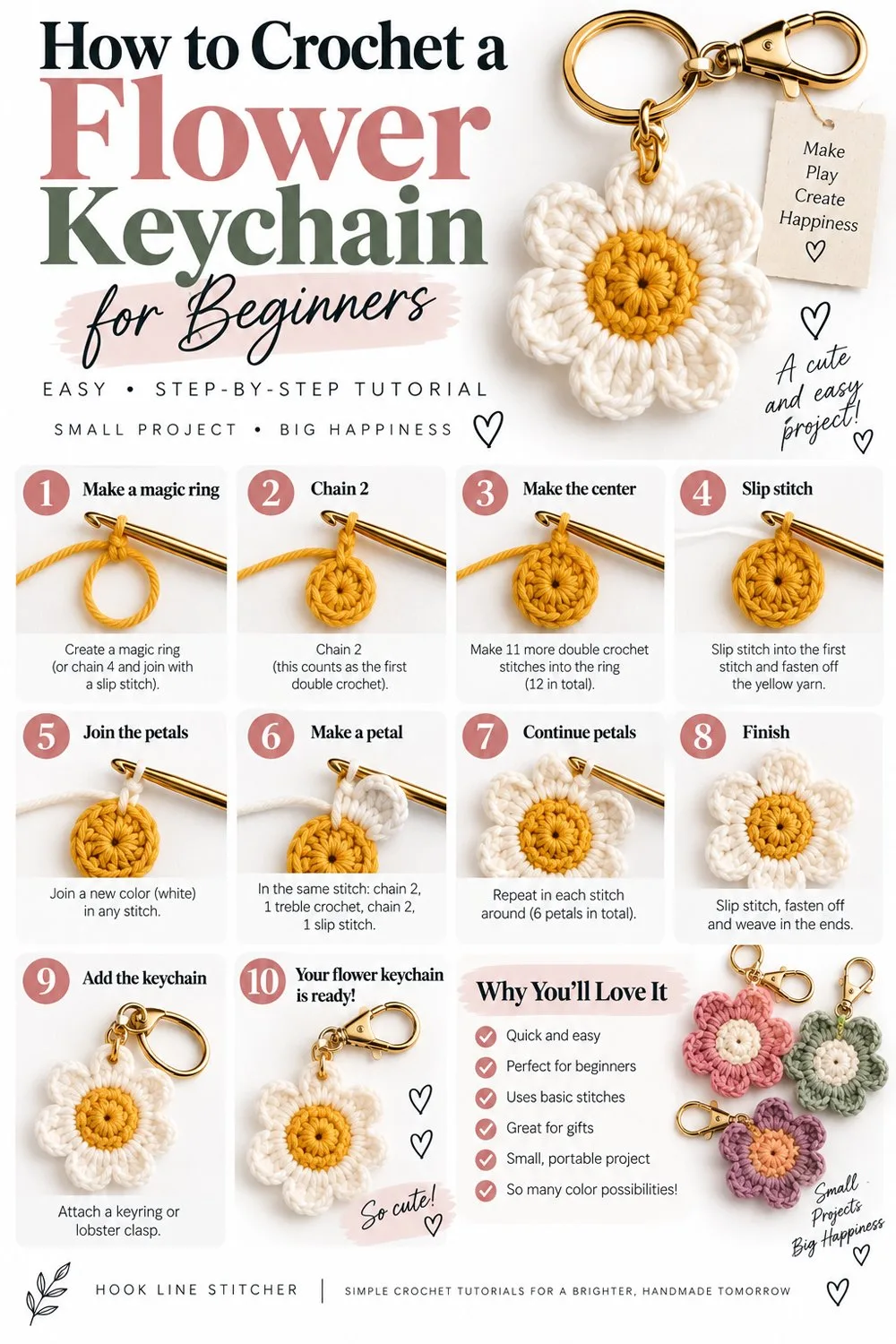
A crochet flower keychain is two rounds of work and about twenty minutes, and it’s the first project most beginners make that other people actually ask for.
- Skill level: Beginner
- Time: About 20 minutes
- Yarn: DK or worsted cotton
- Hook: One or two sizes below the yarn label
- Terms: US crochet terms
That last part matters more than it sounds. There’s a real difference between making a practice swatch and making something you hand to a friend. Keychains sit in that sweet spot — small enough to finish in one sitting, useful enough to give away, and cheap enough that you can make eight in an evening from scraps.
There’s also a catch that most tutorials skip entirely. A keychain lives a violent life. It gets shoved in pockets, dropped on pavements, sat on, and rubbed against metal keys hundreds of times a week. A flower crocheted the way you’d crochet a blanket square will look tired within a month. The construction choices that stop that are covered below, and they’re the reason this tutorial is longer than “make a flower, attach a ring.”
What you need to know first
You’ll want to be comfortable with:
- Chain stitch
- Double crochet
- Treble crochet
- Slip stitch
- The magic ring — there’s a workaround if you haven’t learned it, but it’s genuinely worth learning before a keychain, for durability reasons explained below
If you’ve made a crochet heart before, this uses all the same skills in a different arrangement.
What you need for a crochet flower keychain
Cotton yarn, DK or worsted weight. Not a suggestion — cotton is the right choice here and acrylic isn’t. Acrylic pills and goes fuzzy under friction, and a keychain is nothing but friction. Cotton holds its shape, resists abrasion, and stays crisp. Mercerised cotton is even better if you have it, since the tighter twist sheds less.
A hook one or two sizes smaller than the yarn calls for. A 3.0mm for DK, or a 3.5mm for worsted. You want a dense, tight fabric with no visible gaps. Loose crochet on a keychain turns into a snagged mess.
A split-ring keyring. The flat spiral kind, 25mm or 30mm. Cheap in packs of fifty online or from any craft shop.
A tapestry needle and scissors.
Optional: a jump ring or lobster clasp if you want it to clip onto a bag rather than sit on a keyring. A small button or bead for the flower centre.
Cathrinee’s Supply Kit
The beginner basics I recommend
A note on terms
This pattern uses US crochet terms.
- ch = chain
- sl st = slip stitch
- dc = double crochet (UK treble)
- tr = treble crochet (UK double treble)
- st(s) = stitch(es)
The crochet flower keychain pattern
Finished flower roughly 5 cm across in DK cotton on a 3.0mm hook.
Round 1 — the centre
Make a magic ring.
Ch 3 (this counts as your first dc), then work 9 dc into the ring. That’s 10 stitches including the chain-3.
Join with a sl st into the top of the ch-3.
Pull the magic ring tail firmly to close the centre. Pull harder than feels polite. A loose centre is the first thing to fail on a keychain, and this is your only chance to tighten it.
You should have a small firm disc with 10 stitches around the edge.
No magic ring? Ch 4, sl st into the first chain to make a loop, and work the 10 dc into that loop. It leaves a small hole in the centre that you can close from the back with the tail. Acceptable, but the magic ring is genuinely better here — a keychain gets pulled at, and the magic ring is the stronger centre.
Round 2 — the petals
Each petal uses two stitches from Round 1: one to hold the petal, one to anchor it.
Into the next st, work (dc, tr, dc) — all three into the same stitch. Sl st into the following st.
That’s one petal.
Repeat that four more times. Five petals total, using all 10 stitches of Round 1.
After your last sl st you’ll be back where you started. Fasten off, leaving a tail of about 20 cm — you’ll use it to attach the keyring.
Give the flower a gentle stretch and shake. The petals will settle and cup slightly, which is correct.
Attaching the keyring
Two methods. The second one is stronger.
Method 1 — the chain loop. Rejoin yarn between two petals at the back of the flower. Ch 12, thread the chain through the split ring, then sl st back into the same spot on the flower. Fasten off and weave the ends in securely.
Quick, and it looks neat. The weakness is that the chain is a single strand under load, and a chain will eventually stretch or wear through where it rubs the metal ring.
Method 2 — the reinforced loop. Same start: rejoin between two petals, ch 12, thread through the ring. Now instead of one slip stitch, work a slip stitch into every chain back down the loop, then sl st into the flower.
You end up with a doubled cord rather than a single chain. It takes ninety extra seconds and roughly triples how long the keychain survives. This is the method to use for anything you’re giving away.
Making a crochet flower keychain that lasts
The construction details that separate a keychain that survives a year from one that looks sad by March:
Weave ends in properly, then again. Weave each tail in one direction through the back of the stitches, then turn and go back through in the opposite direction. A single pass will work itself loose under the constant movement a keychain gets. Two passes in opposing directions won’t.
Don’t trim ends flush. Leave a few millimetres. Flush-cut ends pop out.
Consider a backing. For the sturdiest version, make a second flat disc — just Round 1, ten dc into a magic ring — and sew it to the back of the flower. It stiffens the whole thing, hides your ends completely, and stops the petals from folding backwards.
Tighten the centre more than you think. Most keychain failures start at the middle.
Skip fabric stiffener. It’s tempting, but it goes brittle and cracks with the constant flexing a keychain gets. A tight gauge and cotton yarn do the job better.
Variations
Six-petal flower. Work 12 dc into the magic ring in Round 1, then work six petals in Round 2, same as written. Rounder, fuller look.
Fuller petals. Use (dc, 2 tr, dc) in each petal stitch instead of (dc, tr, dc). Slightly larger, more overlap between petals.
Two-tone. Work Round 1 in one colour, fasten off, join a second colour for the petals. Yellow centre with white petals reads as a daisy immediately.
Button centre. Sew a small button over the middle of the finished flower. Covers any imperfection in the magic ring and looks deliberate.
Layered flower. Make two flowers, one in DK and one in a finer yarn, and stack the smaller on top of the larger, offsetting the petals. Sew through both centres.
Bag charm. Swap the split ring for a lobster clasp on a jump ring.
Crochet flower keychain troubleshooting
My petals are curling backwards. Usually means Round 1 is too tight relative to Round 2 — the base can’t lie flat under the petals. A backing disc fixes it, or work Round 1 slightly looser next time.
The centre has a hole in it. The magic ring wasn’t pulled fully closed, or the chain-loop method was used. Close it from the back with the tail and a tapestry needle. Then pull harder next time.
My flower is floppy. Tension too loose, or the yarn is wrong. Go down a hook size and use cotton. This project wants a fabric that feels almost stiff.
The petals are different sizes. Easy to miscount when stitches are crowded around a small centre. Each petal takes exactly two stitches from Round 1 — one for the (dc, tr, dc) cluster, one for the sl st. Count the ten base stitches before you start Round 2 and mark every second one if it helps.
Only four petals fit, or I have stitches left over. Round 1 didn’t come out at 10 stitches. The ch-3 counts as your first dc, so it’s 9 more, not 10 more. That’s the usual culprit.
It looks fine but feels rough. Splitting the yarn. Cotton splits more readily than acrylic, especially with a sharp-pointed hook. Slow down and aim under the whole stitch.
What’s next
Flowers scale in every direction. The same two-round structure with a bigger centre and taller petals makes appliques for bags and hats; a handful of them sewn together makes a garland.
If you want another quick finishable project in the same vein, a crochet heart uses the same magic ring and the same idea of varying stitch heights to create a shape.
Frequently asked questions
What’s the best yarn for a crochet keychain?
Cotton, in DK or worsted weight. It resists the abrasion a keychain gets, holds its shape, and doesn’t pill. Acrylic goes fuzzy within weeks under that kind of friction.
How long does a crochet flower keychain take?
Around twenty minutes for a first attempt, ten once you’ve made a few. Two rounds plus the attachment.
How do you attach a keyring to crochet?
Chain a loop from the back of the flower, thread it through the split ring, then slip stitch back down every chain of the loop before joining to the flower. The doubled cord lasts far longer than a single chain.
Do I need a magic ring for this pattern?
It’s strongly preferred. You can chain 4 and join into a loop instead, but the magic ring gives a tighter, stronger centre — which is the part of a keychain most likely to fail.
Should I stiffen a crochet keychain?
No. Fabric stiffener cracks under repeated flexing. A tight gauge, cotton yarn, and an optional backing disc give better durability without the brittleness.
Can I sell crochet keychains I make from this pattern?
Yes. Make and sell the finished items freely. Don’t republish the pattern text itself.
Why do my crochet flowers always come out floppy?
Almost always hook size. Most people use the hook the yarn label recommends, which is right for garments and too loose for small shaped items. Go down one or two sizes.
You are welcome to sell items you make from this pattern. Please do not republish the pattern text — link to this page instead. Pattern © The Hook Line Stitcher.
How do you crochet a flower keychain?
Make a small flower with a magic ring centre and petals worked around it, then attach a chain loop and a keyring. Most flower keychains take under twenty minutes from start to finish.
How do you crochet a flower petal?
Chain outward to set the petal length, work taller stitches into that chain to give it width, then chain back and slip stitch into the base. Repeat around the centre ring for as many petals as you want.
What yarn is best for crochet flowers?
Cotton. It holds the petal shape, lies flat without blocking, and has sharper stitch definition than acrylic. Acrylic flowers tend to be soft and may need pressing.
How do I attach a keyring to a crochet flower?
Attach yarn at the back of the flower, chain 8 to 10, then slip stitch back along the chain to make it firm. Thread the keyring on before securing the end so it cannot come off.
How long does a crochet flower keychain take?
Fifteen to twenty minutes and under 10 yards of yarn. They are ideal for using up scraps and for making in batches as small gifts or market items.


3 Comments on “How to Crochet a Flower Keychain for Beginners: Easy Step-by-Step Tutorial”