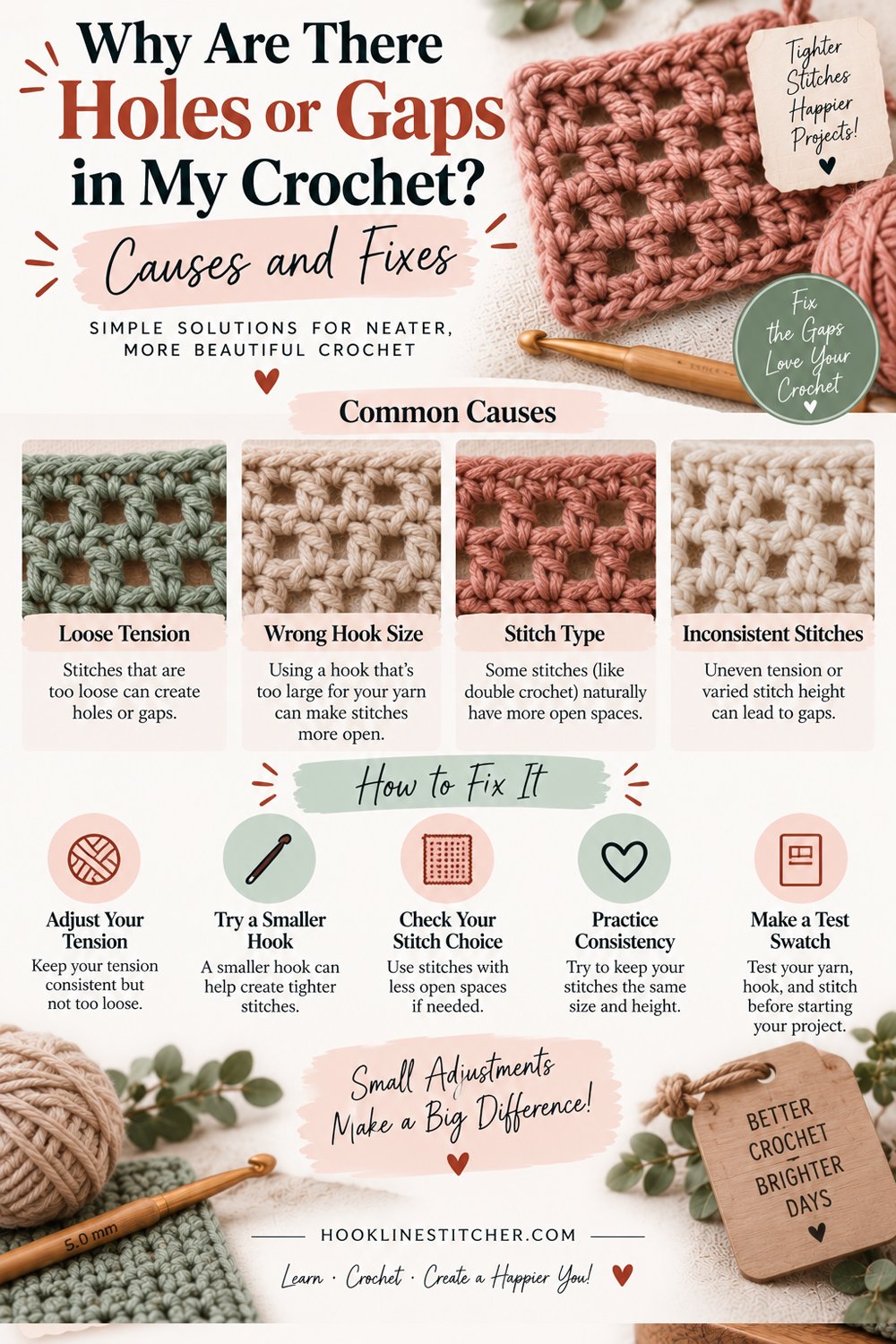
Some holes in crochet are supposed to be there. Others mean something went wrong. Telling the difference is most of the work.
The question people search is “why are there holes in my crochet” — and the useful version of it is where the holes are, because the location tells you the cause almost immediately.
Holes that are supposed to be there
Double crochet and taller stitches are open by nature. Tall stitches leave small regular spaces between them. That’s what gives double crochet its drape, and it’s why blankets are made from it. If you want solid fabric, you want single crochet, not a different technique.
Granny stitch, shell stitch, mesh and lace are built from deliberate gaps. The chain spaces are the pattern — a granny square is mostly holes on purpose.
Amigurumi shows gaps only if the gauge is wrong — there, holes genuinely are a fault, because stuffing shows through.
So: if your holes are small, regular, and evenly spaced across the whole fabric, and you’re working a tall or openwork stitch, nothing is wrong.
Where the holes in my crochet are, and what each location means
| Where the holes are | Cause | Fix |
|---|---|---|
| Everywhere, evenly | Tension too loose | Smaller hook, more friction |
| Vertical line down the edge | Turning chain | Ch 2, don’t count it |
| One large hole, one spot | Missed stitch | Frog back and redo |
| Fuzzy stitch with a gap | Split yarn | Slow down, blunter hook |
| At a colour or ball change | Bad join | Change on the last step of the stitch |
| Small, even, all over, tall stitch | Normal | Nothing |
Cause 1: tension too loose
Where: everywhere, evenly.
The most common cause of unwanted holes. Loose stitches simply don’t sit close enough together.
How to confirm: the fabric is floppy as well as holey, and the piece is coming out larger than the pattern says.
The fix: go down a hook size. Add friction in your yarn hand — wrap the yarn once around your pinky before weaving it through your fingers. That’s usually enough. The Craft Yarn Council hook size chart shows what the next size down is called.
For amigurumi specifically, go one or two sizes below the yarn label, not just one. Dense fabric is the whole requirement.
Cause 2: the turning chain
Where: a vertical line of holes running down one or both edges, one per row.
This is the classic double crochet edge problem, and it catches nearly everyone.
A chain-3 turning chain is slightly narrower than an actual double crochet. If the pattern counts that chain as the first stitch, there’s a small gap where a full-width stitch should be. Repeat over forty rows and you get a visible ladder of holes down the side of a blanket.
How to confirm: the holes are only at the edges, evenly spaced, one per row.
The fix: chain 2 instead of 3, and don’t count it as a stitch. Work a real double crochet into the first stitch of the row. The chain-2 tucks against it and the edge closes up.
Most modern designers do this. If a pattern insists on ch-3 counting, follow the pattern — but for your own projects, ch-2 not counted gives a much better edge.
Cause 3: a missed or skipped stitch
Where: one hole, in one specific place, bigger than the surrounding spaces.
You skipped a stitch. The fabric closes around the gap and leaves a hole roughly twice the normal size.
How to confirm: count the row. If it’s one short, and there’s a single large gap, that’s it.
The fix: frog back to that row and redo it. A skipped stitch also throws your count off, so it’ll cause edge drift if you leave it.
Cause 4: working into the wrong part of the stitch
Where: a row of holes along one horizontal line, or a hole every few stitches.
Two versions:
Working into the chain space instead of the stitch. Common in the first row after a foundation chain, and in patterns with chain-1 gaps. You put the hook into the hole rather than into the top of a stitch, which enlarges the hole.
Splitting the yarn. The hook goes through the middle of a strand rather than under the whole stitch. It leaves a fuzzy, loose-looking stitch with a gap beside it.
How to confirm: look closely at one bad stitch. If yarn fibres are pulled apart, it’s splitting. If the stitch sits in a gap rather than on top of a V, you worked into the space.
The fix: slow down, and aim under both loops of the V. For splitting specifically, a blunter hook helps — sharp-tipped hooks split loosely spun yarn and cotton readily.
Cause 5: joining new yarn badly
Where: one hole where a new ball started.
If you join by knotting and carrying on, the knot pushes the stitches apart and leaves a gap.
The fix: join by working the last stitch of the old yarn up to its final step, then completing that step with the new yarn. Leave 10 cm tails on both and weave them in afterwards — one direction, then back the other way.
Never rely on a knot to hold. Knots work loose, and they show.
Can you fix a hole without frogging?
A single small hole can be closed with a tapestry needle and a length of matching yarn — duplicate the surrounding stitches by hand across the gap. On textured fabric it disappears entirely; on flat fabric it’s visible up close.
A count error can’t be fixed this way, because the problem isn’t the hole, it’s the missing stitch. Frog back.
Edge holes from turning chains can be partly disguised with a border round of single crochet worked evenly along the edge. It doesn’t close them, but it puts a tidy line between them and the outside world.
Preventing them
- Match your hook to what the fabric needs, not to what the label says
- Chain 2 and don’t count it, on your own double crochet projects
- Count every row
- Aim under both loops, deliberately, especially with cotton
- Join new yarn mid-stitch rather than with a knot
- Work in good light
Frequently asked questions
Why does my crochet have holes in it?
Most often tension that’s too loose. Go down a hook size. If the holes are only along the edges, it’s the turning chain; if there’s one large hole, you skipped a stitch.
Are holes in double crochet normal?
Yes. Taller stitches leave small regular gaps, which is what gives double crochet its drape. Use single crochet if you need solid fabric.
Why are there holes down the side of my crochet blanket?
The chain-3 turning chain is narrower than a real double crochet, so counting it as a stitch leaves a gap every row. Chain 2 instead and don’t count it.
Why can I see stuffing through my amigurumi?
The gauge is too loose. Use a hook one or two sizes smaller than the yarn label recommends. It can’t be fixed after the piece is made.
How do I fix a single hole in crochet?
Duplicate the surrounding stitches across the gap with a tapestry needle and matching yarn. If the hole came from a missed stitch, frog back instead — the count is wrong too.
Why does my yarn keep splitting?
Usually a sharp-tipped hook with loosely spun yarn or cotton. Slow down, aim under the whole V, and try a blunter hook.
Cathrinee’s Supply Kit
The beginner basics I recommend
Why are there holes in my crochet?
The usual cause is a hook too large for your yarn, which spaces the stitches too far apart. Gaps can also come from loose tension, from accidentally working into the wrong part of the stitch, or from skipping a stitch without noticing.
How do I get rid of gaps in single crochet?
Go down one hook size and check that you are inserting the hook under both loops of each stitch. Single crochet should produce a dense fabric — if you can see daylight through it, the hook is too big.
Why does my crochet have a gap at the start of each round?
That is the turning chain gap, and it is normal with double crochet worked in joined rounds. You can close it by working the first stitch into the same place as the join, or by using a standing double crochet instead of a chain 3.
Are holes in crochet always a mistake?
No. Mesh bags, lace shawls and market totes are built entirely from deliberate holes. A gap is only a fault when the fabric was meant to be solid — a blanket, an amigurumi, a potholder.
How do I stop stuffing showing through amigurumi?
Use a hook one or two sizes smaller than the yarn label suggests. Amigurumi is worked deliberately tight so the fabric can contain the fibrefill. If you can see white between the stitches, no amount of careful stuffing will fix it — the hook has to come down.


4 Comments on “Why Are There Holes or Gaps in My Crochet? Causes and Fixes”