You followed the pattern exactly. Same yarn, same hook, same stitch count. Your hat fits a melon.
This confuses beginners more than almost anything, because it feels like the pattern lied. It didn’t. What happened is gauge — and crochet gauge explained properly takes about five minutes, after which the whole thing stops being mysterious.
What gauge actually is
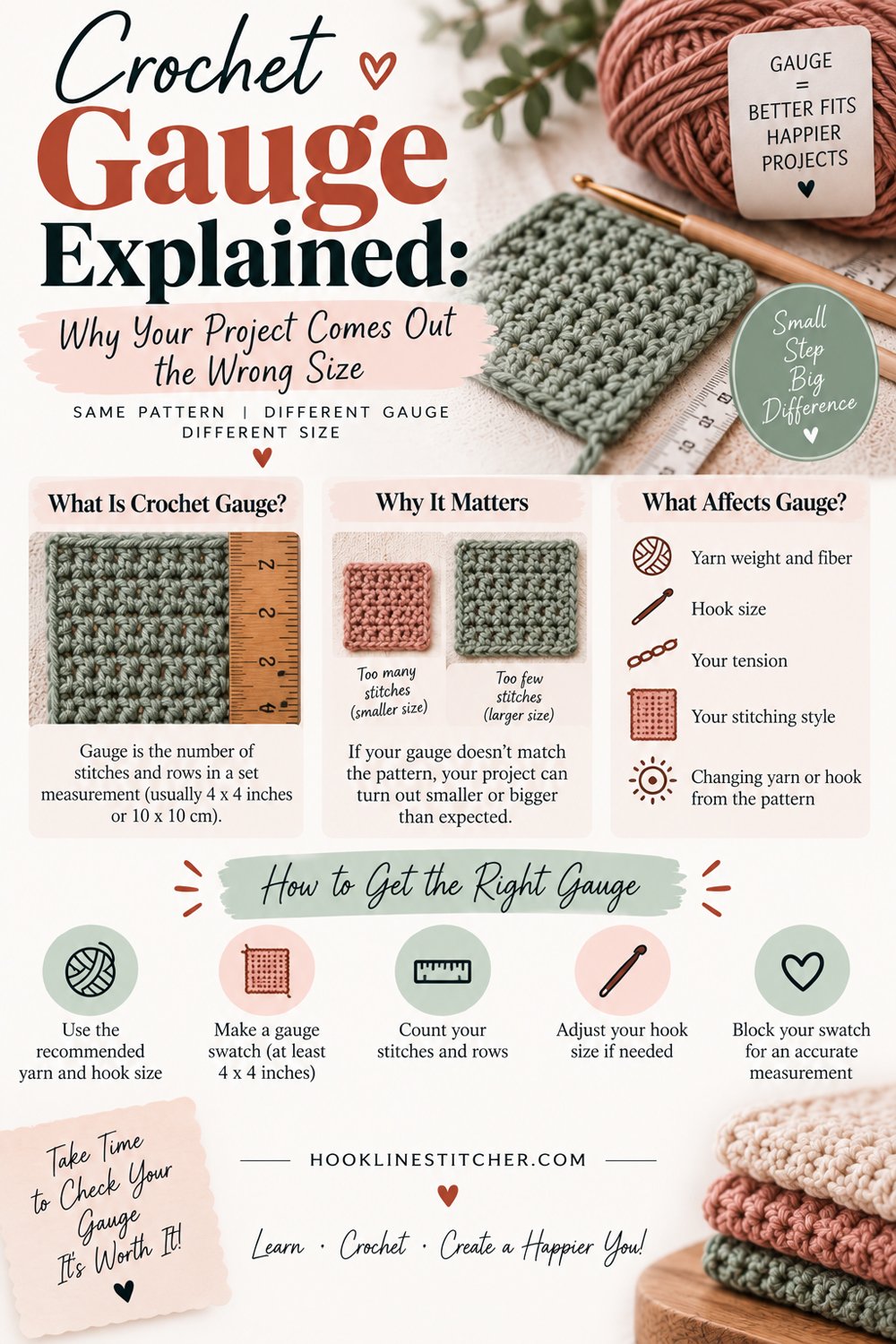
Gauge is how many stitches and rows you get in a given measurement — usually a 10 cm square.
A pattern might say: 16 sc and 18 rows = 10 cm on a 5.0mm hook.
That’s the designer telling you how big their stitches were. If your stitches are a different size, your finished object will be a different size, even though you followed every instruction correctly.
Why does it differ between people? Because tension is personal. Two people with the same hook and yarn will produce different-sized stitches based on how tightly they hold things. It’s not a skill difference — it’s a hand difference, and it persists no matter how experienced you get.
This is also why patterns specify a hook only as a starting point. The instruction is really “use whatever hook gets you to this gauge.” The Craft Yarn Council yarn weight system lists the gauge range each yarn weight is expected to produce, which is a useful sanity check.
How to measure it
Make a swatch bigger than you need. At least 15 cm square, which usually means chaining about 20 stitches and working 20 rows for worsted weight.
Why bigger? Because the edges of any piece behave differently from the middle. A 10 cm swatch is all edge.
Block it first if you’ll block the final piece. Blocking changes measurements, sometimes significantly, and measuring an unblocked swatch for a project you’ll block gives you a wrong number.
Lay it flat. Don’t stretch it, don’t hold it up, don’t pin it tight. Flat on a table, relaxed.
Measure the middle. Place a ruler across the centre and count how many stitches fall within 10 cm. Count the partial stitches at the edges as fractions — if there are 15 and a half stitches in 10 cm, that’s your number.
Do the same vertically for rows.
Crochet gauge explained: what to do when yours is off
The maths is simple.
Too many stitches in 10 cm — your stitches are smaller than the designer’s, so your project will come out too small. Go up a hook size.
Too few stitches in 10 cm — your stitches are bigger, so the project will be too large. Go down a hook size.
One hook size typically changes gauge by about one stitch per 10 cm. If you’re three stitches off, expect to change by two or three sizes. That feels wrong and it’s correct — using a 3.5mm where a pattern says 5.0mm is entirely normal if that’s what matches gauge.
Don’t try to fix gauge by crocheting differently. Deliberately working looser or tighter than your natural tension is unsustainable — you’ll drift back within twenty rows, and the piece will have two different gauges in it. Change the hook instead.
Row gauge matters less than stitch gauge, most of the time. Many patterns are worked to a length rather than a row count, so if your stitch gauge is right and your row gauge is slightly off, carry on and measure as you go.
When gauge genuinely doesn’t matter
Being honest about this saves a lot of unnecessary swatching.
It doesn’t matter for: scarves, blankets, dishcloths, coasters, bags, baskets, garland, ornaments, most home items. Anything where “a bit bigger or smaller” is fine.
It matters somewhat for: hats, headbands, mitts. Things that need to fit a body part but have some stretch and some tolerance.
It matters a great deal for: garments, fitted items, anything with sleeves, and amigurumi.
Amigurumi surprises people on that list, because the size of the finished toy genuinely doesn’t matter. But the fabric density does — too loose and stuffing shows through, which can’t be fixed afterwards. So for amigurumi the swatch isn’t about size, it’s about whether the fabric is solid.
The honest advice about swatching
Nobody enjoys it. Most beginners skip it. Here’s the sensible middle ground.
Skip the swatch for scarves, blankets, dishcloths and home items. Just start, and check the width after five rows against what the pattern predicts. If it’s badly off, you’ve lost five rows.
Swatch properly for anything fitted, anything expensive, and anything that takes more than about ten hours. An hour of swatching against forty hours of blanket is good arithmetic.
For amigurumi, work the first three rounds and hold them up to the light. If you can see through them, change hook and restart. That’s a thirty-second swatch and it’s the only one that matters.
Things that change your gauge without you noticing
Stress and rushing. Tension tightens when you’re working against a deadline. This is why the gauge on a project started in October differs from the same project finished in December.
Long breaks. Pick a project up after three weeks and your gauge will have drifted. On a blanket this shows as faint horizontal banding.
Different yarn of the same weight. “Worsted weight” covers a range. Two worsted yarns from different brands can give noticeably different gauges.
Which hook you’re using. Ergonomic hooks change how hard you grip, and so change gauge. If you switch hooks mid-project, expect a change.
Where you are. People crochet looser in front of the television and tighter at a table. It’s real, and it’s another reason to make projects in consistent conditions when gauge matters.
Frequently asked questions
What is gauge in crochet?
How many stitches and rows you get in a measured area, usually 10 cm. It determines the finished size of anything you make.
How do I measure crochet gauge?
Make a swatch at least 15 cm square, block it if you’ll block the final piece, lay it flat without stretching, and count how many stitches fall within 10 cm in the middle.
Why is my crochet coming out the wrong size?
Your gauge differs from the designer’s. Too many stitches per 10 cm means your project will be too small — go up a hook size. Too few means it’ll be too large — go down.
Do I have to use the hook size the pattern says?
No. The hook is a starting suggestion. Use whichever hook gets you to the stated gauge.
When can I skip the gauge swatch?
For scarves, blankets, dishcloths, coasters, bags and baskets, where size is flexible. Swatch for anything fitted, anything expensive, and anything that takes many hours.
Does gauge matter for amigurumi?
Yes, but for density rather than size. If the fabric is loose enough to show stuffing, the toy is spoiled and it can’t be corrected afterwards.
Can I fix gauge by crocheting tighter or looser?
Not reliably. You’ll drift back to your natural tension within twenty rows. Change the hook size instead.
Cathrinee’s Supply Kit
The beginner basics I recommend
What is crochet gauge?
Gauge is the number of stitches and rows that fit into a set measurement, usually 4 inches. It is how a pattern tells you what size its stitches were, so you can match them and get the same finished dimensions.
How do I make a gauge swatch?
Crochet a square at least 6 inches wide in the pattern stitch, then measure the middle 4 inches and count the stitches and rows inside it. Measuring the middle matters — the edges are always distorted.
What if my gauge does not match the pattern?
If you have more stitches than the pattern says, your tension is tight — go up a hook size. If you have fewer, go down a size. Change the hook, never your natural tension, because forced tension never holds for a whole project.
Do I really need to make a gauge swatch?
For anything that has to fit — hats, garments, slippers, bags — yes. For blankets, scarves and dishcloths you can skip it, because being an inch out changes nothing. The swatch costs twenty minutes and saves whole projects.
Does gauge change after washing?
It can, especially with cotton and wool, which relax or shrink. If the finished item will be washed regularly, wash and dry your swatch before measuring it so your gauge reflects the fabric as it will actually live.


2 Comments on “Crochet Gauge Explained: Why Your Project Comes Out the Wrong Size”