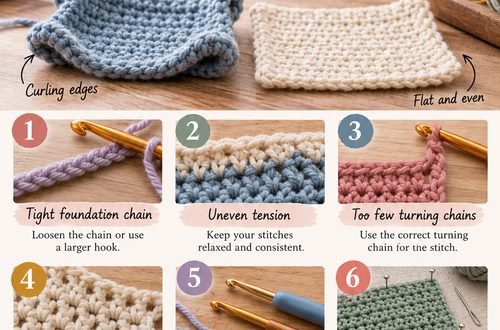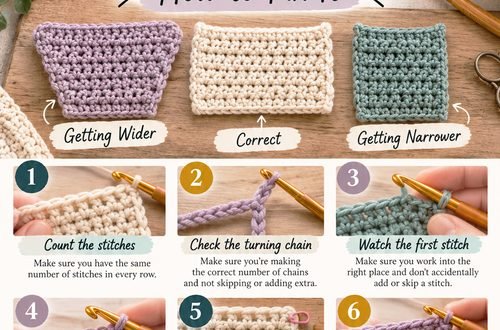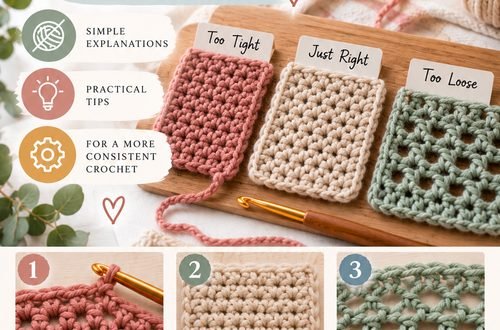
Splitting is the problem beginners most often blame on themselves, and it’s the one least likely to be their fault.
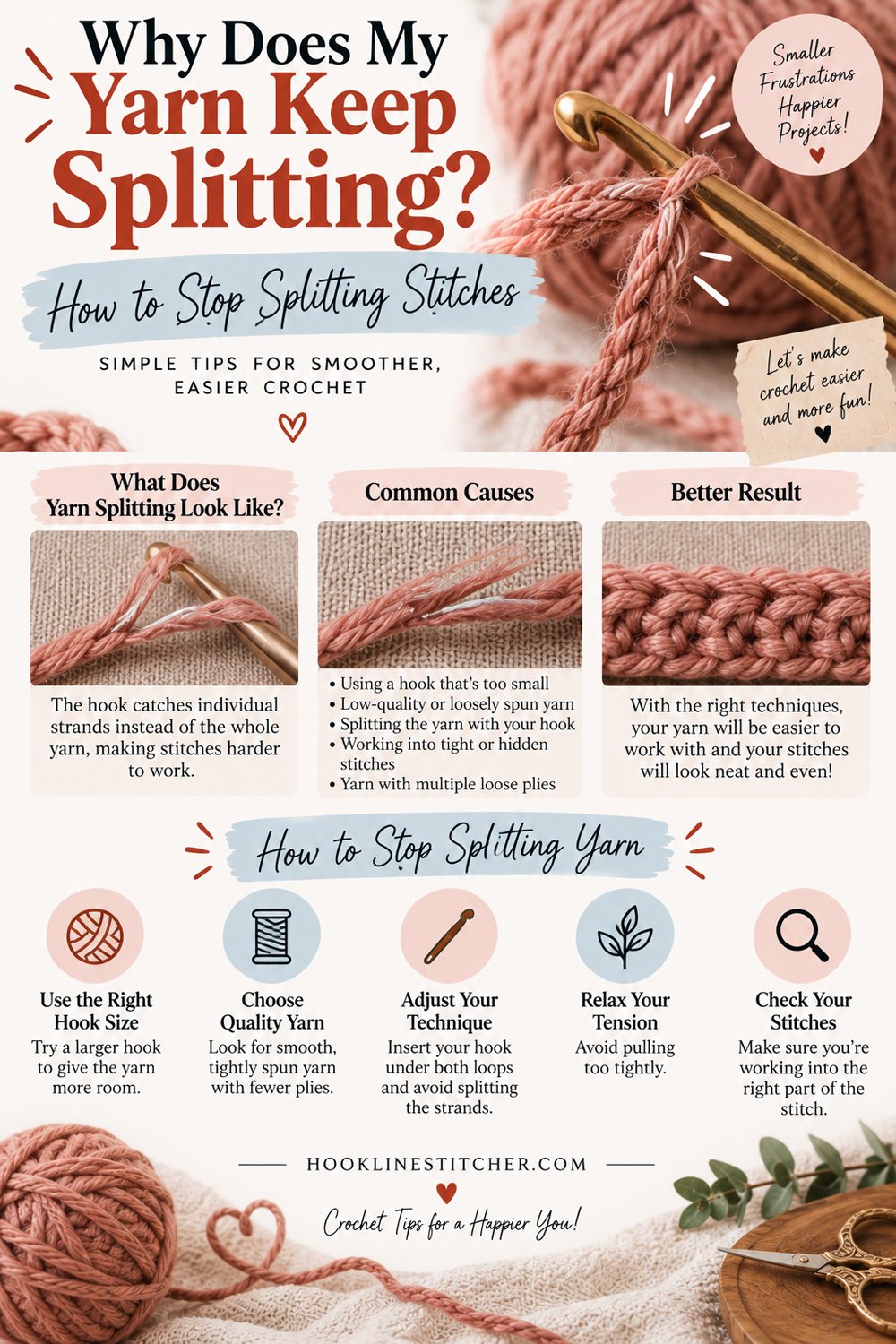
A split stitch happens when your hook passes through a strand of yarn rather than under the whole stitch. The result is a fuzzy, loose-looking stitch with a gap beside it, and a small tuft of fibre sticking out.
It feels like clumsiness. So when you ask why does my yarn keep splitting, the honest answer is usually equipment rather than technique.
Why does my yarn keep splitting? Quick diagnosis
| What’s happening | Cause | Fix |
|---|---|---|
| Splits with one hook, not another | Hook tip shape | Use the blunter hook |
| Splits on one yarn, not others | Loosely spun or cotton yarn | Change yarn, or slow down |
| Splits when you’re distracted | Speed and attention | Slow down, better light |
| Splits and the hook won’t go in | Tension too tight | Loosen, or go up a size |
Cause 1: the hook tip
The biggest factor by a distance, and almost nobody mentions it.
Crochet hooks come with different tip shapes, and they behave very differently.
Pointed, tapered tips slide into tight stitches easily, which is genuinely useful. They also slide straight into the middle of a yarn strand, which is not.
Rounded, blunt tips push fibres aside rather than piercing them. Much harder to split with, slightly harder to insert into tight work.
How to confirm: if you split constantly with one hook and rarely with another in the same yarn, it’s the hook. Try it — most people own two brands without realising they’re differently shaped.
The fix: use a blunter hook for splitty yarn. If you only own pointed ones, this is the single most worthwhile hook purchase you’ll make. The Craft Yarn Council hook size chart is useful for matching sizes across brands, since letter and millimetre labels don’t always agree.
Cause 2: the yarn
Some yarns split because of how they’re made.
Loosely spun yarn splits easily. The plies aren’t twisted tightly, so there’s space between them for a hook to enter.
Cotton splits more than acrylic. Cotton fibres are short and the plies separate readily.
Multi-ply yarn with four or more plies splits more than a tightly twisted two-ply.
Mercerised cotton splits noticeably less — the treatment tightens the twist. If you’re making something in cotton and splitting constantly, mercerised is worth the small extra cost.
How to confirm: you split with every hook on one yarn and with none on another.
The fix: change yarn, or accept it and slow down. There’s no technique that makes loosely spun cotton behave like tightly spun acrylic.
Cause 3: how you’re aiming
The part that is about you, and it’s straightforward.
Aim under both loops of the V, at the base of them. Not into the middle of the strand, not at the very top edge. The hook should slide into the open space under the V. If your hook hold feels awkward in the first place, how to hold a crochet hook and yarn is the place to start.
Two things make this harder:
Going too fast. Splitting is overwhelmingly a speed problem. Slowing down by ten percent eliminates most of it.
Not looking. A lot of crochet happens with half an eye on a screen. That’s fine for plain rows in acrylic; it’s not fine for cotton.
Cause 4: tension too tight
Tight stitches close up, leaving no space for the hook to enter cleanly. So the hook takes the only route available — through the yarn.
How to confirm: you’re also struggling to insert the hook at all, and the fabric feels stiff.
The fix: loosen your grip, or go up a hook size. This also fixes several other problems at once.
Can you fix a split stitch after the fact?
If it’s in the current row: undo back to it and redo. Thirty seconds.
If it’s a few rows down and visible: you can often tease the split fibres back together with a tapestry needle and work them into place. On textured fabric it vanishes completely.
If it’s a few rows down and not obvious: leave it. A single split stitch in a blanket is not worth forty minutes.
If it’s in amigurumi: fix it. Split stitches leave gaps, gaps show stuffing, and small pieces are unforgiving.
Preventing it
- Use a blunt-tipped hook for cotton and loosely spun yarn
- Slow down. The most effective change available to you
- Work in good light. You can’t aim at what you can’t see
- Use light-coloured yarn while learning. Dark yarn hides the V entirely
- Loosen your tension. Tight stitches leave no space to aim at
- Consider mercerised cotton for anything where it matters
The reassuring part
Splitting is the crochet problem that most strongly correlates with materials rather than ability. Experienced crocheters split yarn too — they’ve just quietly learned which hooks and yarns to avoid.
If you’re splitting constantly on your third project, you haven’t failed to learn something. You’re probably using a pointed hook with cheap cotton, which would frustrate anyone.
Frequently asked questions
Why does my crochet hook keep splitting the yarn?
Most often the hook tip. Pointed, tapered tips pierce yarn strands; rounded, blunt tips push fibres aside. Try a different hook before assuming it’s technique.
What hook is best for yarn that splits?
A blunt, rounded tip. They’re harder to insert into tight stitches but far less likely to split the yarn.
Why does cotton yarn split so much?
Cotton fibres are short and the plies separate more readily than wool or acrylic. Mercerised cotton has a tighter twist and splits noticeably less.
How do I stop splitting stitches in crochet?
Use a blunter hook, slow down, work in good light, and aim under both loops of the V rather than at the strand itself.
Is splitting yarn a beginner mistake?
Not really. It correlates far more with hook shape and yarn construction than with skill. Experienced crocheters avoid it mainly by knowing which materials to avoid.
Can I fix a split stitch?
In the current row, undo and redo it. Further back, tease the fibres together with a tapestry needle, or leave it — a single split stitch in a blanket isn’t worth the time.
Cathrinee’s Supply Kit
The beginner basics I recommend
Why does my yarn keep splitting?
Yarn splits when the hook goes between the plies instead of under them. It happens most with loosely spun yarn, with cotton, and with hooks that have a sharp pointed head. It is a tooling and technique issue, not a sign you are doing something wrong.
Which hook stops yarn splitting?
A hook with a rounded, tapered head rather than a sharp inline one. Inline hooks like Susan Bates dig in more; rounded hooks like Boye slide under the plies. If your yarn splits constantly, changing hook brand often solves it on its own.
Which yarn splits the least?
Tightly spun, smooth yarns with a higher ply count. Mercerised cotton and smooth acrylic behave well. Loosely spun single-ply yarns, chenille and cotton with low twist split the most, so avoid those while you are learning.
How do I stop splitting the yarn with my hook?
Slow down and aim the hook head under both loops rather than into the middle of them, and keep a little tension on the working yarn so the plies stay together. Most splitting happens when the yarn is slack and the hook is moving fast.
Can I fix a project where the yarn has split?
Small splits usually disappear once the fabric is worked and washed. A badly split stitch that shows can be teased back together with a yarn needle. If it has split the yarn nearly through, cut it out and rejoin rather than risk a break later.