Counting is the least glamorous skill in crochet and the one that prevents the most problems.
Nearly every beginner failure — rows that widen, circles that ruffle, amigurumi that comes out lopsided — is a counting failure wearing a costume. And nearly every one of them could have been caught in eight seconds at the end of the row where it happened.
The trouble is that how to count crochet stitches isn’t as obvious as it sounds. Several things look like stitches and aren’t.
How to identify a stitch
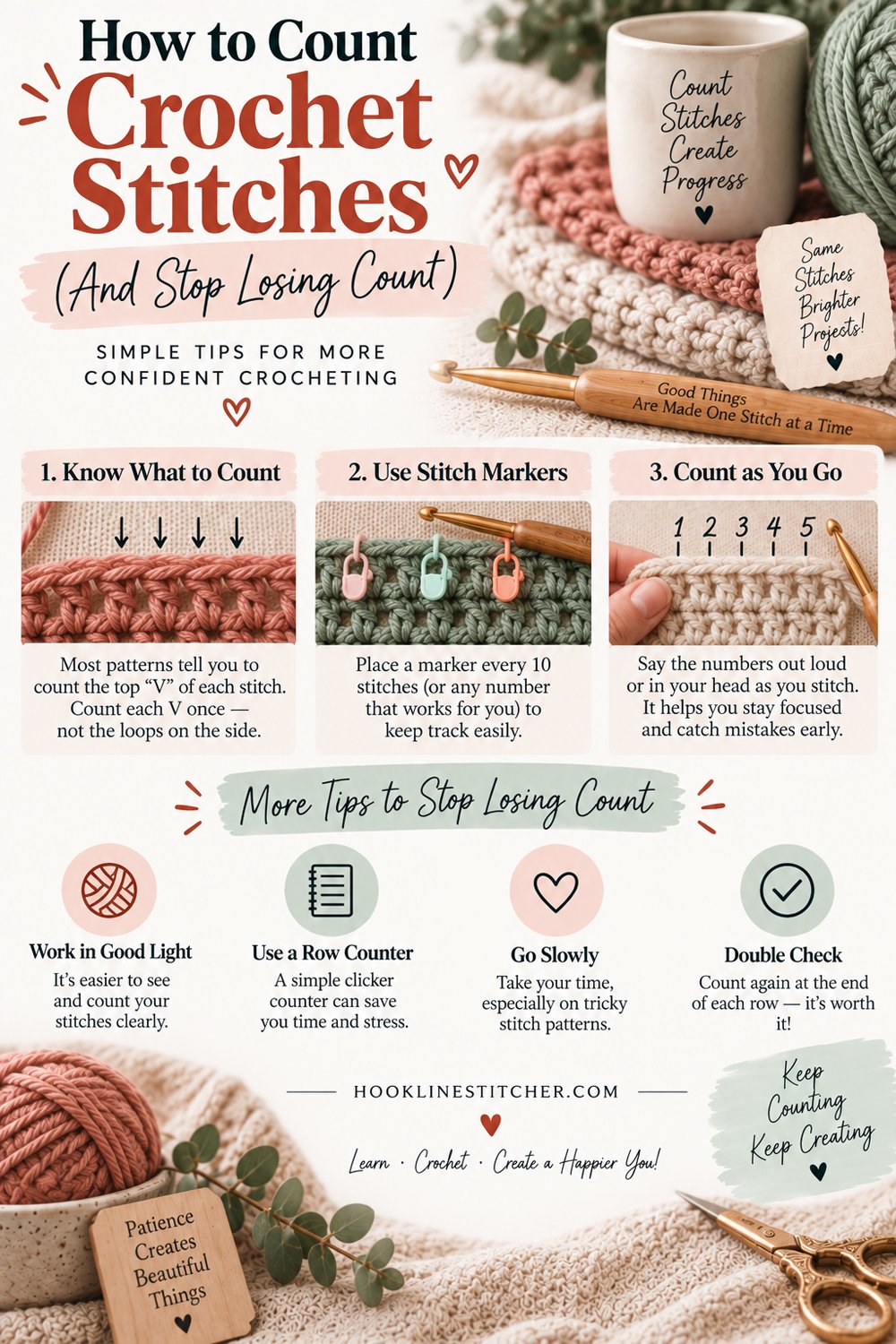
Every completed crochet stitch has a V across the top — two loops side by side forming a small chevron. One V equals one stitch. That’s what you’re counting.
To count a row: lay the work flat, look at the top edge, and count the Vs from one end to the other.
Three things that are NOT stitches:
The loop on your hook. It’s a live loop, not a finished stitch. Never counted.
The slip knot. It’s an anchor. Never counted, in any circumstance.
The turning chain — usually. In single crochet, the ch-1 is height only and is never a stitch. In double crochet it depends on the pattern: “ch 3 (counts as first dc)” means it is one; a plain “ch 3, turn” usually means it isn’t.
That third one causes most of the confusion, and the answer is always in the pattern. Read it once at the start and hold to it.
How to count crochet stitches in a foundation chain
Lay the chain flat with the front facing you. Count the Vs, starting from the one just below your hook and working down toward the slip knot.
Don’t count the loop on the hook. Don’t count the slip knot.
If a pattern says “chain 20,” you want 20 Vs.
For long chains, use markers. Place one every 20 chains as you go. On a 180-chain blanket foundation, losing your place and recounting from the beginning is genuinely demoralising, and markers cost nothing.
Counting rows
Count the Vs along the top edge of your current row. That’s your stitch count.
Do it at the end of every row while you’re learning. Eight seconds. If the number matches the row before, carry on. If it doesn’t, you’ve caught the error one row after it happened rather than twenty.
Counting rows — as opposed to stitches — is different. Look at the side edge of the piece. Each row shows as a horizontal bar or a small bump along the edge. Count those. For taller stitches, count the stitches themselves stacked up the side.
If you’re likely to need a row count later — matching two pieces, following a pattern that says “repeat until 40 rows” — put a marker every ten rows as you go. Counting forty rows after the fact is unreliable.
Counting rounds
Two situations, and they’re quite different.
Joined rounds — you slip stitch to close each round. There’s a visible seam line, so you always know where a round begins. Count the stitches between one join and the next. This is how a granny square works.
Continuous spirals — used in amigurumi. You never join and there is no seam. There is no way to tell where a round starts by looking. This is not a skill you develop; the information genuinely isn’t there.
So in spirals, the marker isn’t optional. Put one in the first stitch of every round and move it up as you begin the next. Every experienced amigurumi maker does this.
What to use as a marker
- Proper stitch markers — the little plastic locking ones. Cheap, and they don’t fall out.
- A safety pin — works fine.
- A scrap of contrasting yarn — thread it through the stitch and leave the ends hanging. Free, and for long projects arguably better, because it can’t snag.
- A paperclip — works, but it snags on some yarns.
Don’t use a split ring marker on crochet if you can avoid it; they slip out of stitches more easily than locking ones.
The habits that actually prevent problems
Marker in the first stitch of every row or round. The single most useful habit in crochet. It tells you where the row begins, which means you can’t miss the first stitch — and it tells you where the row ends on the way back.
Count at the end of every row. While learning, every row without exception. Later, every few rows on anything where the count matters.
Count before you put it down. Stopping mid-row is how people lose their place. If you must stop mid-row, put a marker in your working loop so you know which direction you were going.
Note your row number when you stop. Write it on your phone. “Row 23, 30 sts.” Takes three seconds and saves ten minutes of counting when you come back.
Work in good light. A large share of miscounts are simply not-seen stitches.
Use light, smooth yarn while learning. You cannot count what you cannot see, and dark or fuzzy yarn makes the Vs genuinely hard to distinguish. A smooth worsted weight is the easiest thing to learn on — the Craft Yarn Council yarn weight system explains what the numbers on the label mean.
When you’ve lost count entirely
It happens. Here’s the order to try things.
1. Count what you have. Compare it to the pattern. If your current round has 24 stitches and the pattern has a round with 24, you’re probably there.
2. Look at the shape. A circle that’s clearly mid-increase is a different place from one that’s been worked straight for a while.
3. Count rows from a known point. If you know round 5 ended at 30 stitches and you’ve worked six rows since, you’re at round 11.
4. Rip back to somewhere identifiable. The last colour change, the last increase round, the point where the shape changed. Losing four rows is annoying; guessing wrong and discovering it fifteen rows later is worse.
5. On amigurumi, rip back further than feels necessary. Small pieces distort fast, and a guess that’s one round off is visible in the finished toy.
Frequently asked questions
How do you count crochet stitches?
Count the V shapes along the top edge of your work. Don’t count the loop on your hook, and don’t count the slip knot.
Does the turning chain count as a stitch?
In single crochet, never. In double crochet it depends on the pattern — “ch 3 (counts as first dc)” means yes, a plain “ch 3, turn” usually means no.
Do you count the loop on the hook as a stitch?
No. It’s a live loop, not a finished stitch.
How do you count rows in crochet?
Look at the side edge of the piece and count the horizontal bars, one per row. For a long project, place a marker every ten rows as you work.
Do I need stitch markers for crochet?
For amigurumi worked in a continuous spiral, yes — there’s no seam, so there’s genuinely no other way to know where a round starts. For rows, a marker in the first stitch prevents the most common beginner error.
How do I stop losing count in crochet?
Mark the first stitch of every row or round, count at the end of every row, and note your row number whenever you put the project down.
Why do I keep losing my place in amigurumi?
Spiral rounds have no seam to mark where they begin. This is the technique’s one weakness and a stitch marker is the only solution.
Cathrinee’s Supply Kit
The beginner basics I recommend
How do I count crochet stitches?
Look at the top of your work for the row of small Vs — each V is one stitch. Count them left to right without including the loop on your hook. For taller stitches you can also count the vertical posts along the row.
Where is the first stitch of a crochet row?
For single crochet it is the stitch directly below your chain 1. For double crochet, the chain 3 counts as the first stitch, so your first real stitch goes into the second V. Getting this wrong is the single most common cause of uneven edges.
Do I count the loop on my hook as a stitch?
No. The loop on your hook is the working loop, not a stitch. Counting it is a very common beginner mistake and it makes every row appear one stitch longer than it is.
How do I keep count in a crochet round?
Place a stitch marker in the first stitch of every round and move it up as you begin each new round. Rounds worked as a continuous spiral have no join to count from, so without a marker there is no reference point at all.
How often should I count my stitches?
Every row while you are learning, then every few rows once your edges are reliable. For anything worked in rounds, count at the end of every round — errors in rounds compound much faster than errors in rows.


7 Comments on “How to Count Crochet Stitches (And Stop Losing Count)”