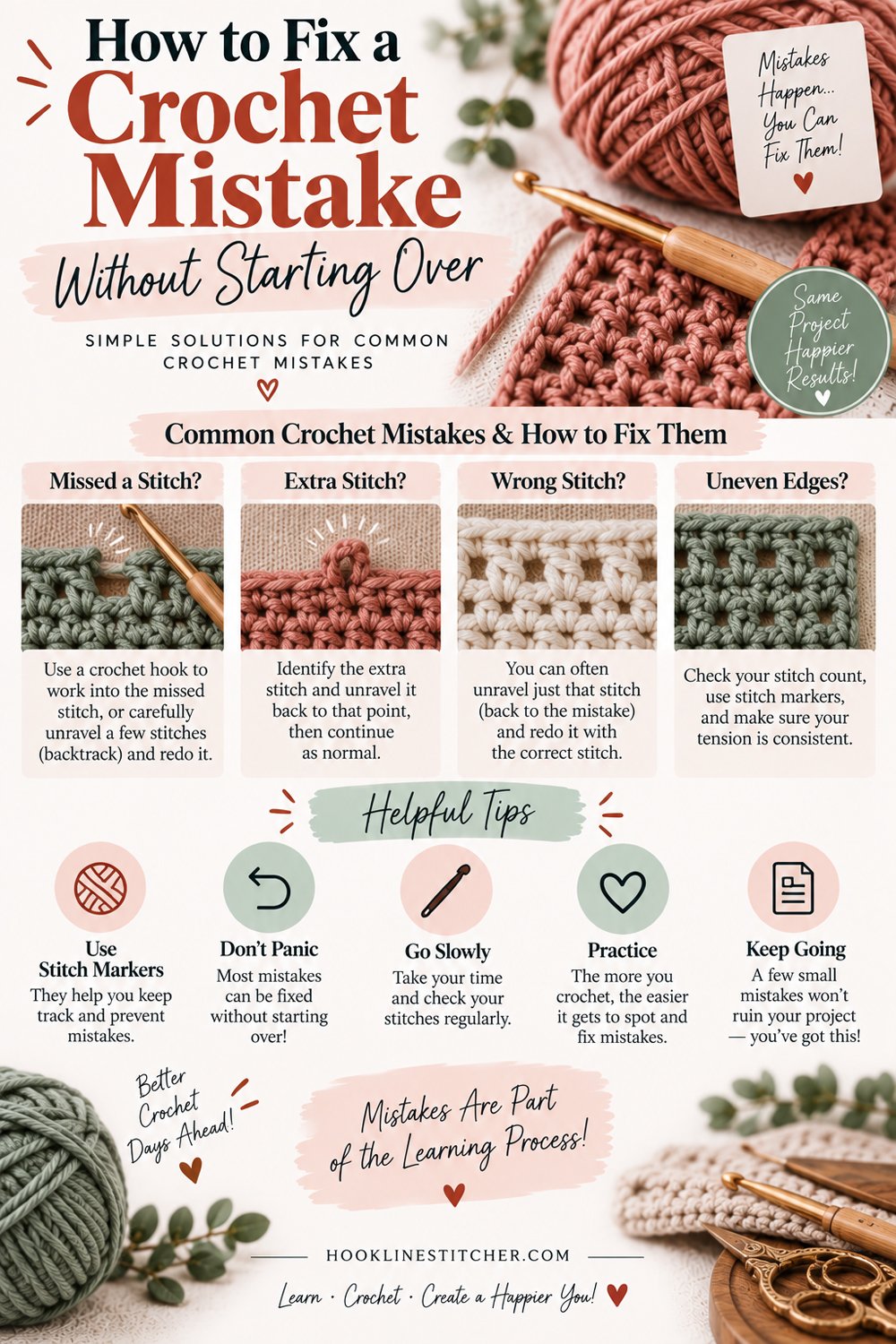
The good news about crochet mistakes is structural: crochet does not unravel on its own.
Knitting has an entire row of live stitches waiting to escape. Crochet has exactly one live loop. Drop it and nothing happens — the work sits there, intact, until you pick it up again. That single fact makes crochet far more forgiving to fix than most people assume.
So almost nothing requires starting over. Below is how to fix a crochet mistake without damaging the yarn, and how to decide what’s worth fixing at all.
First: does it need fixing at all?
Genuinely worth asking, especially early on.
Fix it if: the stitch count is wrong, the shape is affected, it’s in a visible place on something you’ll give away, or it’ll compound — a miscount in round 3 of a circle distorts every round after it.
Leave it if: it’s a single slightly uneven stitch, it’s on the inside of an amigurumi, it’s on a first project, or it’ll be hidden in assembly.
Beginners rip back far more than they need to. A slightly uneven stitch on your third dishcloth is not worth forty minutes. Finishing things matters more than perfecting them, especially in the first few months.
Undoing a few stitches
Called tinking — knitting backwards, sort of.
Pull the loop off your hook and gently tug the working yarn. The last stitch undoes. Repeat as many times as you need, putting the hook back in when you’re done.
Go one stitch at a time and pull gently. Yanking hard can tighten a knot into the yarn.
Good for anything within the current row.
Undoing whole rows
Called frogging — because you rip it, rip it.
Take the hook out. Pull the working yarn steadily, and the row unravels. Keep going until you reach the row you want.
Do it slowly. Fast frogging tangles the yarn as it comes free, and untangling costs more time than the careful version saved.
Stop one row before you think you should. It’s easier to see clearly from a complete row than from a half-undone one.
Put the hook back in properly. Insert it into the live loop from front to back, the same way it sat before. A twisted re-insertion gives you one odd stitch that you’ll notice later.
Count before you continue. Confirm you’re where you think you are.
How to fix a crochet mistake several rows down
This is the situation people assume means starting over. Usually it doesn’t.
If the mistake is cosmetic — a slightly wrong stitch, a small gap — leave it. Honestly. Nobody but you will find it.
If the mistake affects the count, you have two options.
Option 1: frog back to it. Tedious, and it’s the reliable answer. Rip back to the row above the error, fix it, and rework. On a wide piece this hurts, but it’s correct.
Option 2: compensate. If you’re twenty rows past and the error is one stitch, you can add or remove a stitch at the edge to bring the count back.
Be honest with yourself about this one. It leaves a visible step in the edge. It’s acceptable on something that’ll be seamed or bordered, and not acceptable on a scarf where both edges show.
For a dropped or split stitch in the middle of the fabric: you can sometimes fix it with a tapestry needle and a length of matching yarn, duplicating the stitch by hand. Fiddly, and on textured fabric it disappears completely. Worth trying before frogging twenty rows.
Fixing amigurumi
Stricter rules here, because small pieces distort fast.
Before stuffing: frog back. A miscount in a round of 18 is visible in the finished toy, and there’s no bordering or blocking to hide it.
After stuffing and closing: you’re generally committed. Take the stuffing out and frog only if the piece is genuinely unusable.
If a limb is sewn on crooked: unpick the sewing, not the crochet. Two minutes, and it’s the fix for most assembly problems. Everyone repositions ears at least once — see amigurumi problems and fixes for the rest.
Looking after the yarn
Frogged yarn comes out crinkled, especially cotton and anything tightly spun. Working with crinkly yarn gives uneven tension.
For a small amount: just work with it. The crinkle relaxes into the new stitches.
For a lot: wind it into a loose ball and leave it overnight. Most of the crinkle drops out.
For a whole project’s worth: wind it into a loose skein, dampen it, hang it with a light weight, and let it dry. It comes back almost new.
Don’t frog acrylic aggressively. It pills where it rubs against itself, and heavily frogged acrylic looks fuzzy in a way that doesn’t recover.
When starting over is right
Rare, but real.
The gauge is wrong for the whole piece. If your tension means the blanket will be half a metre too narrow, no amount of fixing helps. Better to know at row ten than row two hundred — the Craft Yarn Council yarn weight system is worth checking before you commit to a substitute yarn.
The yarn is wrong. Acrylic for a pot holder, soft yarn for a basket. These are materials problems and no technique rescues them.
It’s your first attempt at something and you’ve learned a lot. A second attempt with what you now know is often faster and much better than repairing the first. This isn’t failure — it’s the normal way skills are built.
Preventing the situation
- Count at the end of every row or round
- Marker in the first stitch
- Check the piece every few rows — lay it flat and look at it
- Note your row number when you stop
- Catch problems early. A mistake found one row later costs one row
Frequently asked questions
Will crochet unravel if I drop the loop?
No. Crochet has only one live loop, and dropping it does nothing. The work stays intact until you pull the working yarn deliberately.
What does frogging mean in crochet?
Pulling out rows of crochet by tugging the working yarn. The name comes from “rip it, rip it.”
How do I undo just a few crochet stitches?
Take the loop off your hook and gently tug the working yarn one stitch at a time. Pull gently — yanking can tighten a knot into the yarn.
Can I fix a crochet mistake several rows back without ripping it out?
Sometimes. A cosmetic error can be left or duplicated over with a tapestry needle. A count error usually needs frogging back, though you can compensate at the edge if the piece will be seamed or bordered.
Can I reuse frogged yarn?
Yes. Wind it loosely and leave it overnight to relax, or dampen and hang it with a light weight for a full project’s worth. Acrylic pills if frogged repeatedly.
Should I fix every crochet mistake?
No. Fix anything that affects the stitch count or the shape. Leave single uneven stitches, hidden areas, and anything on an early practice project.
How do I fix a crooked amigurumi limb?
Unpick the sewing, not the crochet, and reposition it. Everyone repositions ears at least once.
Cathrinee’s Supply Kit
The beginner basics I recommend
How do I fix a crochet mistake without starting over?
Pull back only to the row containing the error rather than unravelling the whole piece. Slide your hook out, pull the working yarn gently to undo stitches one at a time, then put the hook back into the last good loop and carry on.
What is frogging in crochet?
Frogging means pulling out your work to undo it — named because you “rip it, rip it”. It sounds destructive but it is a normal part of crochet, and every experienced crocheter does it regularly.
How do I fix a mistake several rows down?
If it is a single missed or extra stitch, you can often leave it and compensate on the next row, or sew it closed with a yarn needle afterwards. For anything structural, pull back to that row — it is faster than trying to patch it.
How do I stop my crochet unravelling while I fix it?
Put a locking stitch marker or a spare hook through the working loop before you pull anything out. That stops the unravelling exactly where you want it and saves you undoing more than you meant to.
Should I fix every crochet mistake?
No. A single stitch out of place in a blanket will never be noticed. Fix mistakes that affect the shape, the fit, or the stitch count. Leave the ones that are only visible when you go looking for them.