
There are hundreds of crochet stitches. To get started, you need seven — and these easy crochet stitches for beginners will carry you through almost every pattern you’ll meet in your first two years.
That isn’t a simplification to make learning feel smaller. Almost every beginner crochet pattern is built from a handful of basic stitches, and the elaborate-looking ones — shells, bobbles, granny clusters — aren’t new stitches at all. They’re arrangements of the basic ones. A shell is five double crochets worked into the same place. A granny stitch is three double crochets with a gap beside them.
So the list below isn’t seven things to memorise. It’s four genuine stitches and three ways of using them, ordered so that each one builds directly on the one before.
Learn them in this order, and by the end you’ll be able to read most beginner patterns without looking anything up.
What makes a crochet stitch easy for beginners?
It’s worth knowing what “easy” actually means here, because it changes how you judge your own progress.
An easy stitch has few steps, a clear place to put your hook, and a result you can see. The chain stitch is one movement repeated. Single crochet is two short steps. Double crochet adds one step at the start and one at the end.
What makes crochet feel hard to beginners usually isn’t the stitch at all. It’s tension — how tightly you hold the yarn and hook — and counting, knowing where each row starts and ends. Both improve with practice regardless of which stitch you’re working.
So if a stitch feels difficult, it’s often not the stitch. It’s that your hands are still learning to hold everything. That settles within a couple of weeks, and every stitch on this list gets easier at the same time. If your hands feel awkward, start with how to hold a crochet hook and yarn.
Before you start: US and UK crochet terms
This trips up more beginners than any actual technique, so it’s worth thirty seconds now.
Crochet uses two naming systems, and they overlap in an unhelpful way — the same name means different stitches depending on which country the pattern came from.
| US name | UK name | Abbreviation (US) |
|---|---|---|
| Chain | Chain | ch |
| Slip stitch | Slip stitch | sl st |
| Single crochet | Double crochet | sc |
| Half double crochet | Half treble | hdc |
| Double crochet | Treble | dc |
| Treble crochet | Double treble | tr |
The stitches themselves are identical. Only the labels shift.
Everything on this site uses US terms, which is what most online patterns and video tutorials use. If you’re ever unsure which system a pattern follows, look for the phrase “single crochet” — if it appears anywhere, the pattern is US.
What you need to practise
Keep this simple. The wrong materials make easy crochet stitches look hard.
A 5.0mm hook. Big enough to see what you’re doing, small enough to feel normal in your hand.
Smooth worsted weight yarn in a light colour. This matters more than people expect. Dark yarn hides the top of each stitch, fuzzy yarn blurs it, and slippery yarn fights your tension. A beginner practising with black eyelash yarn isn’t struggling because they’re bad at crochet — they genuinely can’t see the stitches.
A stitch marker, or a scrap of contrasting yarn. You’ll use it from stitch two onward.
Cathrinee’s Supply Kit
The beginner basics I recommend
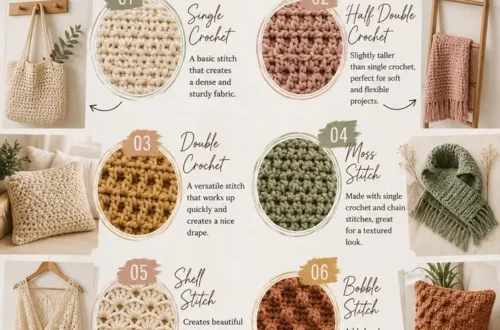
The 7 easy crochet stitches for beginners
1. Chain stitch (ch)
What it is: a loop of yarn pulled through another loop. The simplest thing in crochet, and the foundation of nearly everything else.
How it’s made: yarn over the hook, rotate the hook slightly downward so it faces the loop, and pull the yarn through the loop already on your hook. Repeat.
That small rotation of the wrist is the trick most tutorials skip. Try to pull the hook through while it faces upward and it snags every time.
What it’s for: three jobs. The foundation chain you build your first row on. The turning chain at the start of each row that lifts the yarn to the right height. And chain spaces, the deliberate gaps in lace, mesh and granny squares.
The detail worth knowing: a chain has three parts. Lay it flat and each stitch looks like a small V. Turn it over and a raised ridge runs along the back, called the back bump. Working your first row into the back bump rather than the V leaves a clean edge that matches the top of your finished piece — one of the fastest ways to make beginner work look finished.
Common problem: chains too tight to work into. Work your foundation chain with a hook one size larger, then switch back for the first row. Experienced crocheters do this routinely.
Full step-by-step tutorial: how to crochet a chain stitch.
2. Single crochet (sc)
Height: shortest of the main stitches · Turning chain: 1, and it does not count as a stitch
What it is: the workhorse of crochet. Short, dense, and it makes fabric with almost no gaps.
How it’s made: insert your hook into the stitch, yarn over, pull up a loop so you have two loops on the hook, then yarn over and pull through both.
What it’s for: anything that needs to hold its shape. Amigurumi, baskets, bags, dishcloths, toys — anything stuffed. If the fabric needs structure or needs to hide what’s behind it, single crochet is the stitch.
What it’s bad at: speed. It’s short, so larger projects take many rows, and it uses the most yarn for the area it covers.
Common problem: rows that get wider or narrower. It happens because the first and last stitches of a row are hard to see. Put a stitch marker in the first stitch of every row, move it up as you go, and count at the end of each row.
Full step-by-step tutorial: how to crochet a single crochet stitch.
3. Half double crochet (hdc)
Height: between single and double · Turning chain: 2
What it is: the compromise stitch, and one of the most underrated easy crochet stitches for beginners. It’s taller than single crochet so it grows faster, but still dense enough for most projects.
How it’s made: yarn over first, insert your hook, yarn over and pull up a loop — three loops on your hook — then yarn over and pull through all three at once.
That last step is what makes it different. Every other basic stitch works loops off two at a time.
What it’s for: scarves, hats, blankets, anything where you want speed without the open gaps of double crochet. Plenty of crocheters find it the most pleasant stitch to work once they’ve tried all three.
A quirk worth knowing: half double crochet has a third loop sitting behind the usual V. Working into it creates a horizontal ridge, which is why some patterns mention “the third loop” without explaining it.
4. Double crochet (dc)
Height: roughly twice single crochet · Turning chain: 3 traditionally, 2 in most modern patterns
What it is: the stitch most blankets and scarves are made of, and the point where crochet starts to feel fast.
How it’s made: yarn over, insert your hook, yarn over and pull up a loop — three loops on the hook — then yarn over and pull through two, and yarn over and pull through the last two.
The rhythm: yarn over, in, up, through two, through two. Saying it out loud for the first dozen stitches genuinely helps.
What it’s for: blankets, scarves, shawls, granny squares — anything that should drape. It’s also more economical than single crochet, because the taller stitch covers more ground per length of yarn.
What it’s bad at: structure. Too open and soft for baskets, bags or amigurumi.
Common problem: the turning chain. The traditional method chains 3 and counts it as the first stitch. But a chain-3 is slightly narrower than a real double crochet, so it leaves a small gap at the start of every row — and down the side of a blanket those gaps form a visible line of holes. Most modern designers chain 2, don’t count it, and work a real double crochet into the first stitch. Whichever your pattern uses, stay consistent for the whole project.
Full step-by-step tutorial: how to crochet a double crochet stitch.
5. Granny stitch
Built from: double crochet
What it is: not a new stitch. It’s three double crochets worked into the same space, with a chain beside them, repeated across a row or around a square.
How it works: you work into the chain spaces between clusters rather than into individual stitches. That’s the conceptual jump — and it’s actually easier than working into stitches, because the gaps are large and obvious. You can’t miss them.
What it’s for: granny squares, granny stripe blankets, and a whole family of projects that look far more complicated than they are.
Why it’s on this list: learning the granny stitch roughly doubles the patterns available to you, for about twenty minutes of effort. After the four basics, it’s the most valuable thing here. Try it with how to crochet a granny square.
6. Shell stitch
Built from: double crochet
What it is: several double crochets — usually five — worked into the same stitch, so they fan out into a shell. Stitches are skipped on each side to make room.
How it works: skip two stitches, work five double crochets into the next stitch, skip two, then slip stitch or single crochet into the next. Repeat across.
What it’s for: blanket edges, scarves, baby blankets and bags. It’s the quickest way to make something look like it took skill.
Common problem: stitch counts. Shell patterns need your stitch count to be a set multiple — usually six — so the pattern fits evenly across a row. Count your foundation chain carefully.
7. Bobble stitch
Built from: double crochet
What it is: several double crochets worked into the same stitch but left unfinished, then joined together at the top so they bunch forward into a raised bump.
How it works: work each double crochet only until two loops remain on the hook. After four or five of these, yarn over and pull through every loop at once. The cluster pops out from the fabric.
What it’s for: texture. Baby blankets, cushions, hats — anything that should have dimension. Bobbles look impressive out of all proportion to how hard they are.
Two things to know: bobbles pop out on the back of the work as you make them, which is disorienting the first time. And they use a lot of yarn, so a bobble-heavy project needs noticeably more than you’d estimate.
Crochet stitch height chart
A quick comparison of how the basic stitches relate to each other.
| Stitch | Relative height | Turning chain | Fabric | Best for |
|---|---|---|---|---|
| Single crochet | 1 | 1 (doesn’t count) | Dense, firm | Amigurumi, baskets, bags |
| Half double crochet | 1.5 | 2 | Medium, soft | Hats, scarves, blankets |
| Double crochet | 2 | 3 or 2 | Open, drapey | Blankets, shawls, granny squares |
| Treble crochet | 3 | 4 | Very open | Lace, fast large pieces |
The pattern is simple: taller stitches grow faster, drape more, and hold shape less.
The best order to learn easy crochet stitches for beginners
Chain, then single crochet, then double crochet. Those three alone cover a large share of beginner patterns.
Half double crochet next. It sits between two stitches you already know and takes about ten minutes to learn.
Granny stitch after that, because it opens up more projects than anything else on this list.
Shell and bobble last. They’re decorative rather than structural, and both feel much easier once double crochet is automatic.
A simple two-week practice plan
Short daily sessions beat one long weekend session, because tension is a motor habit and habits form through repetition.
Days 1–2: chain stitch. Make chains of twenty, count them, pull them out, repeat. Aim for even-sized loops.
Days 3–5: single crochet. Work a small square of twenty stitches by twenty rows. Count every row.
Days 6–7: make something with single crochet — a bookmark or a dishcloth. Applying a stitch is how it sticks.
Days 8–9: half double crochet and double crochet. Work a small swatch of each.
Days 10–11: granny stitch. Make one granny square.
Days 12–14: shell and bobble. One small swatch of each, then pick a project that uses your favourite.
Twenty to thirty minutes a day is enough. By the end you’ll know all seven easy crochet stitches for beginners well enough to use them.
How to choose the right stitch for a project
A rough guide that covers most decisions:
Needs to hold a shape — baskets, bags, amigurumi, anything stuffed: single crochet, on a hook smaller than the yarn recommends.
Needs to drape — scarves, shawls, blankets: double crochet or the granny stitch.
Needs to be quick — anything large: double crochet, or half double if you want it slightly denser.
Needs to look decorative — edges, baby blankets, gifts: shell or bobble.
Not sure: half double crochet. It’s the safest default for almost anything.
Common mistakes with beginner crochet stitches
Gripping the hook too hard. The most common cause of tight stitches, sore hands and curling fabric. Relax your hand and check it every twenty minutes.
Not counting. Most beginner problems — wonky edges, lopsided shapes — come from a stitch count that drifted. Count at the end of every row.
Working into the turning chain by mistake. In single crochet, the chain-1 is never a stitch.
Starting with difficult yarn. Smooth, light, worsted weight until the basics feel natural. If your hook keeps catching the strand, see why yarn keeps splitting.
Learning everything at once. Master one stitch before moving on. Each easy crochet stitch makes the next one easier.
Frequently asked questions
What are the easiest crochet stitches for beginners?
The chain stitch, single crochet, half double crochet and double crochet. Those four cover most beginner patterns. The granny, shell and bobble stitches are arrangements of double crochet rather than separate stitches.
Which crochet stitch should a beginner learn first?
The chain stitch, then single crochet. Nearly every pattern starts with a foundation chain, and single crochet is the stitch most beginner projects are built from.
What is the simplest crochet stitch?
The chain stitch — a single movement repeated. Of the stitches used to build fabric, single crochet is the simplest to learn and the easiest to see clearly.
How long does it take to learn basic crochet stitches?
About two weeks of short daily sessions. The stitches themselves take minutes to learn; even tension is what takes the time.
Which crochet stitch works up fastest?
Double crochet, of the basic stitches. It’s roughly twice the height of single crochet, so it covers the same area in about half the rows.
Which crochet stitch uses the least yarn?
Taller stitches use less yarn for the same area, so double crochet is more economical than single crochet.
Is US double crochet the same as UK double crochet?
No. US double crochet is UK treble. UK double crochet is US single crochet — a much shorter stitch.
Do I need to learn all seven stitches?
No. Chain, single crochet and double crochet alone will carry you through a large number of patterns. The others expand what you can make rather than being requirements.


One comment on “Easy Crochet Stitches for Beginners: 7 Simple Stitches to Learn First”