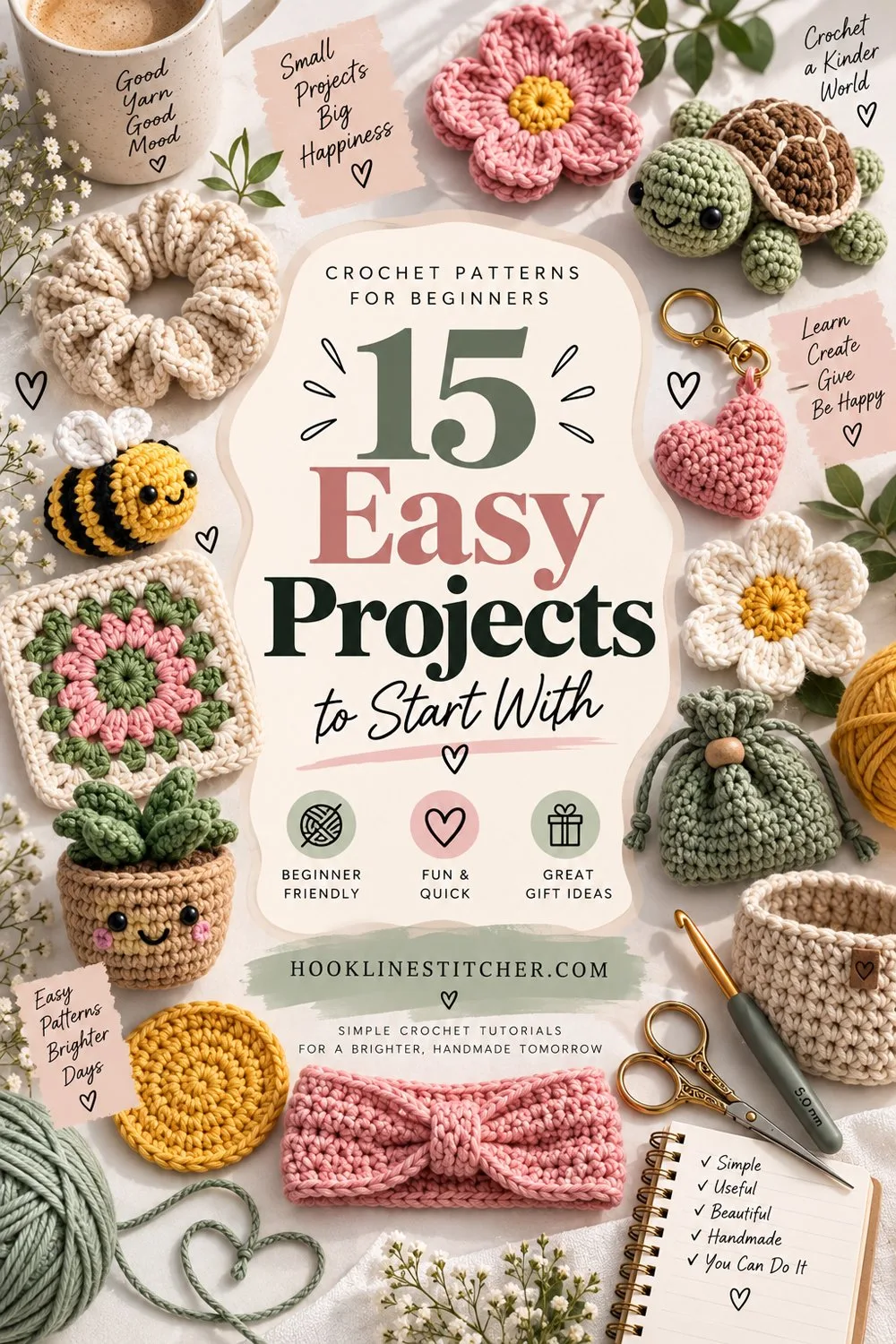
The hardest part of learning to crochet is not the stitches. It is choosing what to make first. The crochet patterns for beginners below are ordered by how hard they actually are, not by how they look.
Most beginners either pick something far too ambitious — a blanket, a jumper — and abandon it half-finished, or they make endless practice swatches and never end up with anything. Both routes lead to the same place: a bag of yarn in a cupboard and a vague sense of having failed at something that is supposed to be relaxing.
The fix is to make real things, in order, starting small. Every project below produces something you can keep or give away, and each one teaches a specific skill that the next one builds on.
They are ordered from genuinely easiest to slightly harder. Work down the list and you will be a competent crocheter by the end of it, without ever having attempted something that was going to defeat you.
All of them are free, and all of them have full step-by-step instructions.
Before you start
If you have never held a hook, these short guides cover what you need before project one:
- How to hold a crochet hook and yarn — grip and tension
- How to crochet a chain stitch — the foundation of nearly every pattern
- How to single crochet — the workhorse stitch
- How to double crochet — the taller stitch most patterns pair with it
That is an hour, maybe two. Then start at number one.
Two pieces of buying advice that will save you frustration: get a 5.0mm hook and smooth, light-coloured worsted weight yarn. Dark yarn hides your stitches, fluffy yarn hides your stitches, and slippery yarn fights your tension. A beginner using black eyelash yarn is not struggling because they are bad at crochet.
Crochet patterns for beginners: the easiest things to make first
1. Bookmark
Teaches: chain stitch, single crochet, turning · Time: 20 minutes · Yarn: about 3 metres
A flat rectangle, seven rows, finished before you lose interest. There is nowhere for a mistake to hide, which sounds bad and is actually the point — you will see your tension clearly and can make a second one the same evening with the lesson applied. Add a tassel and it becomes a gift. Full bookmark pattern.
2. Scrunchie
Teaches: working around an object, joining rounds · Time: 20 minutes · Yarn: about 10 metres
The most forgiving project on this list, because it does not require counting. You cover a hair elastic in single crochet, then double the stitches in a second round, and the ruffle appears. Sixty stitches or fifty-six makes no visible difference. For a beginner, removing the counting pressure entirely is worth a lot. Full scrunchie pattern.
3. Heart
Teaches: the magic ring, varying stitch heights · Time: 10 minutes · Yarn: under 5 metres
One round, and the shape comes from stitch height rather than shaping — tall stitches push out into the lobes, short ones pull in at the sides. Once that clicks you understand something real about how crochet shapes work. Make ten in an evening and you have garland. Full heart pattern.
4. Coaster
Teaches: the flat circle rule · Time: 15 minutes · Yarn: about 15 metres
The most useful thing on this list to learn, disguised as the least ambitious. A flat circle follows one rule — each round adds the same number of stitches as the first round contains — and that rule governs hats, bags, baskets, mandalas and half of amigurumi. Learn it here on something that takes a quarter of an hour. Full coaster pattern.
5. Flower keychain
Teaches: the magic ring, petal construction, attaching hardware · Time: 20 minutes · Yarn: about 10 metres
Two rounds. The first is a small disc, the second turns it into five petals. It is also the first project on the list that other people will ask you for, which is a different kind of milestone. Full flower keychain pattern.
Once the basics feel comfortable
6. Dishcloth
Teaches: consistent tension over a larger piece · Time: 1 hour · Yarn: about 40 metres
The traditional second project, and it earns its place. Big enough that tension problems become visible, small enough to finish. Chain 31, single crochet across, repeat until square. Genuinely useful afterwards, which matters more than it sounds.
7. Headband
Teaches: back loop only ribbing, sizing to a body · Time: 1 hour · Yarn: about 40 metres
Your first wearable, and the gentlest possible introduction to sizing. Working every stitch into the back loop only turns flat crochet into stretchy ribbing that looks knitted. One measurement, one short seam, and if it is wrong you unpick one seam rather than a whole garment. Full headband pattern.
8. Mini basket
Teaches: circle base into straight sides, the back loop corner · Time: 90 minutes · Yarn: about 60 metres
The moment crochet stops being flat. Make a circle, stop increasing, keep going — the fabric rises into sides on its own. This is the single most transferable trick in round crochet, and a basket is the best place to learn it because you find out immediately whether it worked. Full mini basket pattern.
9. Granny square
Teaches: clusters, chain spaces, working into spaces rather than stitches · Time: 20 minutes each · Yarn: about 15 metres each
The most famous shape in crochet, and much easier than it looks — it is groups of three double crochets separated by chain spaces, worked round and round. One square is a coaster. Nine sewn together is a cushion cover. Sixty is a blanket, built twenty minutes at a time, which is how most beginners actually finish a blanket.
10. Mini bag
Teaches: the same circle-to-sides construction, plus straps · Time: 2 hours · Yarn: about 70 metres
A basket with taller sides and a handle. Worth making after the basket rather than instead of it, because the strap technique — chaining then slip stitching back along the chain so it does not stretch — is a detail most patterns skip and most beginners learn the hard way. Full mini bag pattern.
Your first toys
Amigurumi is worth reaching by project ten or so. It uses almost no stitch variety — single crochet and very little else — but it demands consistent counting, which is why it comes later rather than earlier.
11. Turtle
Teaches: amigurumi construction, assembly · Time: 90 minutes
The best first amigurumi and almost nobody says so. A turtle body is two flat circles sewn together with stuffing between — no sphere, no neck, no decrease rounds that have to line up. And a turtle is lumpy by design, so slight irregularity reads as character. Full turtle pattern.
12. Bunny
Teaches: the amigurumi sphere, working in a continuous spiral · Time: 2–3 hours
The classic shape: increase out, work straight, decrease in, stuff, close. This version works the head and body as one continuous piece, which removes the neck seam that ruins most first attempts. Full bunny pattern.
13. Cat
Teaches: the same sphere, plus flat-worked ears · Time: 2–3 hours
Same construction as the bunny with triangular ears worked in rows instead of long ones worked in the round. Easier than the bunny in one specific way: two small triangles are more forgiving than two long ears that have to match. Full cat pattern.
Two to aim at
14. Simple scarf
Teaches: committing to a long project, tension over hundreds of rows · Time: 8–12 hours · Yarn: about 300 metres
Not difficult — it is one stitch repeated — but it is the first project that takes more than an evening, and finishing it is a skill of its own. Half double crochet is the best choice: taller than single crochet so it grows faster, softer than double crochet in drape.
15. Beanie
Teaches: the flat circle worked into a dome, sizing in the round · Time: 3–4 hours · Yarn: about 120 metres
The natural end of this list, because it combines everything before it. A beanie is a flat circle that you stop increasing at the right moment, then work straight down. If you made the basket, you have already done the hard part — the only new idea is knowing when to stop, which comes down to one measurement.
How to actually get through this list
Do not skip to the toys. Amigurumi looks like the fun part and it is, but it is the least forgiving of counting errors. Projects one to five build the habits that make project eleven work.
Finish things. A half-made project in a bag teaches nothing. If something is going badly, pull it out and start again the same day rather than leaving it.
Make the small ones twice. The second bookmark, second coaster, second scrunchie will be visibly better than the first, and seeing that improvement is more motivating than any amount of encouragement.
Count. Every row, every round, every time. It is five seconds and it prevents the large majority of beginner problems.
Use the right yarn. Smooth, light, worsted weight, cotton or acrylic. Save the beautiful fluffy skein for project twenty.
More beginner round-ups
If you want a shorter list aimed at one thing in particular:
- Small crochet projects under an hour — twelve quick makes sorted by time, ideal for scrap yarn
- Easy amigurumi patterns — ten crochet animals by difficulty, plus the four things that go wrong
- Easy crochet gifts — what to make for whom, and how to present it properly
- Crochet projects for your home — room by room, with the yarn choices that decide whether things hold their shape
Frequently asked questions
What should a complete beginner crochet first? A bookmark or a scrunchie. Both take about twenty minutes, use almost no yarn, and need only chain stitch and single crochet.
Are these crochet patterns free? Yes. Every pattern linked here is free and written out in full with step-by-step instructions.
What do I need to start crocheting? A 5.0mm hook, smooth worsted weight yarn in a light colour, and scissors. A tapestry needle and stitch markers become useful by project six or so.
How long does it take to learn to crochet? Most people are comfortable with the basic stitches within two or three weeks of short regular sessions. Working through this list takes a couple of months at an easy pace.
Is crochet hard to learn? It is easier than knitting for most people, mainly because there is only ever one live loop — if you drop it, nothing unravels. The hard parts are tension and counting, and both come with practice rather than talent.
What is the difference between US and UK crochet terms? The names differ and the stitches do not. US single crochet is UK double crochet; US double crochet is UK treble. All patterns on this site use US terms.
Can I sell things I make from these patterns? Yes, sell the finished items freely. Please do not republish the pattern text itself.
Cathrinee’s Supply Kit
The beginner basics I recommend
What should a complete beginner crochet first?
A chain, then a simple flat square like a dishcloth or coaster. Flat projects let you focus on consistent stitches and straight edges without shaping, and you finish something in an evening.
What supplies do I need to start crocheting?
A 5.0 mm hook, a skein of worsted weight yarn in a light solid colour, scissors and a blunt yarn needle. That is genuinely everything. Light colours matter because you can actually see your stitches.
How long does it take to learn to crochet?
Most people can make a chain and single crochet within an hour. Consistent tension and straight edges take a few projects rather than a few days. Expect to be making useful things within a week.
Which crochet hook size is best for beginners?
A 5.0 mm hook with worsted weight yarn. It is large enough to see what you are doing and small enough to produce a fabric that holds together. Avoid very small hooks and very fine yarn while learning.
Is crochet easier than knitting?
For most beginners, yes. Crochet uses one hook and one live loop, so a dropped stitch does not unravel the whole piece, and mistakes are easier to pull back and fix.


One comment on “Crochet Patterns for Beginners: 15 Easy Projects to Start With”