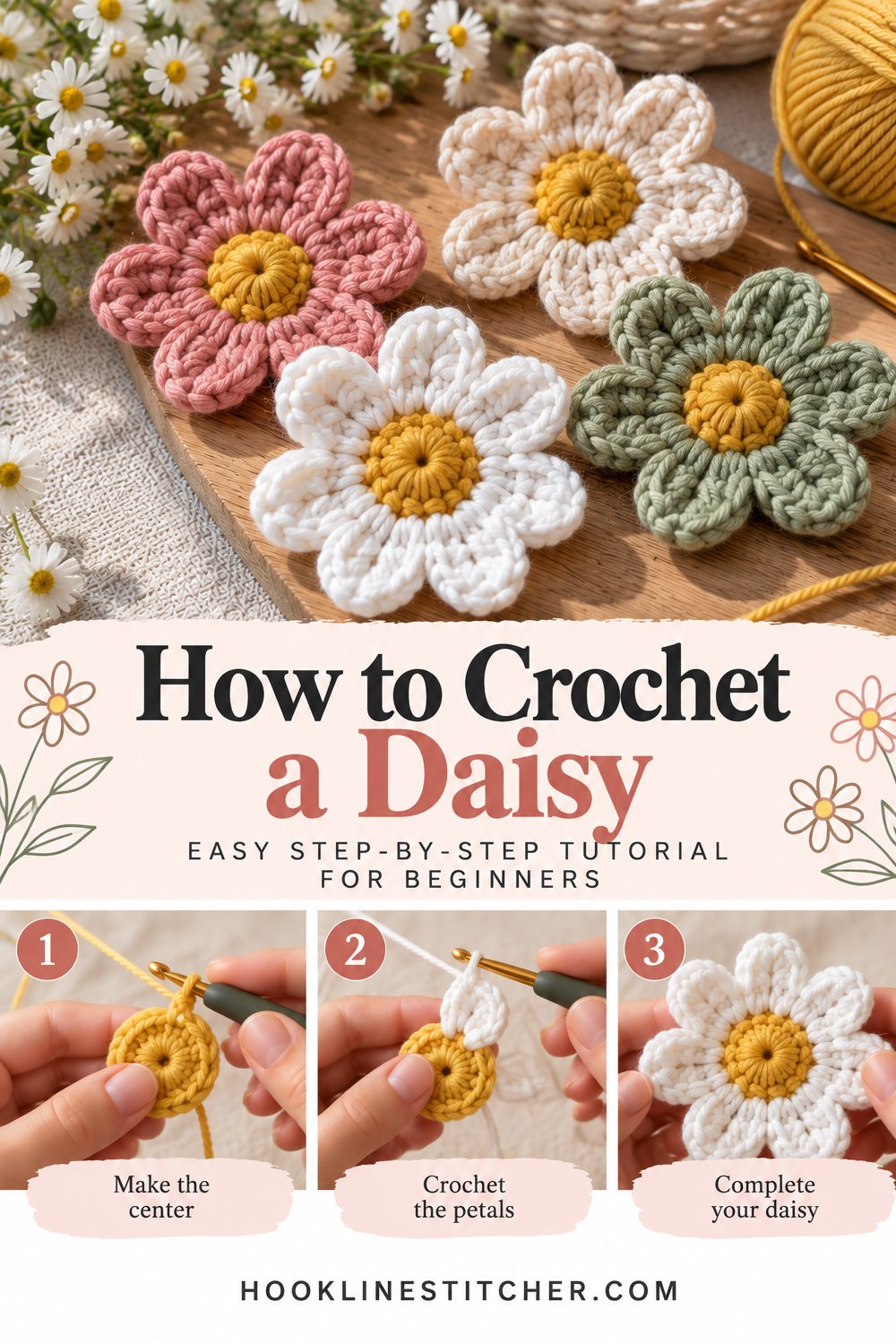
The daisy is the flower every crocheter should learn first. It is ten minutes of work, it uses two scraps of yarn, and it sits flat — which means you can sew it onto absolutely anything. Bags, hats, blankets, cardigans, hair clips, gift wrapping. A single daisy turns a plain project into a finished one.
It is also the clearest possible lesson in how crochet petals are built. Once you see how a petal is made from a chain and a few stitches worked back into the same place, you can invent your own flowers rather than looking up patterns.
What you will need
| Item | What I recommend | Why |
|---|---|---|
| Yarn | Worsted weight (#4) in white and yellow, scraps | Under 10 yards total |
| Hook | 4.0 mm | Gives crisp, well-defined petals |
| Yarn needle | Blunt tapestry needle | Weaving in ends |
| Scissors | Any | Cutting yarn |
Cotton is the best choice for flowers. It holds a shape, the petals stay flat without blocking, and the stitch definition is sharper than acrylic. If you only have acrylic, it works — you may just want to press the finished daisy under a book for an hour.
Cathrinee’s Supply Kit
The beginner basics I recommend
Stitches you need to know
- Magic ring — the adjustable starting loop
- Chain (ch) — see how to crochet a chain stitch
- Single crochet (sc) — see how to crochet a single crochet stitch
- Double crochet (dc) — see how to crochet a double crochet stitch
- Slip stitch (sl st)
If the magic ring is new to you, you can substitute chain 4 and slip stitch into the first chain to make a small ring. It leaves a slightly larger hole in the centre but works fine.
How a crochet petal actually works
Worth understanding before you start, because it makes the instructions obvious rather than cryptic.
Each petal is built at a single anchor point. You chain outward to set the petal’s length, work taller stitches into that chain to give the petal width, then chain back and slip stitch into the base. The chain going out and the chain coming back form the two sides of the petal; the stitches between them fill it. Change the chain length and you change the petal length. Change the stitch height inside and you change the petal shape.
That is all a flower is. Eight anchor points around a circle, eight petals.
How to crochet a daisy step by step
The centre
- In yellow: magic ring. Work 8 single crochet into the ring.
- Pull the ring closed by tugging the starting tail. It should shut completely, leaving no hole.
- Slip stitch into the first single crochet to join the round. You now have a small yellow disc with 8 stitches.
- Change to white. Cut the yellow, leaving a tail to weave in later, and join white yarn with a slip stitch into any stitch.
The petals
- Petal 1: Chain 4. Work 2 double crochet into the fourth chain from the hook. Chain 4. Slip stitch into the next stitch of the yellow centre.
- Repeat around. Work that same sequence into each of the remaining 7 stitches of the centre: chain 4, 2 dc into the fourth chain from the hook, chain 4, slip stitch into the next centre stitch.
- You should finish with 8 petals, one anchored in each stitch of the yellow centre. Slip stitch into the base of the first petal to close.
- Fasten off, leaving a tail if you plan to sew the daisy onto something.
- Weave in the yellow tail on the back of the flower, and the white tail too if you are not using it to attach the daisy. Trim close.
- Shape it. Lay the daisy face down and press each petal flat with your thumb. If the petals cup or twist, press the whole flower under a heavy book for an hour, or if you used cotton, spray it lightly with water, flatten it and let it dry.
Troubleshooting
My petals are different sizes. Your chain counts drifted. Count carefully: chain 4 out, 2 dc, chain 4 back, every time.
The petals overlap and crowd each other. You worked two petals into the same centre stitch, or your centre has fewer than 8 stitches. Count the yellow round before you start the petals.
The daisy cups instead of lying flat. Too many petals for the centre, which pushes the outer edge into a ruffle. This is exactly the situation described in why is my crochet circle not flat — the outside is growing faster than the inside. Either reduce to 6 petals or increase the centre to 10 stitches.
There is a hole in the middle of the yellow centre. The magic ring was not pulled fully closed. Thread the starting tail, run it around the ring and pull hard, then secure it.
My petals are pointed when I wanted them rounded. Work 3 dc into the chain instead of 2, or use (dc, hdc, dc) for a softer curve.
The whole flower looks floppy. Acrylic yarn and a large hook. Go down to a 3.5 mm hook, or switch to cotton.
Variations to try
- Bigger daisy. Work 10 single crochet in the centre and chain 6 for each petal instead of 4.
- Two-layer daisy. Make two daisies, one slightly smaller, and stack them with the petals offset. Instantly looks more expensive.
- Coloured daisies. Pink, lavender and cream petals all work. Keep the centre yellow and it still reads as a daisy.
- Sunflower. Brown centre, longer gold petals — or see how to crochet a sunflower for a dedicated version.
- Daisy chain garland. Make twelve and join them with a long chain between each.
- Daisy hair clip. Sew one to a snap clip. Ten minutes, and it is a genuinely nice small gift.
- Applique on other projects. Sew daisies onto a tote bag, a cushion cover, a headband or a mini bag.
What to do with a pile of daisies
Flowers are the most useful thing to have a supply of. They cost almost nothing, they take ten minutes, and they solve the problem of a finished project that looks slightly plain.
Make a batch in one sitting while watching something, keep them in a jar, and use them as you go. Three daisies in a row along the bottom of a bag, one on the corner of a blanket, a cluster of five on a cushion. It is the fastest way to make handmade work look designed rather than just completed.
For more small makes, see small crochet patterns for beginners, and for a similar quick embellishment, how to crochet a flower keychain.
If you want to check your yarn weight against your hook, the Craft Yarn Council yarn weight system has the chart.
How many petals does a crochet daisy have?
Eight is standard and gives a balanced flower that lies flat. Each petal is anchored into one stitch of the yellow centre, so an 8-stitch centre gives 8 petals. Adding more petals without enlarging the centre makes the flower cup and ruffle.
How do you crochet a flower petal?
Chain outward to set the petal length, work taller stitches into that chain to give it width, then chain back and slip stitch into the base. For a daisy that is: chain 4, 2 double crochet into the fourth chain from the hook, chain 4, slip stitch into the next centre stitch.
Why does my crochet daisy curl instead of lying flat?
The outer edge is growing faster than the centre can support. Either reduce to 6 petals or work 10 stitches in the yellow centre instead of 8. Cotton yarn also lies flatter than acrylic — if you used acrylic, press the finished flower under a book for an hour.
What yarn is best for crochet daisies?
Cotton or a cotton blend. It holds the petal shape, lies flat without blocking, and has sharper stitch definition than acrylic. Acrylic works but the petals tend to be softer and may need pressing.
How long does it take to crochet a daisy?
About ten minutes once you know the petal sequence, using under 10 yards of yarn. They are worth making in batches — keep a jar of them and sew them onto bags, hats, blankets and cushions as finishing details.


One comment on “How to Crochet a Daisy: Easy Step-by-Step Tutorial for Beginners”