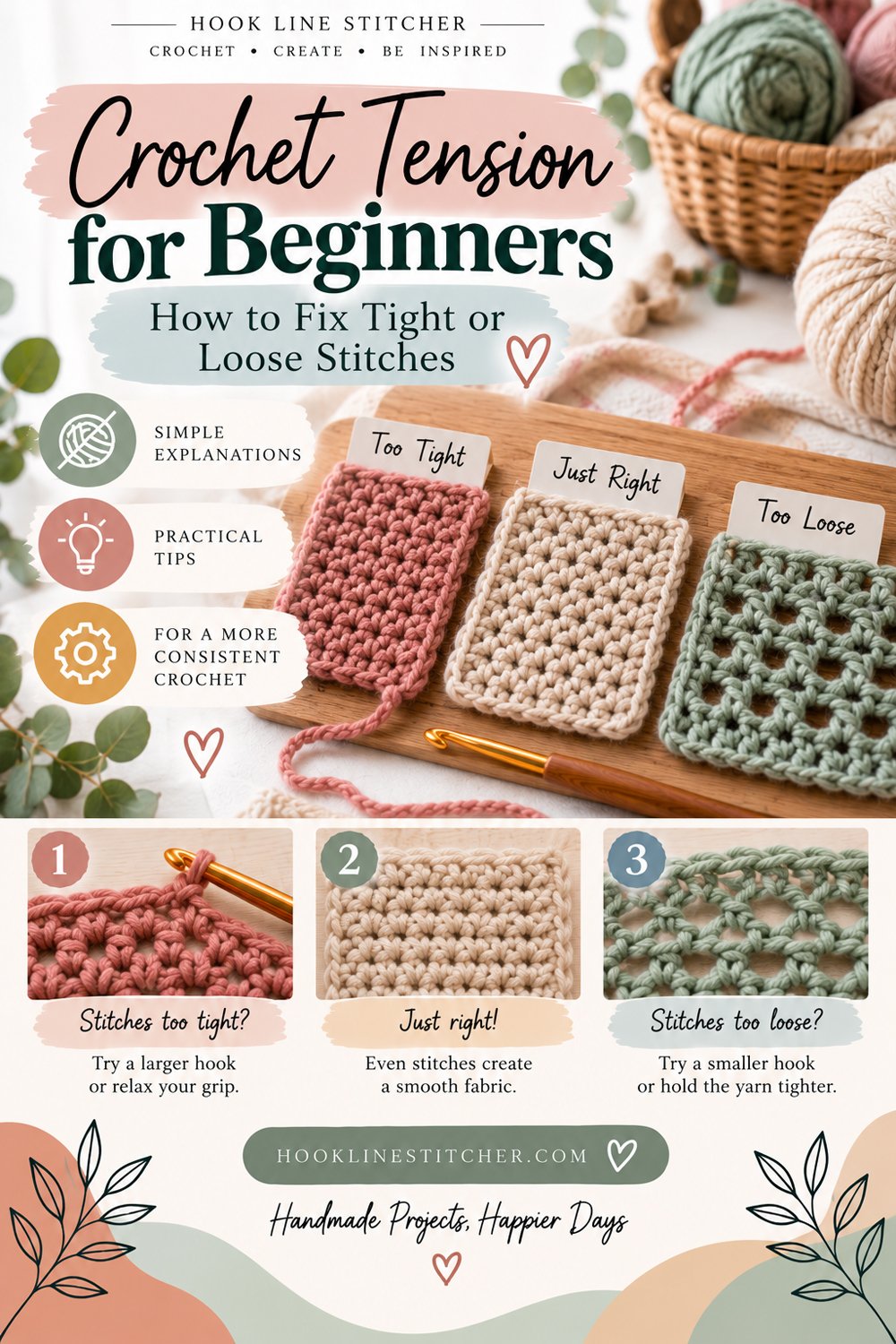
Tension is the difference between crochet that looks handmade and crochet that looks homemade, and almost every beginner has it wrong in the same direction.
You’re probably crocheting too tightly. It’s not a character flaw — it’s what happens when you’re concentrating. New crocheters grip the hook hard because they’re worried about dropping the loop, and that grip pressure goes straight into the stitches.
The whole of this guide to crochet tension for beginners is really one idea: tension lives in your hands, not in your technique. Nothing here is difficult. It’s mostly noticing.
What tension actually is
Tension is how much resistance the yarn meets on its way to the hook, and how hard you pull each stitch closed. Consistent tension means every stitch is the same size. Good tension means they’re the right size for the yarn and hook.
Two separate things, and beginners usually have trouble with both. Consistency comes with practice and nothing else. Size is adjustable today.
Diagnosing it
Signs your tension is too tight:
- You struggle to get the hook into the previous row’s stitches
- The fabric feels stiff, like card rather than cloth
- Your hands ache within fifteen minutes
- The finished piece is smaller than the pattern says
- The edges curl and won’t relax
- The hook drags along the yarn rather than gliding
Signs your tension is too loose:
- Visible gaps between stitches
- The fabric is floppy and won’t hold shape
- Stitch tops are hard to identify because the edges look vague
- The finished piece is larger than the pattern says
- The loop on your hook slides around
Too tight is far more common. If you’re not sure which you have, it’s probably too tight.
Crochet tension for beginners: the fixes in order
1. Loosen your grip
Genuinely the answer most of the time. Consciously relax your hook hand and work ten rows.
Then check again twenty minutes later, because grip pressure creeps back without you noticing. This is the single most useful habit in crochet and nobody teaches it.
2. Change hook size
If loosening isn’t enough, change the tool.
Too tight? Go up a size. A 5.5mm instead of a 5.0mm.
Too loose? Go down a size.
There is no virtue in using the hook a pattern names. Patterns specify a hook as a starting point and ask you to match gauge — the hook that gets you there is the correct hook, whatever the label says. The Craft Yarn Council hook size chart is handy if your hooks are labelled in letters rather than millimetres.
3. Adjust your yarn hand
Your non-dominant hand controls how much resistance the yarn meets. If you have never been shown this properly, start with how to hold a crochet hook and yarn.
Too loose? Add friction. Wrap the yarn once around your pinky before weaving it through your fingers. More friction, tighter stitches.
Too tight? Remove friction. Unwrap the pinky, or run the yarn over fewer fingers.
4. Change the yarn
Some yarns fight you. Slippery yarns — bamboo, silk blends, shiny acrylic — need more friction. Sticky yarns — wool, cotton with a loose twist — need less.
If your tension is fine on one yarn and terrible on another, it’s the yarn, not you.
Why your tension is worse in some places
The first two rows are always worse. Working into a foundation chain is genuinely harder than working into stitches. Don’t judge your tension before row three — this is normal for everyone, permanently.
The first and last stitches of a row. Both are awkward to place, so both tend to be tighter than the middle.
When you’re stressed or rushing. Tension tightens under pressure, which is why crochet done against a deadline comes out different from crochet done on a Sunday afternoon. It’s also why starting seasonal projects early genuinely matters.
When you pick a project back up after a break. Tension drifts between sessions. On a long project this shows as faint horizontal banding. Blocking softens it considerably.
Consistency takes time, and that’s the honest answer
Stitch size is adjustable in five minutes. Stitch consistency takes weeks, and there’s no shortcut.
What helps:
- Crochet regularly rather than in long bursts. Twenty minutes daily beats three hours on Sunday.
- Stay on one yarn and hook while you’re learning. Changing materials constantly means you never build muscle memory for any of them.
- Make small things repeatedly. Five coasters teach you more than one blanket, because you see the improvement between them.
- Don’t compare row one to row fifty. They will look different. That’s evidence of progress, not failure.
What tension is not
It’s not about strength. Pulling harder doesn’t make better stitches, it makes smaller ones.
It’s not fixed. Your tension will change over months, and patterns you made early will look different from what you make now.
It’s not a talent. It’s a motor habit, and motor habits are built by repetition.
Frequently asked questions
How do I fix crochet that’s too tight?
Loosen your grip on the hook first — that solves it most of the time. If not, go up one hook size, and remove any extra wrap from your yarn hand.
How do I fix crochet that’s too loose?
Go down a hook size, and add friction in your yarn hand by wrapping the yarn once around your pinky.
Why does my hand hurt when I crochet?
You’re gripping the hook too hard, which is also what’s making your stitches tight. Relax your hand, take a break every twenty minutes, and consider an ergonomic hook.
How long does it take to get even crochet tension?
A few weeks of regular short sessions for most people. Stitch size is adjustable immediately; consistency is what takes time.
Should I use the hook size the pattern says?
As a starting point. Patterns ask you to match gauge, not hook size — use whichever hook gets you there.
Why is my tension worse at the start of a project?
Working into a foundation chain is harder than working into stitches. The first two rows are worse for everyone, always.
Cathrinee’s Supply Kit
The beginner basics I recommend
What is crochet tension?
Tension is how tightly you hold the yarn and how tightly you form each stitch. It decides the size of your finished piece, how the fabric drapes, and whether a pattern comes out the dimensions it promises. It is personal — no two crocheters have identical tension.
How do I fix tight crochet tension?
Go up a hook size first, which fixes it instantly without retraining your hands. Then work on relaxing your grip, letting the yarn run over your fingers rather than being gripped, and pulling each loop up to the full height of the stitch before finishing it.
How do I fix loose crochet tension?
Go down a hook size, and hold the working yarn with slightly more resistance by wrapping it once more around your little finger. Loose tension also comes from pulling the loop too high, so keep the loop on your hook snug against the shaft.
Why does my tension change partway through a project?
Usually because you relaxed as you got comfortable, or tightened up while tired or stressed. Long projects show it most. Working in shorter sessions and checking your width every twenty rows catches it before it becomes visible.
Does tension matter for every project?
No. Blankets, scarves and dishcloths forgive almost anything. Tension matters when something has to fit — hats, garments, slippers, bags — and for those you should work a gauge swatch first rather than hoping.


2 Comments on “Crochet Tension for Beginners: How to Fix Tight or Loose Stitches”