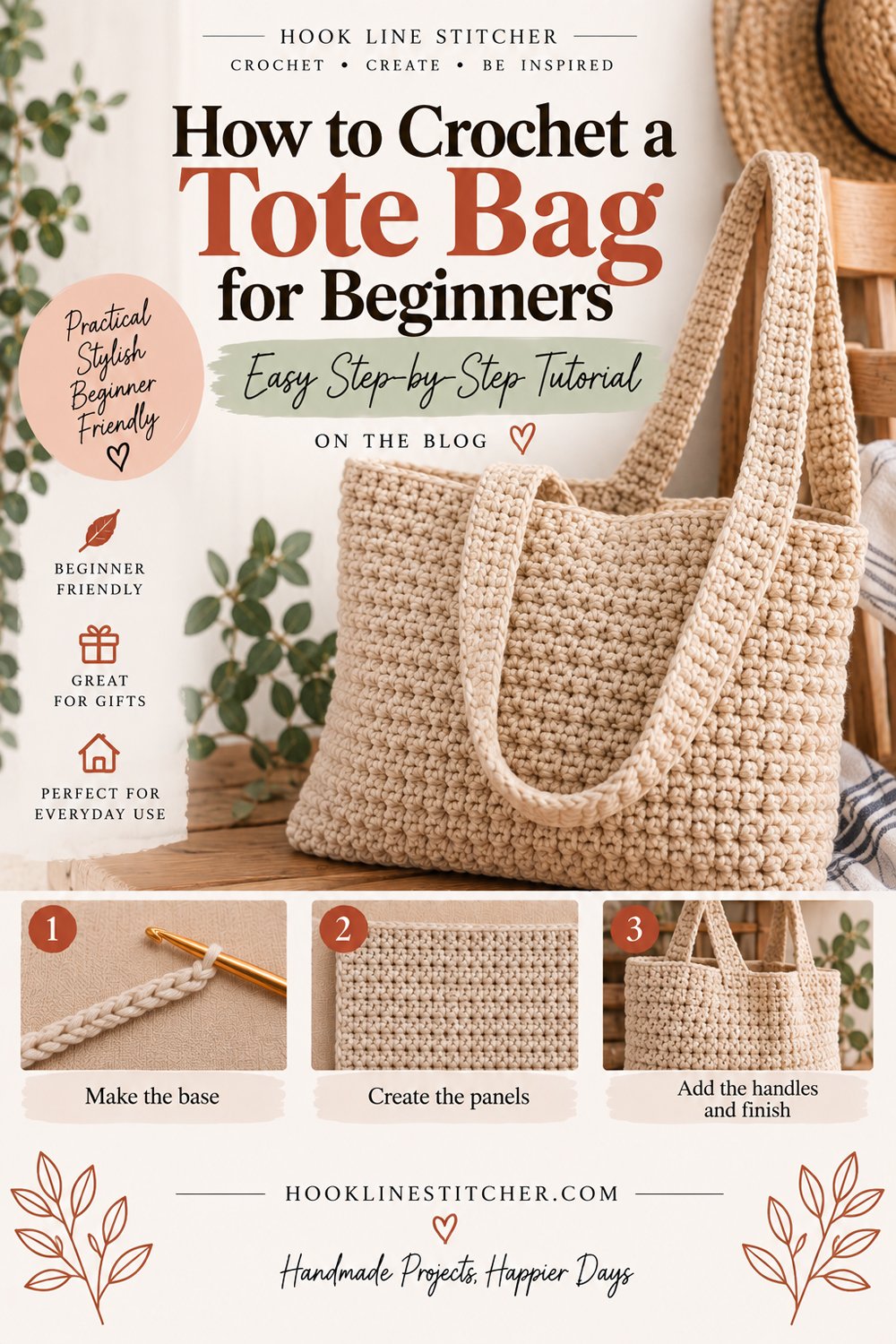
Learning how to crochet a tote bag is really learning three things in sequence: a flat circle, straight sides, and a handle. You already know the first two if you’ve made a crochet basket — a tote is the same construction, taller and with handles.
What makes a tote different from every other beginner project is that it has to carry weight. A wonky coaster is a wonky coaster. A bag that stretches until the handles reach your knees is a bag you stop using. So this guide spends as much time on what stops a bag stretching as on the pattern itself.
About four hours.
From the shop · New pattern
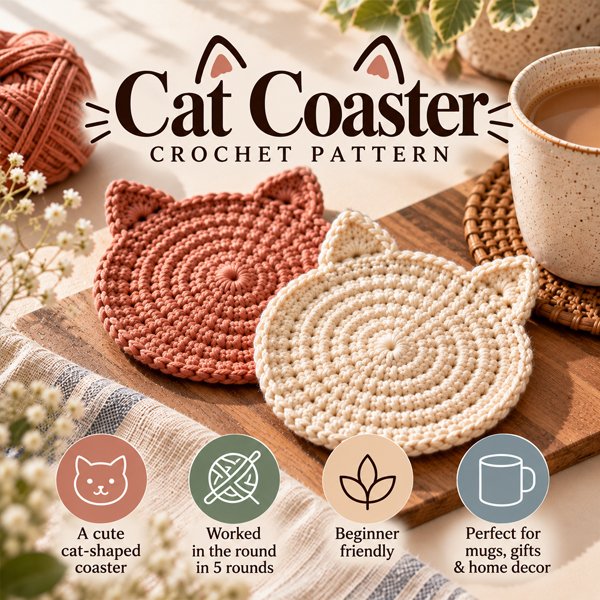
A sweet cat-ear coaster in just 5 rounds. Beginner friendly, printable 7-page PDF for $4.99.
See the pattern →What you need to know first
- Chain stitch
- Single crochet
- Working in a continuous spiral
- Increasing
- Back loop only — used once, to turn the corner from base to sides
What you need
100% cotton yarn, worsted weight. This one isn’t a preference. Cotton has almost no stretch, and a bag made from stretchy yarn sags permanently under the first heavy load. Acrylic makes a beautiful bag that ruins itself the first time you put a bottle of milk in it.
About 400 metres for a medium tote. The Craft Yarn Council’s yarn weight system is worth a look if you’re substituting — you want a (4) that says 100% cotton on the label.
A 4.0mm hook — a full size smaller than worsted cotton usually calls for. Dense fabric is what carries weight.
A stitch marker and a tapestry needle.
From the shop · New pattern
A sweet cat-ear coaster in just 5 rounds. Beginner friendly, printable 7-page PDF for $4.99.
See the pattern →Cathrinee’s Supply Kit
Everything you need for this project
Terms
US crochet terms.
- MR = magic ring · ch = chain · sc = single crochet (UK double crochet) · inc = 2 sc into the same stitch · BLO = back loop only · sl st = slip stitch
The pattern
Worked in a continuous spiral from the base up. Keep a marker in the first stitch of every round.
Step 1: The base
This is a flat circle. Every round adds 6 stitches — the flat circle rule for single crochet.
- R1: 6 sc in MR — (6)
- R2: inc in each st — (12)
- R3: (sc, inc) x6 — (18)
- R4: (2 sc, inc) x6 — (24)
- R5: (3 sc, inc) x6 — (30)
- R6: (4 sc, inc) x6 — (36)
- R7: (5 sc, inc) x6 — (42)
- R8: (6 sc, inc) x6 — (48)
- R9: (7 sc, inc) x6 — (54)
- R10: (8 sc, inc) x6 — (60)
The base should now measure about 20 cm across and lie completely flat.
If it’s ruffling, you have too many stitches — count against the pattern. If it’s cupping, too few, or your tension is tight. It must be flat before you go on, because a warped base makes a bag that won’t stand up.
For a bigger bag, keep going: R11 is (9 sc, inc) x6 for 66, R12 is (10 sc, inc) x6 for 72. Each extra round adds about 2 cm to the diameter.
Step 2: Turn the corner
R11: sc BLO in each st around — (60)
One round, worked into back loops only. This makes the fabric turn a sharp 90-degree corner instead of curving gently, which is the difference between a bag with a defined base and a bag shaped like a bowl.
It’s the single most important round in the pattern and it takes two minutes.
Step 3: The sides
Every round: sc in each st around — (60)
No increases at all. Repeat until the bag is as tall as you want.
- Small tote: 25 rounds, about 18 cm tall
- Medium tote: 35 rounds, about 25 cm tall
- Large market bag: 45 rounds, about 32 cm tall
This is the long part. It’s also completely mindless, which makes it good company for a film.
Step 4: The top edge
Work 3 rounds of sc, then join with a sl st and fasten off.
Those last rounds are the same stitch — they just give the rim something to hold on to. The top of a bag takes more strain than anywhere except the handles.
Step 5: The handles
Handles are where bags fail, so this is worth doing properly.
Lay the bag flat and mark four points along the top edge: the handles should sit about 12 cm apart, centred on each side.
For each handle:
Join yarn at the first marked point. Ch 40 — that’s a comfortable shoulder-length strap; use ch 25 for a hand-carried bag. Attach with a sl st at the second marked point.
Now work back along the chain: sc into each chain all the way to the start, then sl st to secure.
Then work a second row of sc back along the handle, and a third.
Three rows of single crochet along every handle. A bare chain handle will stretch to twice its length within a month — this is not a theoretical risk, it’s what happens. The extra rows take fifteen minutes and they’re the difference between a bag you use for years and a bag you use twice.
Repeat for the second handle, checking both are the same length before you fasten off.
Weave all ends in twice, in opposite directions. Handle ends especially.
Troubleshooting your crochet tote bag
The base won’t lie flat. Count your rounds — each should add exactly 6 stitches. Ruffling means too many, cupping means too few.
The bag is bowl-shaped instead of having a flat base. You skipped the back loop only round, or worked it through both loops.
The sides flare outward. You kept increasing after the base. The side rounds have no increases at all.
The bag stretches when I put things in it. The yarn isn’t cotton, or the hook is too large. Neither can be fixed afterwards — it’s why the yarn rule is at the top of this page.
The handles have stretched long. They weren’t reinforced. Add two more rows of single crochet along each one; it will help, though it won’t fully reverse it.
The bag won’t stand up. Fabric too loose. Go down another hook size next time.
Small items fall through gaps in the fabric. Your tension is loose for a bag. Single crochet in cotton on a 4.0mm hook should be nearly solid.
Variations
- Market mesh bag: after the base, work the sides in (ch 2, skip 2, sc) mesh for a stretchy string bag that packs down small.
- Lined tote: cut a fabric rectangle, hem it, and hand-stitch it inside the top edge. Lining stops small items escaping and makes the bag considerably sturdier.
- Striped: change colour every five rounds. Because it’s a spiral, the stripes spiral gently — which looks deliberate.
- Beach bag: make the large size in bright cotton and skip the lining, so sand falls out.
- Small project bag: 30 rounds in the small size, perfect for carrying a granny stripe blanket in progress.
Frequently asked questions
How do you crochet a tote bag for beginners?
Work a flat circle for the base, then one round in back loop only to turn the corner, then straight rounds with no increases for the sides. Finish with reinforced chain handles.
What yarn is best for a crochet tote bag?
100% cotton, worsted weight. Cotton barely stretches, so the bag keeps its shape under weight. Acrylic sags permanently once loaded.
How do I stop crochet bag handles stretching?
Never leave a handle as a bare chain. Work at least three rows of single crochet along it — that’s what stops it stretching to twice its length.
Why won’t my crochet bag base lie flat?
The stitch count has drifted. Every round of a single crochet circle adds exactly 6 stitches — ruffling means too many, cupping means too few.
How much yarn does a crochet tote bag use?
About 400 metres of worsted weight cotton for a medium tote.
How do I give my crochet bag a flat base?
Work one round in back loop only where the base meets the sides. It forces the fabric to turn a sharp corner instead of curving.
How long does it take to crochet a tote bag?
About four hours for a medium tote.


5 Comments on “How to Crochet a Tote Bag for Beginners: Easy Step-by-Step Tutorial”