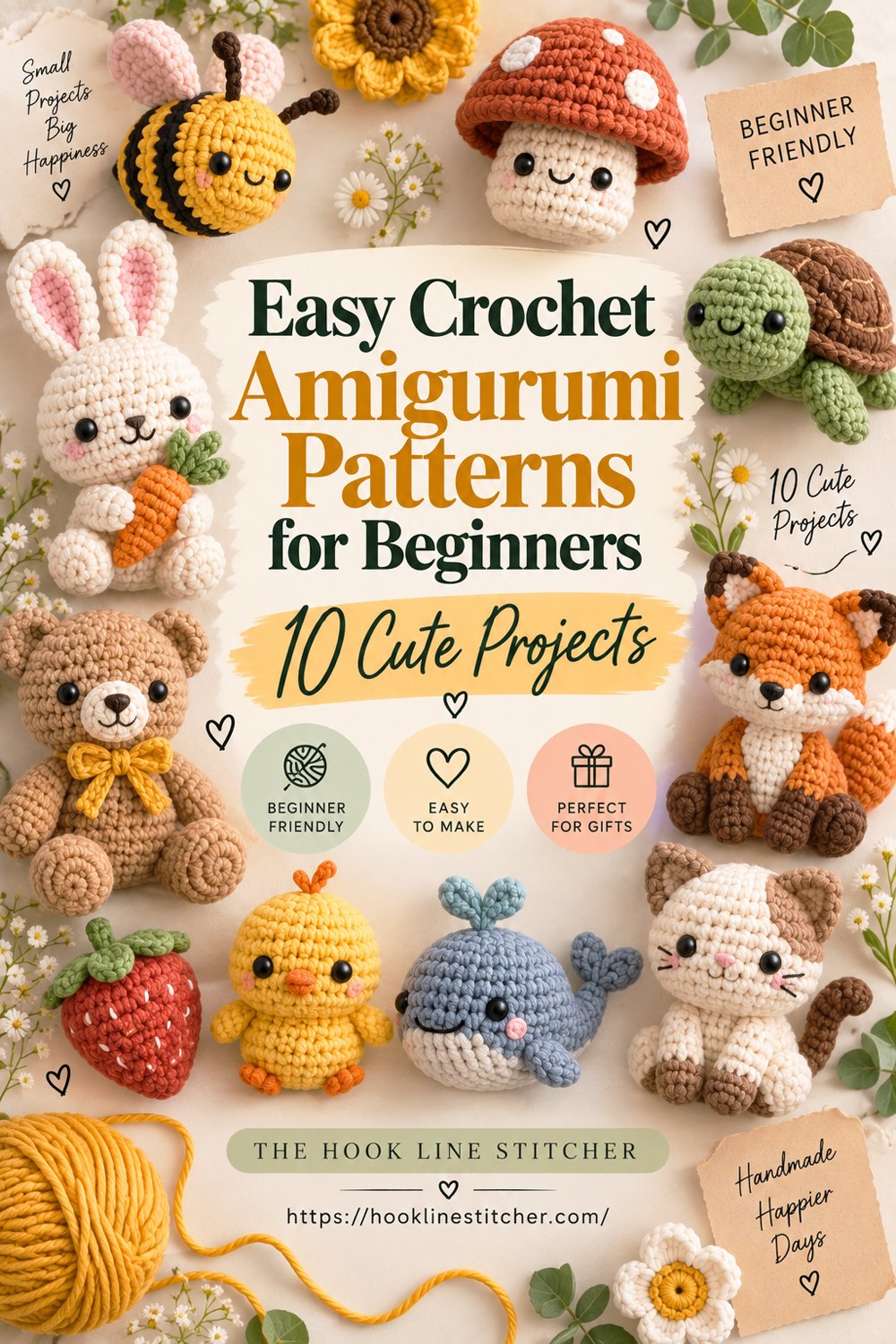
Amigurumi uses fewer stitches than almost any other kind of crochet. The easy amigurumi patterns for beginners below all rest on the same handful of stitches.
That surprises people. A blanket might use four or five different stitches; a full amigurumi cat uses one. It is single crochet, worked round and round, with increases to grow and decreases to shrink. That is the whole vocabulary.
So why does it have a reputation for being hard?
Because it is unforgiving in a way flat crochet is not. A blanket that is one stitch wide in the wrong place is a blanket with a slightly wobbly edge. An amigurumi head that is one stitch out at round four is visibly lopsided by round eleven, and there is no blocking it into shape afterwards. Amigurumi does not demand skill so much as attention.
Which is good news, because attention is learnable in an afternoon. Below are ten projects ordered from genuinely easy to moderately involved, plus the four things that actually go wrong.

From the shop · New pattern
A sweet cat-ear coaster in just 5 rounds. Beginner friendly, printable 7-page PDF for $4.99.
See the pattern →What amigurumi actually requires
Four techniques and one habit.
- Single crochet — essentially the only stitch
- The magic ring — an adjustable starting loop that closes completely, so there is no hole in your toy’s face
- Working in a continuous spiral — no joining, no turning, just round and round
- Increasing and decreasing
And the habit: a stitch marker in the first stitch of every round, moved up as you go. In a spiral there is no seam to tell you where a round starts. Every experienced amigurumi maker uses a marker. This is not a beginner crutch, and skipping it is the fastest way to ruin a project.
The four things that go wrong
Worth reading before you start anything, because three of these cannot be fixed after the fact.
1. The hook is too big. Use one or two sizes smaller than the yarn label recommends — 3.5mm for worsted, 3.0mm for DK. Amigurumi fabric must be dense enough that stuffing does not show through the gaps. If you can see white fluff through your stitches, the piece is finished and it cannot be rescued. This is the single most common beginner mistake.
2. It is under-stuffed. Stuff firmer than feels reasonable. The piece should hold its shape when squeezed and spring back. Soft, squashy amigurumi sags within days, and heads sag first because the neck carries all the weight.
3. The count drifted. Count at the end of every round against the pattern. A missed increase at round four becomes a visibly wonky head by round eleven.
4. The eyes are in the wrong place. This one is fixable, and almost everyone fixes it at least once. Eyes set wide apart and low on the face read as cute. Close together and high reads as unsettling. Instinct pulls you the wrong way — pin scrap yarn in position and look at it before you commit.
One safety note before anything else: for a toy going to a child under three, embroider the eyes with yarn. Safety eyes and beads are a choking hazard regardless of what the packaging says. Embroidered eyes look just as good.
Easy amigurumi patterns for beginners: start here
1. Turtle
Difficulty: easiest · Time: 90 minutes · New skill: amigurumi assembly
The best first amigurumi, and it is underrated because it does not look like a beginner project. A turtle body is two flat circles sewn together with stuffing between them — no sphere, no neck, no decrease rounds that have to mirror increase rounds. If you have made a coaster, you have already made the hard part.
A turtle is also lumpy by nature, so small irregularities read as character rather than error. That is a genuinely useful property in a first attempt. Full turtle pattern.
2. Ball or baby rattle
Difficulty: easiest · Time: 45 minutes · New skill: the amigurumi sphere, on its own
Before an animal, make the shape every animal is built from. Increase out for five rounds, work straight for six, decrease in for five, stuffing before you close. That is a sphere, and it is the head of nearly every amigurumi you will ever make.
It sounds like a practice swatch and it is not — a firm crochet ball is a real baby toy, and adding a rattle insert makes it a gift.
3. Bunny
Difficulty: easy · Time: 2–3 hours · New skill: head and body as one continuous piece
The classic. This version works the head and body without a break, which removes the neck seam where most first amigurumi comes apart — literally and figuratively. The ears are worked separately and sewn on flat, not stuffed. Full bunny pattern.
4. Cat
Difficulty: easy · Time: 2–3 hours · New skill: flat-worked pieces sewn to a round body
The same body as the bunny with triangular ears worked in rows instead of long ones worked in the round. Slightly easier than the bunny, because two small triangles are more forgiving than two long ears that have to match each other in length and angle. Full cat pattern.
5. Bee
Difficulty: easy · Time: 90 minutes · New skill: colour changes mid-round
A stuffed oval with black and yellow stripes and two small wings. The oval is simpler than a sphere, and the stripes introduce changing colour without any shaping happening at the same time — which is the right way to learn it.
Once the sphere feels natural
6. Bear
Difficulty: moderate · Time: 3 hours · New skill: limbs attached to a body
Where amigurumi starts having arms and legs, and where assembly becomes the real challenge rather than the crochet. Four limbs have to sit symmetrically, and the only way to get that right is to pin everything before sewing anything.
7. Octopus
Difficulty: moderate · Time: 2 hours · New skill: repetition and patience
A simple stuffed head with eight identical legs. Not technically difficult — the legs are just spirals — but making eight of anything the same length is its own kind of discipline, and it is good training.
8. Chick or duckling
Difficulty: moderate · Time: 2 hours · New skill: small fiddly details
A round body with a tiny beak and small wings. The body is straightforward; the challenge is that beaks and wings are small enough to be genuinely awkward, which teaches you to work with pieces that do not want to be held.
9. Elephant
Difficulty: moderate · Time: 3 hours · New skill: a shaped appendage
The trunk is the lesson — a tapered tube worked with decreases along its length. It is the first amigurumi piece that is not a sphere, a cylinder, or a flat shape, and it introduces the idea of sculpting with stitch counts.
10. Whale
Difficulty: moderate · Time: 2 hours · New skill: an asymmetric body
A body that is wide at one end and tapers to a tail, so the increase and decrease rounds are not symmetrical. Good preparation for anything more sculptural, and it looks far more advanced than it is.
A realistic order to work through them
Turtle, then a ball, then the bunny or the cat. Those three cover every core technique in amigurumi, and after them everything else is a variation.
Do not start with a bear because bears are cute. Start with a turtle because turtles are forgiving, and get to the bear when your counting is solid.
Choosing yarn for amigurumi
Cotton gives crisper stitch definition and holds its shape well. Slightly harder on the hands because it has no give.
Acrylic is softer, cheaper, and more forgiving to work with. Stitch definition is a little less sharp.
Either is fine. What matters far more is that the yarn is smooth and light-coloured — you have to see your stitches to count them, and fluffy or dark yarn makes counting genuinely difficult. Save the beautiful textured skein for a scarf.
Frequently asked questions
What is the easiest amigurumi for beginners? A turtle. The body is two flat circles rather than a sphere, so there is no complex shaping, and its natural lumpiness forgives small errors.
What hook size should I use for amigurumi? One or two sizes smaller than the yarn label says — 3.5mm for worsted weight, 3.0mm for DK. The tight gauge stops stuffing showing through.
Why can I see stuffing through my amigurumi? Gauge is too loose. It cannot be corrected after the piece is made, which is why the smaller hook matters so much.
Do I need a stitch marker for amigurumi? Yes. Amigurumi is worked in a continuous spiral with no seam, so there is no other way to tell where a round begins.
Are safety eyes safe for babies? Not reliably. For any toy going to a child under three, embroider the eyes with yarn instead.
How firmly should I stuff amigurumi? Firmer than feels natural. It should hold its shape when squeezed and spring back.
Is amigurumi good for beginners? Yes, as long as you can single crochet and work in the round. It uses almost no stitch variety — the difficulty is attention and counting, not technique.
Can I sell amigurumi I make from these patterns? Yes, sell the finished toys freely. Please do not republish the pattern text itself.
If you are not at amigurumi yet, the full beginner list starts with much smaller things — see the complete guide to beginner crochet projects.
From the shop · New pattern
A sweet cat-ear coaster in just 5 rounds. Beginner friendly, printable 7-page PDF for $4.99.
See the pattern →Cathrinee’s Supply Kit
Everything you need for this project
What is amigurumi?
Amigurumi is the Japanese craft of crocheting small stuffed animals and characters. It is worked in continuous spiral rounds of single crochet, with a hook deliberately smaller than the yarn suggests so the fabric is dense enough to hold stuffing.
What is the easiest amigurumi for a beginner?
A ball-shaped animal with no neck join — a frog, a ghost or a simple round creature where the head and body are one piece. Anything that avoids sewing two spheres together is far easier for a first attempt.
What hook size should I use for amigurumi?
One or two sizes smaller than your yarn label recommends. With worsted weight yarn that means a 3.5 mm hook rather than 5.0 mm. If stuffing shows between your stitches, go down again.
What do I need to start amigurumi?
Worsted weight yarn, a 3.5 mm hook, polyester fibrefill, a stitch marker and a blunt yarn needle. The stitch marker is not optional — amigurumi is worked in unjoined spirals with no seam to count from.
Is amigurumi safe for babies?
Only if you embroider the face in yarn rather than using safety eyes or buttons, stitch every piece on twice, and use machine washable yarn and stuffing. Avoid all hard attached parts for children under three.


4 Comments on “Easy Crochet Amigurumi Patterns for Beginners: 10 Cute Projects”