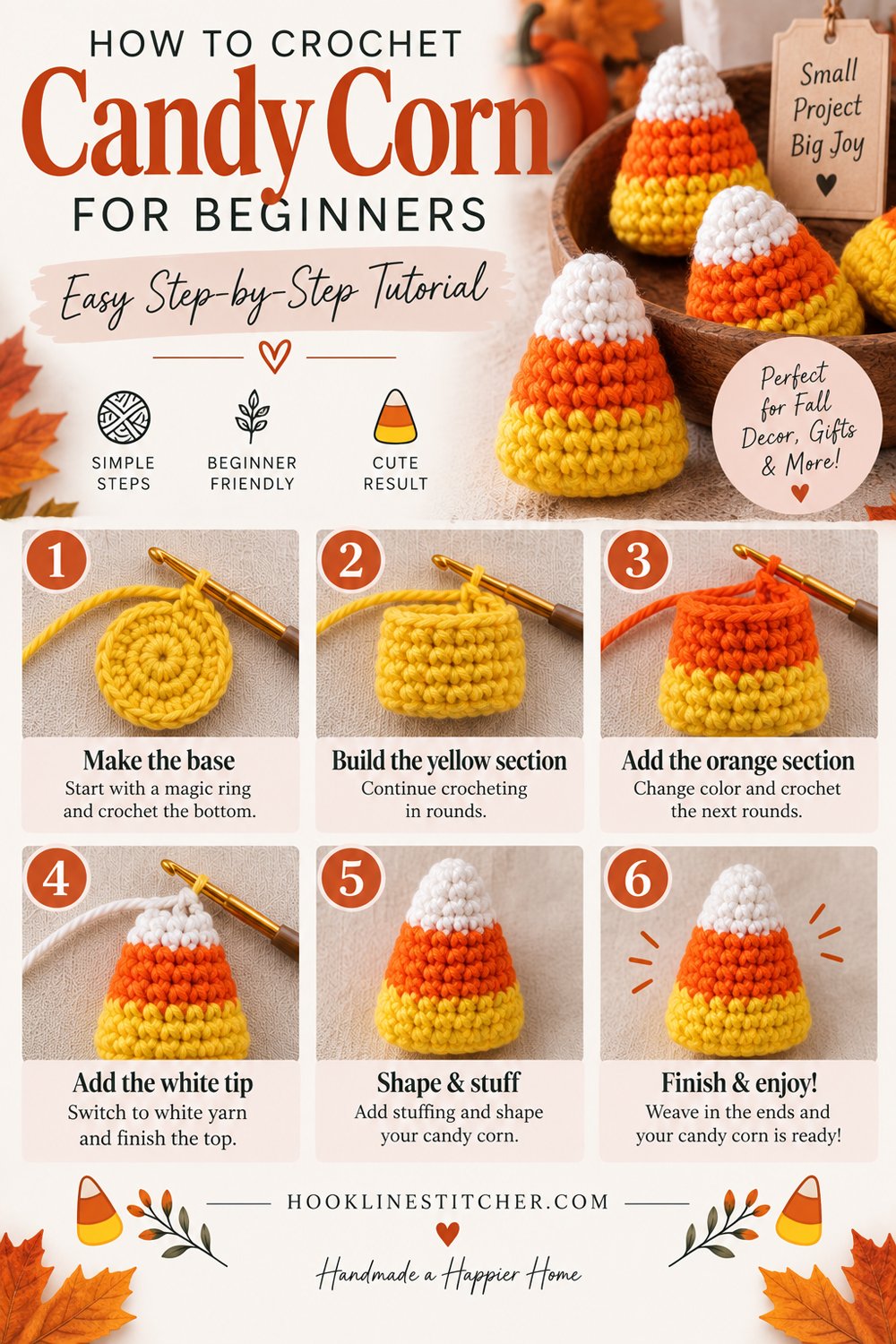
Candy corn is the best project for learning to change colour, and it’s not close. Below is how to crochet candy corn as a flat triangle, and how to change colour cleanly while you do it.
Colour changes intimidate beginners more than they should. The technique takes about four seconds, but people usually meet it for the first time halfway through a blanket, where a botched change means unpicking twenty rows. That’s the wrong place to learn it.
A crochet candy corn is a flat triangle with two colour changes in it. It takes fifteen minutes. If you mess up a change, you’ve lost seven minutes and you can immediately do it again. By the time you’ve made six, changing colour is automatic.
They’re also genuinely useful — garland, ornaments, appliques, or just a bowl of them by the door.
From the shop · New pattern
A sweet cat-ear coaster in just 5 rounds. Beginner friendly, printable 7-page PDF for $4.99.
See the pattern →What you need to know first
- Chain stitch
- Single crochet
- Decreasing — two stitches worked together
- Turning at the end of a row
What you need
Worsted weight (4) yarn in yellow, orange and cream. About four metres of each.
A colour note: mustard, burnt orange and cream look considerably better in a house than bright yellow, neon orange and white. The muted version reads as decor; the bright version reads as packaging. Both are recognisable as candy corn.
A 4.0mm hook — slightly smaller than worsted usually calls for, so the triangle holds its shape.
A tapestry needle and scissors.
From the shop · New pattern
A sweet cat-ear coaster in just 5 rounds. Beginner friendly, printable 7-page PDF for $4.99.
See the pattern →Cathrinee’s Supply Kit
Everything you need for this project
Terms
US crochet terms.
- ch = chain · sc = single crochet (UK double crochet) · dec = decrease · st(s) = stitch(es)
How to change colour
Worth thirty seconds before you start, because doing it the wrong way leaves a visible bump at every change.
The rule: change colour on the last step of the previous stitch, not at the start of the new one.
So on the final stitch before a change: insert your hook, yarn over and pull up a loop as normal, then drop the old colour and pick up the new one to complete the stitch — the yarn over and pull through both loops.
That way the new colour’s first full stitch is already the right colour at the top, and the transition looks clean. Changing at the start of the next row instead leaves the old colour poking up through the new one.
Leave 10 cm tails at each change and weave them in at the end.
How to crochet candy corn, row by row
Worked from the wide bottom up to the point. Finished candy corn roughly 8 cm tall.
Yellow section
Ch 13.
- Row 1: sc in the 2nd ch from hook and in each ch across — (12)
- Row 2: ch 1, turn, dec, sc in next 8, dec — (10)
- Row 3: ch 1, turn, sc in each st across — (10)
Change to orange on the last stitch of row 3.
Orange section
- Row 4: ch 1, turn, dec, sc in next 6, dec — (8)
- Row 5: ch 1, turn, sc in each st across — (8)
- Row 6: ch 1, turn, dec, sc in next 4, dec — (6)
Change to cream on the last stitch of row 6.
Cream section
- Row 7: ch 1, turn, sc in each st across — (6)
- Row 8: ch 1, turn, dec, sc in next 2, dec — (4)
- Row 9: ch 1, turn, dec, dec — (2)
- Row 10: ch 1, turn, dec — (1)
Fasten off and weave in all the ends — two passes in opposite directions each, or they’ll work loose.
The proportions matter. Real candy corn has a wide yellow base, a broader orange middle, and a small white tip. That’s why the cream section is the shortest here. If you make all three bands equal, it stops looking like candy corn and starts looking like a striped triangle.
The optional edging
A round of single crochet all the way around sharpens the shape and stops the edges curling.
In cream, or in a contrasting colour: ch 1, then sc evenly around the whole triangle, working 3 sc into the point and 3 sc into each bottom corner. Join with a slip stitch and fasten off.
One sc into the end of each row along the slanted sides. If it looks crowded as you go, skip one.
Troubleshooting
There’s a bump at each colour change. You changed at the start of the new row instead of on the last step of the previous stitch. See the colour change section above.
The edges are curling. Normal for single crochet, and the edging round fixes it. Blocking also helps — dampen it and press it flat under a book overnight.
It’s not triangular. The decreases need to be at both ends of the decrease rows, one at each edge. Check that every decrease row starts and ends with a dec.
The sides are uneven. Count every row. It’s a small piece, so a single missed stitch shows.
The point is too blunt. Row 10 should bring you to a single stitch. If you stopped at two, work one more decrease.
My ends keep coming loose. A small piece with six tails needs each one woven in twice, in opposite directions. Don’t trim flush — leave a few millimetres.
Variations
Garland. Make eight to twelve and chain about 10 stitches between each, joining as you go. The single most effective Halloween decoration per hour of work.
Ornaments. Add a chain loop to the point. Ch 10, slip stitch back down every chain, attach.
Appliques. Sew onto a plain tote bag, a cushion, or a child’s jumper.
Coasters. Make them larger — start with ch 21 and add three or four rows to each colour section — and add a firm edging round in cotton.
A bowl of them. Twelve candy corn in a wooden bowl by the front door. Simple, and it’s a decoration that takes one evening.
Reverse colours. Cream at the bottom and yellow at the tip. Not accurate, and it looks good in a group with the standard ones.
Why this is a good teaching project
The reason to make this one early isn’t that it’s Halloween. It’s that colour changing is a skill you’ll use constantly — striped blankets, granny squares, amigurumi with markings, colour-blocked bags — and almost nobody gets a low-stakes place to learn it.
Fifteen minutes and four metres of yarn is as low-stakes as practice gets. Make six, and the technique is yours permanently.
More seasonal ideas: Easy Crochet Halloween Projects for Beginners →
Frequently asked questions
How do you change colour in crochet?
Complete the last stitch of the old colour up to the final step, then drop the old yarn and use the new colour to finish that stitch. Changing at the start of the next row leaves a visible bump.
How long does it take to crochet candy corn?
About fifteen minutes each, faster once you’ve made a few.
What yarn colours should I use for crochet candy corn?
Yellow, orange and cream. Muted shades — mustard, burnt orange, cream — look better in a house than bright versions.
How do I stop my crochet candy corn curling?
Work an edging round of single crochet around the whole triangle, and block it flat.
How many should I make for a garland?
Eight to twelve, chained together with about 10 chains between each.
Is candy corn a good beginner crochet project?
It’s an excellent one. It’s small, it’s fast, and it’s the best low-risk place to learn colour changes.
How do you crochet candy corn?
Work a flat triangle in three colour bands — white at the narrow tip, then orange, then yellow at the wide base. Make two identical triangles, then single crochet them together around the edge, stuffing lightly before you close.
What colours do I need for crochet candy corn?
White, orange and yellow, in that order from tip to base. Those three bands are the whole identity of the shape — get the order right and it reads instantly, even if the triangle is not perfectly even.
How do I change colour neatly on candy corn?
Change on the last stitch of the row before, working until two loops remain on the hook, then dropping the old colour and finishing the stitch with the new one. This puts the join inside the stitch and gives a clean horizontal line.
Can I make candy corn without sewing?
Yes. Hold the two triangles together and single crochet around the edge through both layers with your hook. That joins and edges them in one pass, and needs no yarn needle except for weaving in the ends.
What can I use crochet candy corn for?
Garlands, bowl fillers, hair clips, keychains or gift toppers. They take about twenty minutes each and use almost no yarn, which makes them one of the best Halloween projects to batch.


One comment on “How to Crochet Candy Corn for Beginners: Easy Step-by-Step Tutorial”