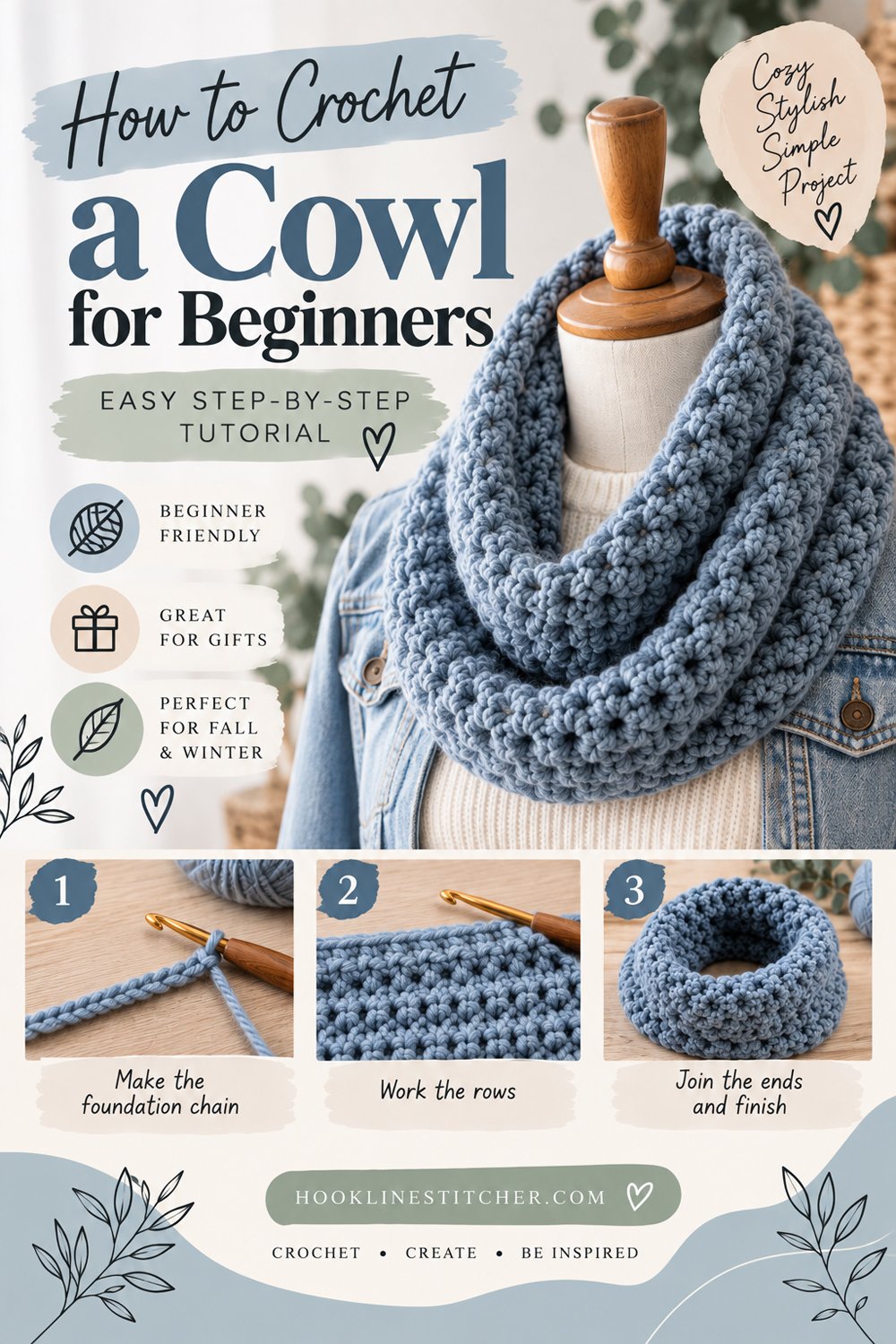
Learning how to crochet a cowl gives you something a scarf can’t: a finished object in an evening, with no ends dangling and nothing to tie.
A cowl is a loop. That’s the whole design. And because it’s a loop, it has one quality that makes it ideal for a beginner — nobody can see where it starts. On a scarf, both ends are on display and every unevenness in your first rows sits right under someone’s chin. On a cowl, the seam goes at the back of the neck and your early rows disappear.
Two to three hours. One evening.
What you need to know first
- Chain stitch
- Half double crochet or double crochet
- Turning at the end of a row
- Seaming two edges together — or not, if you choose the second method below
Two ways to make a cowl
Both give the same result. They differ in which part you find easier.
The flat method. Crochet a long rectangle, then seam the two short ends together. Easiest to work, because it’s just rows. You do have one seam to sew.
The round method. Chain a length, join it into a ring, and work round and round. No seam at all, but the starting chain has to be joined without twisting — and if it twists, you get a Möbius loop and have to start again.
For a first cowl, use the flat method. The seam takes five minutes and there’s nothing that can go irreversibly wrong.
What size should a crochet cowl be?
| Style | Circumference | Height |
|---|---|---|
| Snug neck warmer | 55–60 cm | 20 cm |
| Standard cowl | 65–70 cm | 25 cm |
| Loose, drapey | 80–90 cm | 30 cm |
| Double-wrap infinity | 130–140 cm | 20 cm |
The number that matters is 55 cm. Below that it won’t go over an adult head. Check by measuring loosely around your head from crown to chin — a cowl must clear that, not just fit your neck.
What you need
Worsted weight (4) yarn, about 200 metres for a standard cowl. Soft is the priority here — this sits directly against the neck. Merino, a soft acrylic, or an alpaca blend. Avoid anything scratchy, and avoid cotton, which has no warmth and no give.
A 5.5mm hook.
A tapestry needle and scissors.
Cathrinee’s Supply Kit
Everything you need for this project
Terms
US crochet terms.
- ch = chain · hdc = half double crochet (UK half treble) · sl st = slip stitch · BLO = back loop only · st(s) = stitch(es)
The pattern — flat method
Worked sideways. The rows run around the cowl, not up it, which means your starting chain sets the height and the number of rows sets the circumference.
That’s worth understanding, because it’s the opposite of what people expect.
Step 1: The starting chain
Ch 42 for a 25 cm high cowl.
Measure it flat before going further — it should be about 25 cm without stretching. Add or remove chains to suit.
Step 2: The rows
Row 1: hdc in the 3rd ch from the hook and in each ch across. (40)
Row 2: Ch 2, turn. hdc BLO in each st across. (40)
Repeat row 2 until the piece measures your chosen circumference — about 65 cm for a standard cowl, which is usually 70 to 80 rows.
Why back loop only: it turns flat half double crochet into a stretchy vertical rib. The cowl gains give, so it stretches over a head and springs back around a neck. Worked through both loops you’d get a flat, stiff tube. This one technique is what makes the difference between a cowl and a fabric loop.
Count every row — 40 stitches, always. On a piece this long a drift of one stitch per row becomes a visible wedge, and the counting habits here take eight seconds a row.
Step 3: Seaming
Fasten off, leaving a tail about three times the height of the cowl — roughly 75 cm.
Bring the two short ends together. Check the piece isn’t twisted before you sew: lay it flat in a loop on a table and make sure the ribs all run the same direction.
Thread the tail and whip stitch across, catching one stitch from each side. Work all the way along, then go back through the same stitches in the opposite direction for strength.
Turn the cowl so the seam is inside, and weave the end in.
Troubleshooting your crochet cowl
It won’t go over my head. Too short. It needs at least 55 cm of circumference — add rows. There’s no fix after seaming except unpicking the seam and adding more.
It’s baggy and hangs like a loop of rope. Too long, or the fabric is too loose. Go down a hook size next time, and check the circumference before seaming.
It isn’t stretchy. You worked through both loops instead of back loop only. The ribbing is what gives a cowl its stretch.
The seam is bulky and shows. You caught too much of each edge. Whip stitch through one stitch from each side only, and keep the tension even rather than tight.
The piece is twisted after seaming. Unpick, lay it flat, and re-seam. This is the most common cowl mistake and the reason to check before sewing.
The edges are uneven. Count every row, and put a marker in the first stitch.
It’s scratchy. The yarn. Nothing fixes that — a cowl touches the neck, so soft yarn isn’t optional.
Variations
- Infinity scarf: make it 140 cm long instead of 65, then seam. It wraps twice.
- Chunky cowl: chunky yarn and an 8.0mm hook, starting chain of 24. Done in about an hour.
- Striped: change colour every six rows. Because the rows run around the cowl, the stripes are vertical when worn.
- Buttoned cowl: don’t seam it. Add three buttons along one short end and buttonholes on the other — chain 3 and skip 3 stitches where each buttonhole goes. Then it opens flat.
- Matching set: the same yarn and stitch makes a crochet hat and fingerless mitts — a three-piece gift from about 400 metres.
Why a cowl is a better first wearable than a scarf
It’s worth saying plainly, because most beginners start with a scarf and lose interest halfway.
A scarf is 150 cm of the same row. A cowl is 65 cm of the same row — under half the work — and it looks complete rather than like a long strip. You get the finished-object feeling four times sooner, and finishing things is what keeps people crocheting.
If a scarf has been sitting unfinished in a bag for a month, this is the project to make instead.
Frequently asked questions
How do you crochet a cowl for beginners?
Crochet a long rectangle in back loop only half double crochet, then seam the two short ends together into a loop. The rows run around the cowl, so the starting chain sets the height.
How big should a crochet cowl be?
At least 55 cm around so it passes over an adult head, and 20–30 cm tall. A standard cowl is about 65 cm around and 25 cm tall.
How much yarn does a crochet cowl need?
About 200 metres of worsted weight yarn for a standard cowl.
Why isn’t my crochet cowl stretchy?
You worked through both loops instead of back loop only. Working in back loops creates the ribbing that gives a cowl its stretch.
Is a cowl easier than a scarf for beginners?
Yes. It’s less than half the work of a scarf, and the seam hides your first rows at the back of the neck where nobody sees them.
How long does it take to crochet a cowl?
Two to three hours in worsted weight, or about an hour in chunky yarn.
What yarn is best for a crochet cowl?
Something soft — merino, a soft acrylic or an alpaca blend. A cowl sits against the neck, so avoid scratchy yarn and cotton.


One comment on “How to Crochet a Cowl for Beginners: Easy Step-by-Step Tutorial”