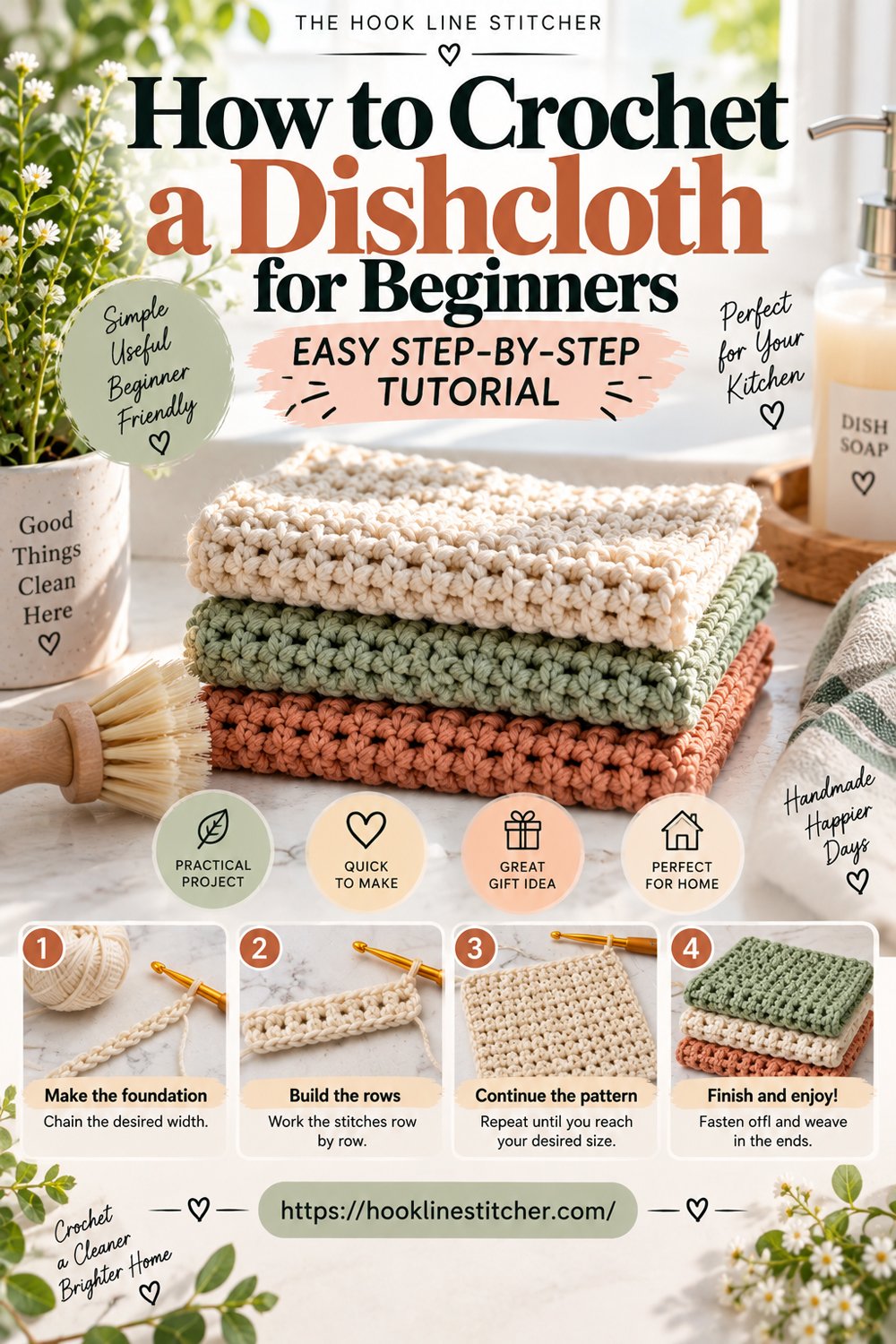
The dishcloth is the traditional second crochet project, and it deserves the position for a reason that isn’t obvious. Below is how to crochet a dishcloth in three stitch options, and why cotton is the only yarn that works.
It’s the first thing you’ll make that’s big enough to be honest with you.
A coaster is small enough that tension problems hide. A dishcloth is about 20 cm square, which is roughly thirty rows — long enough that if your tension drifts, or your edges creep, you will see it. That’s uncomfortable and it’s the fastest way to improve, because you can make a second one the same week with the lesson applied.
It’s also genuinely useful. Cotton dishcloths outperform shop-bought cloths noticeably, they wash hot, and they last months rather than weeks.
About 45 minutes.
From the shop · New pattern
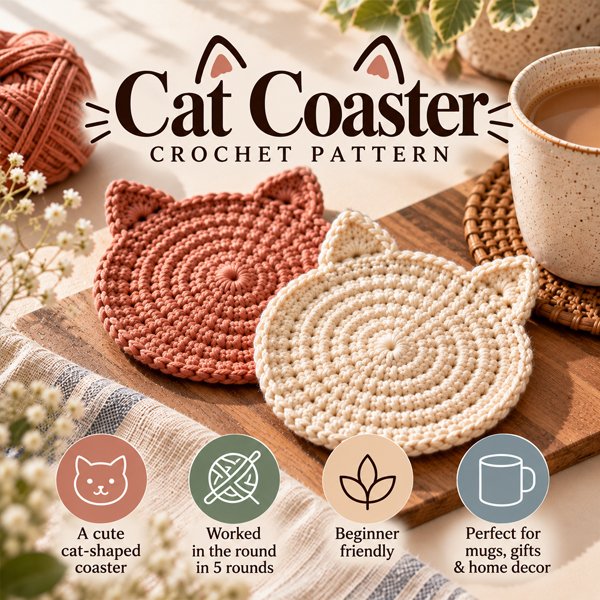
A sweet cat-ear coaster in just 5 rounds. Beginner friendly, printable 7-page PDF for $4.99.
See the pattern →What you need to know first
- Chain stitch
- Single crochet
- Turning at the end of a row
What you need
100% cotton yarn, worsted weight. This isn’t a preference. Cotton absorbs water, scrubs without scratching, and survives a hot wash. Acrylic does none of those things — it repels water rather than absorbing it, which makes it useless for washing up, and it can melt against a hot pan.
If a dishcloth pattern doesn’t specify cotton, it was written by someone who hasn’t used the result.
A 5.0mm hook.
A tapestry needle and scissors.
About 40 metres — most of a 50g ball.
From the shop · New pattern
A sweet cat-ear coaster in just 5 rounds. Beginner friendly, printable 7-page PDF for $4.99.
See the pattern →Cathrinee’s Supply Kit
Everything you need for this project
Terms
US crochet terms.
- ch = chain · sc = single crochet (UK double crochet) · dc = double crochet (UK treble) · st(s) = stitch(es)
How to crochet a dishcloth: the basic pattern
Finished cloth around 20 cm square.
Ch 31.
Row 1: sc in the 2nd ch from hook and in each ch across — (30)
Row 2: ch 1, turn, sc in each st across — (30)
Repeat row 2 until the piece is square — roughly 28 to 32 rows depending on your tension.
How to know when it’s square: fold one corner diagonally across to the opposite edge. If the fold reaches exactly, it’s square. Much more reliable than measuring.
Fasten off and weave in the ends, going one direction through the back of the stitches and then back the other way.
The turning chain: the ch-1 at the start of each row is height only. It is never a stitch, and you should never work into it at the end of the next row. Doing so is the main reason beginner dishcloths come out as trapezoids.
Count every row. Thirty, always.
Two better stitch options
The plain single crochet version works. These two work better, and neither is harder.
The moss stitch version
Makes a more absorbent, more flexible cloth with a woven-looking texture.
Ch 32.
Row 1: sc in the 2nd ch from hook, ch 1, skip 1 ch, sc in next ch, repeat across.
Row 2: ch 1, turn, sc in the ch-1 space, ch 1, skip the sc, repeat across, ending with sc in the last space.
Repeat row 2 until square.
The small gaps hold water better than solid fabric, and the cloth stays flexible when wet instead of going stiff.
The double thickness version
For a cloth that scrubs harder and lasts longer.
Work the basic single crochet pattern with two strands of cotton held together on a 6.0mm hook, and start with ch 25 instead of 31.
Thicker, more absorbent, and it holds up to considerably more use.
The optional edging
A round of single crochet all the way around tidies the edges and stops them stretching with use.
Ch 1, then sc evenly along each side, working 3 sc into each corner so the corners turn sharply. Join with a sl st and fasten off.
“Evenly” means one sc into the end of each row along the sides. If it looks crowded or gappy as you go, add or skip one. Nobody inspects a dishcloth.
Troubleshooting
It’s coming out as a trapezoid. Either you’re working into the turning chain at the end of rows (getting wider) or skipping the first stitch after turning (getting narrower). Mark the first stitch of each row until the habit forms.
The edges are wavy. Uneven tension. It settles as you make more, and an edging round disguises a lot.
It’s stiff and doesn’t drape. Tension too tight. Go up a hook size. Cotton is less forgiving than acrylic, so tight crochet shows more.
It curls. Common in single crochet. Usually resolves after washing once. If not, tension is too tight.
It’s not absorbing. The yarn isn’t cotton, or isn’t fully cotton. Check the label — a cotton-acrylic blend absorbs poorly.
It went hard and crunchy after washing. Normal for cotton, and it softens again within a few uses. Don’t use fabric softener; it coats the fibres and reduces absorbency.
How long they last and how to wash them
A cotton dishcloth used daily lasts around three to six months before it starts looking tired. That’s considerably longer than a shop-bought sponge.
Machine wash hot with towels. Cotton handles 60°C, which is what actually sanitises a cloth.
Don’t use fabric softener.
Air dry or tumble dry. Either is fine; cotton doesn’t mind.
Make six at once. One in use, one in the wash, four in the drawer. A single dishcloth is a project; six is a functioning kitchen supply.
What’s next
The crochet pot holder is the natural companion — same yarn, same stitch, one important safety rule.
More project ideas: Easy Crochet Projects for Fall →
Frequently asked questions
What yarn should I use for crochet dishcloths?
100% cotton, worsted weight. Acrylic doesn’t absorb water and can melt against heat, which makes it unsuitable regardless of how it looks.
How big should a crochet dishcloth be?
Around 20 cm square. Big enough to wrap around a plate, small enough to wring out easily.
How many stitches for a crochet dishcloth?
Chain 31 for 30 single crochet stitches across, then work about 30 rows.
Why is my crochet dishcloth not square?
Your stitch count is drifting — usually by working into the turning chain, which adds a stitch each row.
How long does a crochet dishcloth last?
Three to six months with daily use and hot washing.
Can you put crochet dishcloths in the washing machine?
Yes, cotton ones can be washed hot with towels. Avoid fabric softener, which reduces absorbency.
Is a dishcloth a good beginner project?
It’s one of the best. Simple stitches, but large enough that tension problems become visible — which is exactly what a beginner needs to see.
How do you crochet a dishcloth?
Chain to your desired width, then work rows of single crochet or half double crochet until the piece is square. Finish with a single crochet border. It is the simplest useful project in crochet — a flat square, no shaping at all.
What yarn should I use for crochet dishcloths?
Cotton, always. Cotton absorbs water, survives boiling and bleach, and dries without going sour. Acrylic does not absorb, melts against hot pans, and is genuinely unpleasant to wash dishes with.
What size should a crochet dishcloth be?
Between 7 and 9 inches square. That is large enough to be useful in the hand and small enough to dry quickly, which is what keeps a dishcloth from developing a smell.
Which stitch is best for a dishcloth?
Single crochet for a dense scrubby cloth, or the moss stitch for a more textured, absorbent one. Avoid tall open stitches like double crochet — the gaps make the cloth floppy and less effective.
How long does a crochet dishcloth take?
About an hour for a first one and forty minutes after that. They use around 60 yards of cotton, so one ball makes two or three, which makes them an ideal quick gift set.


One comment on “How to Crochet a Dishcloth for Beginners: Easy Step-by-Step Tutorial”