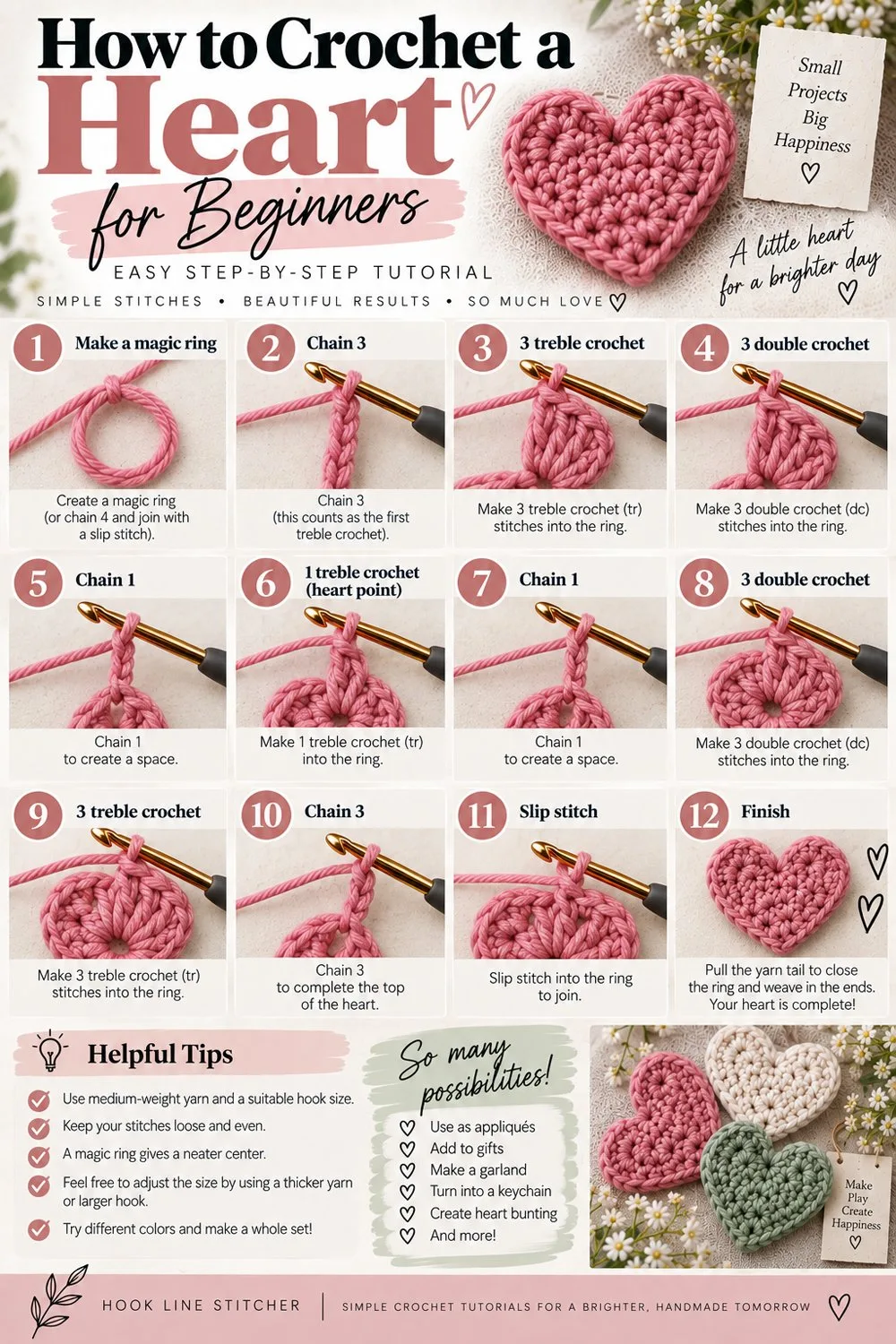
A crochet heart takes about ten minutes and uses less than five metres of yarn. This guide covers how to crochet a heart in three sizes, with the stitch count given at every step.
- Skill level: Beginner (uses double and treble crochet)
- Yarn: Worsted weight (4)
- Hook: 4.0mm or 4.5mm
- Terms: US crochet terms
That combination makes it one of the best beginner projects there is. It’s finished in a single sitting, so you actually get the satisfaction of holding something at the end — which matters far more when you’re learning than anyone admits. And because it’s worked entirely in one round, there’s no turning, no counting rows, and none of the edge problems that make first blankets go crooked.
The clever part is how the shape happens. You don’t shape a heart by increasing and decreasing. You make it by working stitches of different heights out from a single centre point, so the tall ones push out into the lobes and the short ones pull in at the sides. Once you see that, the pattern stops looking like magic.
Free pattern below, in three sizes, with an optional edging.
From the shop · New pattern
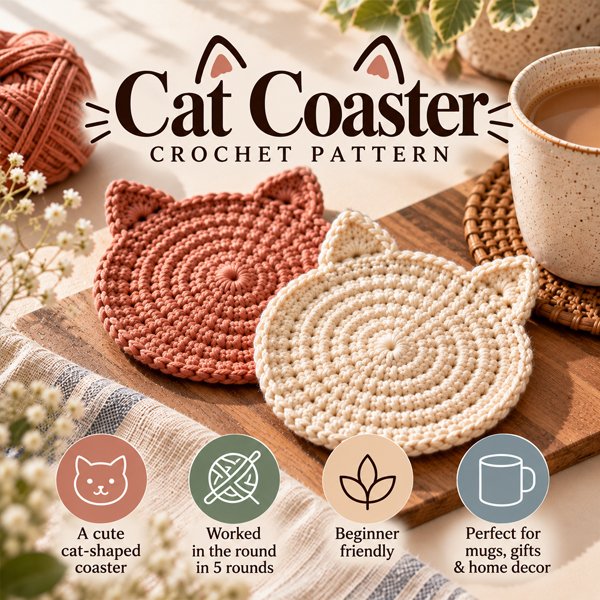
A sweet cat-ear coaster in just 5 rounds. Beginner friendly, printable 7-page PDF for $4.99.
See the pattern →What you need to know first
This is a beginner project, but not a first-day-of-crochet project. You’ll want to be comfortable with:
- Chain stitch
- Double crochet
- Treble crochet — one step taller than double crochet
- Single crochet, if you want to add the edging
- The magic ring — though there’s a workaround below if you haven’t learned it yet
If treble crochet is new, it’s worth ten minutes before you start. It’s double crochet with one extra yarn over at the beginning and one extra “through two” at the end.
What you need
- Worsted weight yarn (weight 4) in whatever colour you want the heart to be. Cotton gives crisper edges and holds its shape better; acrylic is softer and more forgiving. For appliques and decorations, cotton is the better choice.
- A 4.0mm or 4.5mm hook. Smaller than you’d normally pair with worsted. Going down a size gives a tighter fabric with no gaps, which matters a lot for a small dense shape like this.
- A tapestry needle for weaving in ends.
- Scissors.
Scraps are perfect here. A single heart uses so little yarn that this is an ideal project for the leftovers you can’t bring yourself to throw out.
From the shop · New pattern
A sweet cat-ear coaster in just 5 rounds. Beginner friendly, printable 7-page PDF for $4.99.
See the pattern →Cathrinee’s Supply Kit
Everything you need for this project
A note on terms
This pattern uses US crochet terms.
- ch = chain
- sl st = slip stitch
- dc = double crochet (UK treble)
- tr = treble crochet (UK double treble)
- sc = single crochet (UK double crochet)
🧶 Need supplies? Good picks on Amazon: worsted weight yarn, an ergonomic crochet hook set and locking stitch markers. (affiliate links)
How to crochet a heart: the small size
Finished size roughly 5 cm across, worked in worsted weight yarn on a 4.0mm hook.
Everything is worked into a magic ring. The whole heart is one round.
Start: Make a magic ring.
No magic ring? Chain 4 and slip stitch into the first chain to make a small loop, then work into the loop instead. It leaves a tiny hole at the point, which you can close with the tail when you weave in. Fine for a first attempt.
Into the ring, work the following in order:
- Ch 3 — this stands as your first dc and forms one half of the bottom point
- 3 dc
- 3 tr
- Ch 1 — this is the dip between the two lobes
- 3 tr
- 3 dc
- Ch 3
- Sl st into the ring to close
Then: pull the tail of the magic ring firmly to draw the centre closed. The stitches will bunch together and the heart shape will appear as they do. This is the satisfying bit.
Fasten off, leaving a tail long enough to weave in — or long enough to sew the heart onto something, if that’s the plan.
Reading the shape
Look at what you just made and match it to the pattern:
- The two ch-3s and the closed ring form the bottom point
- The dc groups are the sides, sloping up
- The tr groups are the lobes — taller stitches reach further from the centre
- The ch-1 is the dip at the top, where nothing fills the gap
That’s the whole logic. Taller stitch, further out. Once it clicks you can adjust any heart pattern to whatever shape you like.
Two more sizes
Tiny heart (about 3 cm) — good for earrings, cards, garland on fine yarn:
Use DK or sport weight yarn with a 3.0mm hook. Into a magic ring: ch 2, 2 dc, 2 tr, ch 1, 2 tr, 2 dc, ch 2, sl st into ring.
Large heart (about 8 cm) — good for coasters, cushion appliques, bunting:
Use chunky yarn (weight 5) with a 5.5mm hook, and keep the pattern exactly as written for the small heart. Changing yarn and hook is the easiest way to resize — no maths, same instructions.
For anything larger than about 10 cm, a single-round heart gets floppy and loses its shape. At that size you want an edging round, or a heart worked flat in rows instead.
Optional edging
An edging round in a contrasting colour makes the heart look considerably more finished, and it firms up the shape. Worth doing for anything that will be seen up close.
Join your second colour anywhere along an edge, then single crochet evenly all the way around the heart, with two adjustments:
- At the bottom point: work 3 sc into the same spot, so the corner turns sharply instead of rounding off
- At the top dip: work a sl st instead of a sc, so the notch stays pinched rather than filling in
Join with a sl st to your first stitch and fasten off.
“Evenly” is doing some work in that sentence, so here’s what it means in practice: one sc into the top of each dc, and two sc up the side of each tr, because tr stitches are taller and leave more space along the edge. If a section looks crowded or gappy when you get there, add or skip one. On a shape this small, nobody will ever know.
Troubleshooting
My heart looks like a circle. The height difference between your stitch groups isn’t pronounced enough. Check that your trebles are genuinely taller than your doubles — beginners often work trebles short by not pulling the first loop up far enough. If they’re the same height, the shape has nowhere to come from.
My heart is floppy and won’t hold its shape. Tension is too loose for this project. Go down a hook size, or switch to cotton yarn. Single-round shapes need a firmer fabric than you’d want for a blanket.
There’s a hole at the bottom point. The magic ring wasn’t pulled fully closed, or you used the chain-loop method. Pull harder on the tail. If it still gapes, use the tail and a tapestry needle to stitch it shut from the back — takes ten seconds and it’s invisible.
The dip at the top disappeared. Your ch-1 is too loose, or you accidentally worked a stitch into it. It should be a single chain with nothing worked into it.
The two lobes are different sizes. Count your stitch groups. It’s easy to work four trebles on one side and three on the other when everything is crowded into one ring. Counting as you go is genuinely difficult on this pattern because the stitches bunch — take it slowly.
Everything is too crowded to fit into the ring. It will feel crowded. That’s normal and correct — a magic ring holds far more than it looks like it can. Push the stitches around the ring as you work so they don’t pile up in one spot.
What to make with them
Small hearts are the most useful shape in crochet, mostly because they’re so quick:
- Appliques sewn onto bags, hats, cushions, or a plain jumper
- Garland — chain between hearts and hang them along a shelf or mantel
- Bunting for a nursery or a party
- Gift toppers instead of a bow
- Bookmarks, with a chain and a tassel
- Keyrings, worked in cotton and backed with a second heart
- Cards — glued onto card stock
- Coasters, using the large size with an edging round
Make ten in an evening while you’re watching something. They stack up faster than you’d expect.
What’s next
If this went well, the natural next step is a crochet flower — same principle, different arrangement of stitch heights, and it uses the magic ring again.
If the magic ring was the hard part, it’s worth learning properly on its own before your next project. It shows up in nearly everything worked in the round, and the chain-loop workaround becomes a limitation quickly.
Looking for more small projects like this one? Here are 15 easy crochet patterns for beginners, ordered from simplest to hardest.
Frequently asked questions
How long does it take to crochet a heart?
About ten minutes for the small size once you’re comfortable with the stitches. The first one might take twenty-five, mostly spent working out how to fit everything into the ring.
How much yarn does a crochet heart use?
Under five metres for the small size. It’s one of the best scrap-yarn projects there is.
What’s the best yarn for crochet hearts?
Cotton, if the shape needs to stay crisp — appliques, coasters, anything sewn onto something else. Acrylic is softer and easier to work with, and fine for garland or decorations.
Can beginners crochet a heart?
Yes, as long as you can chain, double crochet, and treble crochet. There’s no shaping, no rows, and no turning, which removes most of what makes early projects go wrong.
Do I need a magic ring to crochet a heart?
No. Chain 4 and slip stitch into the first chain to make a loop, then work into that loop. It leaves a small hole at the point that you can close with the tail.
Why is my crochet heart round instead of heart-shaped?
Your taller stitches aren’t tall enough. The shape comes entirely from the height difference between the double and treble crochet groups — if they’re similar heights, you get a circle.
Can I make the heart bigger?
Use thicker yarn and a larger hook with the same instructions. That’s easier and more reliable than adding stitches, which distorts the shape.
You are welcome to sell items you make from this pattern. Please do not republish the pattern text — link to this page instead. Pattern © The Hook Line Stitcher.
How do you crochet a heart?
Work two small half-circles side by side for the top lobes, join them, then decrease down to a point at the bottom. The whole heart is usually a single small piece worked flat in a few rounds.
Why is my crochet heart lopsided?
The two top lobes have different stitch counts. Count each lobe separately before joining them — they must match exactly, or the heart pulls to one side no matter how you block it.
What can I make with crochet hearts?
Garlands, appliqués on bags and blankets, keychains, card decorations, bookmarks or Valentine gifts. They take about fifteen minutes each and store flat.
What yarn is best for crochet hearts?
Cotton in red, pink or cream. Cotton holds the point at the bottom and the curve of the lobes crisply. Acrylic works but the shape is softer and benefits from pressing.
How do I make my crochet heart lie flat?
Block it. Dampen the finished heart, pin it into shape with the point pulled straight, and let it dry. Cotton will hold the shape permanently.


One comment on “How to Crochet a Heart for Beginners: Easy Step-by-Step Tutorial”