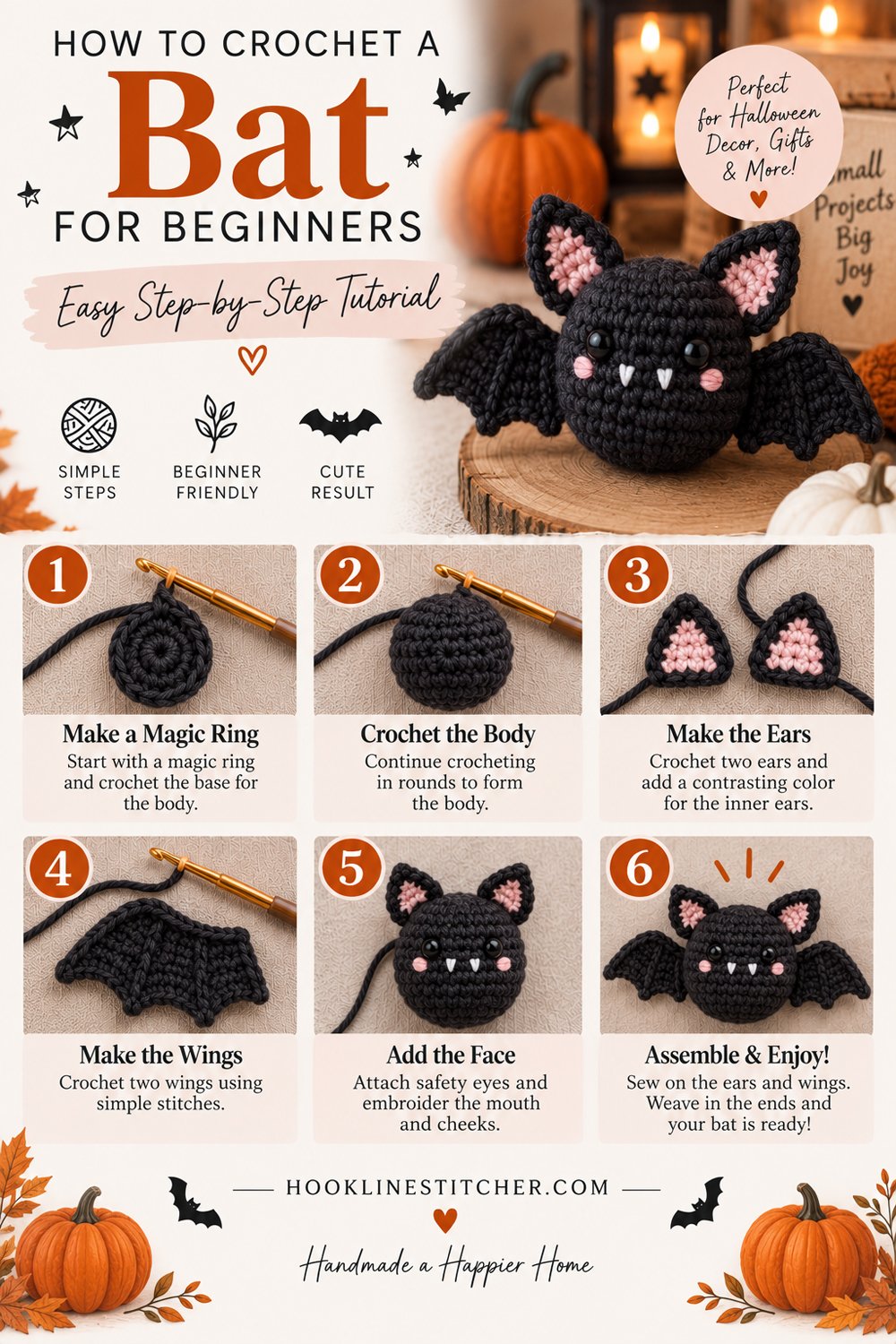
A crochet bat is the best value in Halloween crochet — thirty minutes, and it looks like considerably more than thirty minutes. Below is how to crochet a bat from a small stuffed body and two flat wings.
That’s mostly because of the wings. Wings suggest complexity, and these are flat triangles worked in rows with a decrease at each end. If you can single crochet and decrease, you can make them. They’re also the part that makes the bat read as a bat rather than a small dark blob, so you get a lot of recognition for very little difficulty.
The body is the simplest possible amigurumi: increase out, work straight, decrease in, stuff, close.
Make five. Bats look best in a group, and by the fourth one you’ll be making them in twenty minutes.
From the shop · New pattern
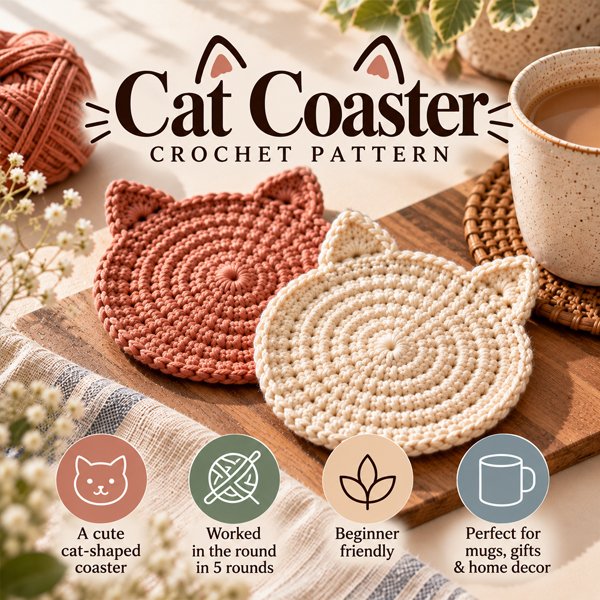
A sweet cat-ear coaster in just 5 rounds. Beginner friendly, printable 7-page PDF for $4.99.
See the pattern →What you need to know first
- Single crochet
- The magic ring
- Working in a continuous spiral
- Increasing and decreasing
- Working in rows and turning, for the wings and ears
What you need
Worsted weight (4) or DK (3) yarn in charcoal, black or dark plum. Charcoal photographs far better than true black — black swallows all the stitch definition and makes the bat look like a shadow.
A 3.5mm hook for worsted, 3.0mm for DK.
A small amount of stuffing.
A stitch marker, a tapestry needle, and a little white or cream yarn for the eyes.
About 25 metres.
From the shop · New pattern
A sweet cat-ear coaster in just 5 rounds. Beginner friendly, printable 7-page PDF for $4.99.
See the pattern →Cathrinee’s Supply Kit
Everything you need for this project
Terms
US crochet terms.
- MR = magic ring · ch = chain · sc = single crochet (UK double crochet)
- inc = 2 sc into the same stitch · dec = decrease · st(s) = stitch(es)
Use the invisible decrease — front loops only of the next two stitches, then yarn over through two, yarn over through two. It disappears into the fabric where a standard decrease leaves a bump.
How to crochet a bat, piece by piece
Body
Worked in a continuous spiral. Keep a marker in the first stitch of each round.
- R1: 6 sc in MR — (6)
- R2: inc in each st — (12)
- R3: (sc, inc) x6 — (18)
- R4–R9: sc in each st around, six rounds — (18)
- R10: (sc, dec) x6 — (12)
Stuff firmly now, before the opening gets too small.
- R11: dec x6 — (6)
Fasten off with a 20 cm tail. Run it through the front loop of each remaining stitch and pull tight to close.
Ears (make 2)
Worked flat, in rows. Ch 5.
- R1: sc in the 2nd ch from hook and across — (4)
- R2: ch 1, turn, dec, dec — (2)
- R3: ch 1, turn, dec — (1)
Fasten off, leaving a tail for sewing. You should have a small triangle. Don’t stuff it.
Wings (make 2)
Also worked flat. Ch 11.
- R1: sc in the 2nd ch from hook and across — (10)
- R2: ch 1, turn, dec, sc in next 6, dec — (8)
- R3: ch 1, turn, dec, sc in next 4, dec — (6)
- R4: ch 1, turn, dec, sc in next 2, dec — (4)
Fasten off, leaving a long tail for sewing.
Optional scalloped edge, which is what makes it read as a bat wing rather than a triangle: along the long slanted edge, work sl st, ch 3, sl st repeatedly. Two minutes, and it changes the shape noticeably.
Assembly
Ears. Sew the flat base of each triangle to the top of the body, around round 3, spaced about 6 stitches apart. Sew along the whole base, not just the corners, or the ear will swivel.
Wings. Sew the straight edge of each wing to the sides of the body, around rounds 5 to 8, with the point angling outward and slightly downward.
Look at the first wing from the front before sewing the second. Wings angled slightly down look like a bat at rest; angled up looks like it’s about to take off. Both work — just make them match.
Face. Two small white or cream stitches for eyes, around round 5, about 5 stitches apart. On a dark body, light eyes are the only thing that will show.
Keep them wide and low. It’s the difference between charming and unsettling, and instinct pulls the wrong way.
Hanging it
Thread a length of yarn through the top of the body between the ears, and knot it into a loop.
For a garland: make five or six bats and chain about 12 stitches between each, attaching as you go.
Troubleshooting
The wings look like triangles, not wings. Add the scalloped edge along the slanted side. It’s the single detail that makes the shape read correctly.
The body is lumpy. Stuffing bunched in one place. Push it out toward the edges before closing.
I can see stuffing through the fabric. Hook too large. Go down a size.
The ears flop. Sew along the full base of the triangle rather than tacking the corners.
The face doesn’t show. On black yarn it won’t. Use charcoal instead, and light-coloured eyes.
The wings are different sizes. Count the rows. Both wings need the same starting chain and the same number of rows.
Variations
A tiny bat. Stop the body increases at round 2 (12 stitches) and work four straight rounds. Wings from ch 8 instead of ch 11. Good for garland, where small is better.
Coloured bats. Dusty plum, deep teal and charcoal together look far more considered than a row of black ones.
A keyring bat. Add a split ring through the hanging loop.
Fangs. Two tiny white stitches below the eyes. Subtle, and it’s the detail people notice.
A bat with its wings folded forward. Sew the wing points to the front of the body so it looks wrapped up. Slightly more work, considerably more charming.
What’s next
Bats and candy corn make the best garland combination — both are fast and both are small.
More seasonal ideas: Easy Crochet Halloween Projects for Beginners →
Frequently asked questions
How do you crochet bat wings?
Work them flat in rows, decreasing one stitch at each end of every row to make a triangle. A scalloped edge along the slanted side turns the triangle into a recognisable wing.
What yarn colour is best for a crochet bat?
Charcoal rather than true black. Black hides the stitch definition and the bat reads as a dark blob.
How long does it take to crochet a bat?
About thirty minutes for the first one, twenty once you’ve made a couple.
How do you hang a crochet bat?
Thread yarn through the top of the body between the ears and knot it into a loop, or chain between several bats to make a garland.
Is a crochet bat good for beginners?
Yes. The body is the simplest amigurumi shape and the wings are flat triangles with one decrease at each end of each row.
How much yarn does a crochet bat use?
About 25 metres, so it’s a scrap project.
How do you crochet a bat for beginners?
Make the body as a small magic-ring sphere in black, then crochet two flat wings with pointed scallops along one edge and sew them to the back. Add two small ears on top and embroider the eyes. It uses only single crochet, increases and decreases.
What yarn is best for a crochet bat?
Worsted weight black acrylic with a 3.5 mm hook. Black hides stitch definition, which is actually helpful for a first amigurumi because small irregularities barely show. Avoid fuzzy yarn — it obscures the wing shape.
How do I make the bat wings stay out instead of drooping?
Work the wings flat and do not stuff them, then sew along the whole inner edge rather than just the tip. Stiffer yarn such as cotton holds a wing shape better than soft acrylic if you want them to stand out properly.
Is a crochet bat safe for a child?
Yes if you embroider the eyes in yarn instead of using safety eyes or beads, weave in every end securely, and use a machine washable yarn and stuffing. Avoid all small attached parts for children under three.
How big is a crochet bat?
About 3 to 4 inches across the wings using worsted weight yarn and a 3.5 mm hook. For a keychain-sized bat of roughly 2 inches, use sport weight yarn with a 2.5 mm hook and follow exactly the same rounds.