Most handmade pot holders aren’t safe to use, and the people who made them don’t find out until they pick up a hot dish. Below is how to crochet a pot holder that is genuinely safe to use, starting with the yarn.
Two things go wrong. The first is yarn: acrylic is a plastic, and against a hot pan it softens, melts, and sticks to skin. It’s not a matter of it wearing out faster — it’s a burn risk. The second is thickness: a single layer of crochet, however dense, conducts heat straight through. A thin pot holder is a decorative object that lies about what it is.
Both are easy to fix and neither requires any skill you don’t already have. The pattern below is two cotton squares joined into a double layer. It’s a beginner project, it takes about two hours, and the result is one you can actually use.
From the shop · New pattern
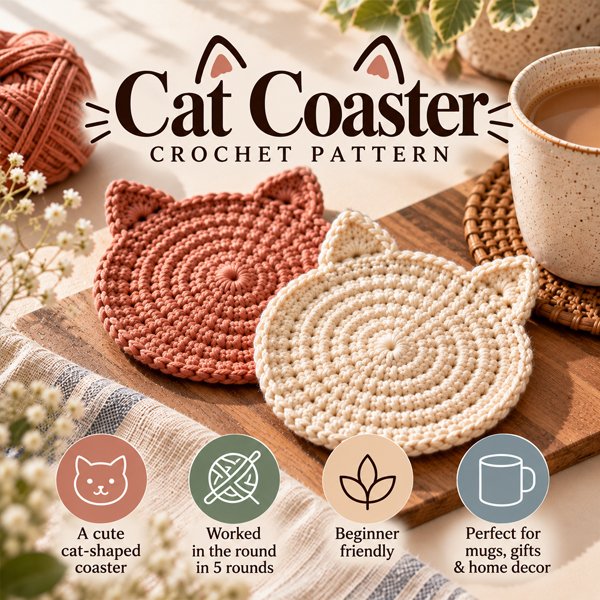
A sweet cat-ear coaster in just 5 rounds. Beginner friendly, printable 7-page PDF for $4.99.
See the pattern →The yarn rule, first
Use 100% cotton. Nothing else.
Not acrylic. Not a cotton-acrylic blend. Not a “cotton-feel” yarn. Check the label and look for 100%.
Cotton scorches rather than melting, which is what you want in something between your hand and a hot dish. Acrylic and other synthetics soften and fuse to skin, and a blend behaves like its synthetic half.
Wool is technically heat-safe but it felts in a hot wash and pot holders need washing, so cotton is the practical answer.
If all you have is acrylic, make a trivet — something that sits under a hot dish on the table, where nothing touches skin — and label it that way in your own head.
What you need to know first
- Chain stitch
- Single crochet
- Turning at the end of a row
- Joining two pieces with single crochet
What you need
100% cotton yarn, worsted weight. About 80 metres for a pair of squares.
A 4.5mm hook — one size smaller than cotton usually calls for. A dense fabric insulates better than a loose one.
A tapestry needle and scissors.
From the shop · New pattern
A sweet cat-ear coaster in just 5 rounds. Beginner friendly, printable 7-page PDF for $4.99.
See the pattern →Cathrinee’s Supply Kit
Everything you need for this project
Terms
US crochet terms.
- ch = chain · sc = single crochet (UK double crochet) · sl st = slip stitch · st(s) = stitch(es)
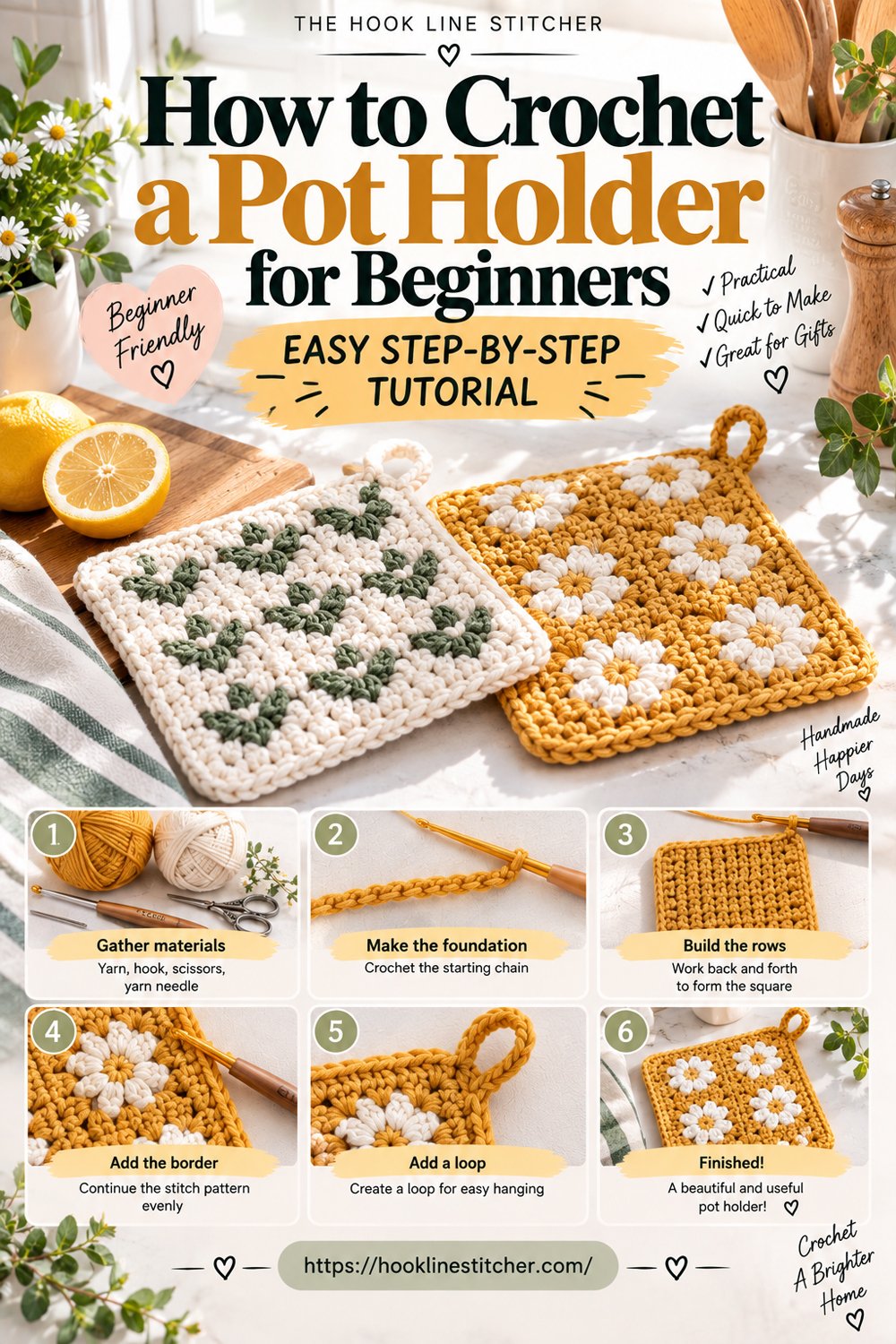
How to crochet a pot holder, step by step
Finished pot holder around 18 cm square.
Make two squares
Ch 29.
Row 1: sc in the 2nd ch from hook and in each ch across — (28)
Row 2: ch 1, turn, sc in each st across — (28)
Repeat row 2 until the piece is square — roughly 26 to 30 rows.
Check for square by folding a corner diagonally to the opposite edge.
Make a second square exactly the same. Count the rows on the first one and match it. Two squares of different sizes won’t join cleanly.
Fasten off the first square and weave its ends in. Don’t fasten off the second — you’ll work straight from it.
Joining the layers
Hold the two squares together with the wrong sides facing each other, so the good sides face out.
Working through both layers at once, single crochet all the way around the edge:
- One sc into the end of each row along the sides
- One sc into each stitch along the top and bottom
- 3 sc into each corner, so the corners turn sharply
Work all four sides, then join with a sl st into your first sc.
If the layers shift as you work, pin them or hold them firmly — cotton doesn’t stretch much, so they should stay aligned if both squares are the same size.
The hanging loop
Don’t fasten off. At a corner:
Ch 12, then sl st into each chain back down to the corner. Sl st into the corner and fasten off.
Slip stitching back down doubles the loop so it holds its shape and doesn’t stretch out on a hook.
Weave the end in — two passes in opposite directions. A pot holder gets pulled at constantly.
Making it thicker
The double layer is enough for most kitchen use. If you want more:
Hold the yarn double. Work both squares with two strands together on a 6.0mm hook, starting with ch 23. Significantly thicker, uses twice the yarn, and it’s the single most effective upgrade.
Add a middle layer. Cut a square of cotton batting slightly smaller than your squares and sandwich it between them before joining. Make sure the batting is cotton, not polyester — polyester batting reintroduces the melting problem inside the pot holder, where you can’t see it.
Make it smaller. A 15 cm pot holder is thicker relative to its size and easier to grip than a large floppy one.
Troubleshooting
My two squares are different sizes. Count the rows rather than measuring. Same chain, same rows, same hook.
The edges pucker when joining. You’re putting too many stitches along the sides. One sc per row end, not two.
The corners are rounded. Three sc into each corner stitch, not one.
It feels thin. Hold the yarn double, or add a cotton batting layer.
The layers shift while I’m joining. Pin them at the corners and the midpoints first.
The hanging loop stretches out. You chained but didn’t slip stitch back down.
It’s stiff and won’t fold. That’s correct for a pot holder. Stiff insulates.
Washing and replacing
Machine wash hot with towels, no fabric softener.
Replace it when it thins. Cotton wears, and a pot holder that’s been used daily for a year is not the object it was. Scorch marks are a signal to retire it.
Make four at a time — two in use, two in the wash.
What’s next
Same yarn, same stitch, smaller project: the crochet dishcloth finishes in about 45 minutes.
More project ideas: Easy Crochet Projects for Fall →
Frequently asked questions
What yarn should I use for crochet pot holders?
100% cotton only. Acrylic and synthetic blends melt against heat and can fuse to skin. Check the label for 100%.
Is acrylic yarn safe for pot holders?
No. Acrylic is a plastic that softens and melts at pan temperatures. Use it for trivets that sit under dishes if you must, never for anything you hold.
How thick should a crochet pot holder be?
Two layers minimum. A single layer conducts heat through to your hand regardless of how dense the stitches are.
How big should a crochet pot holder be?
Around 18 cm square. Smaller than that is awkward to grip; much larger gets floppy.
Can I use batting inside a crochet pot holder?
Yes, but it must be cotton batting. Polyester batting reintroduces the melting risk inside the pot holder where you can’t see it.
What’s the difference between a pot holder and a trivet?
A pot holder is held in your hand, so it must be heat-safe and thick. A trivet sits on a table under a hot dish and never touches skin.
How long does a crochet pot holder last?
Around a year of regular use. Replace it when the fabric thins or you see scorching.
How do you crochet a pot holder?
Work two identical squares in dense single crochet, then join them around the edge so the pot holder is double thickness. That second layer is not decorative — it is what stops heat reaching your hand.
What yarn must I use for a crochet pot holder?
One hundred percent cotton, with no exceptions. Acrylic melts on contact with a hot pan and can fuse to your skin. This is the one crochet project where the wrong yarn is genuinely dangerous.
How thick should a crochet pot holder be?
Double thickness at minimum. Two dense single crochet layers joined together, and for real heat protection add a layer of cotton batting between them before you close the edge.
What size should a pot holder be?
Between 7 and 8 inches square. Large enough to cover your whole hand and grip a pan edge comfortably, small enough to hang neatly beside the oven.
Can I use a crochet pot holder for hot pans?
Yes if it is cotton, double thickness, and densely worked. A single thin layer, an open stitch pattern, or any acrylic content makes it unsafe for anything genuinely hot.